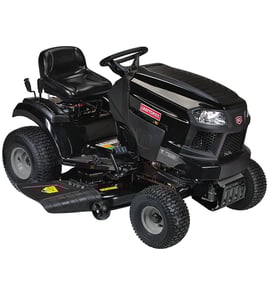

How much is a Craftsman Model 91757599?
Craftsman model 91757599 is a front-engine lawn tractor, and its purchase price depends on whether you’re buying new old stock, used, or for parts. Most used front-engine Craftsman tractors sell based on condition, attachments, and local demand, not the model number alone.
What determines the price most
- Running condition: starts cold, no smoke, steady idle, smooth drive engagement
- Deck condition: rust-through, spindle noise, blade wear, and cut quality
- Hours and maintenance: oil changes, air filter, spark plug, battery age
- Attachments included: bagger, mulch kit, hitch hardware, weights, tire chains
- Tires and steering: dry rot, uneven wear, steering play
- Season and location: spring demand is higher than late fall in many areas
Typical used-price bands (front-engine lawn tractors)
| Condition | What you’re usually buying | Typical range |
|---|---|---|
| Non-running / incomplete | Parts machine or project | $100 to $500 |
| Running, average wear | Mows but may need service soon | $600 to $1,400 |
| Clean, serviced, with attachments | Turnkey mower with extras | $1,200 to $2,000 |
How we recommend you confirm a fair price for 91757599
- Verify the exact model number 91757599 on the ID tag before comparing listings.
- Compare like-for-like: deck size, transmission type, and included accessories.
- Budget for common wear items (belts, blades, spindles, battery) if service history is unknown.
- If you need hitch hardware for towing attachments, price out small missing items such as a hitch pin, 2-pack 596919601.
Why it matters
Two tractors with the same model number can be priced very differently because condition and included hardware drive real ownership cost. A “cheap” unit can become expensive quickly if it needs deck or drive repairs.
Last updated: February 2026
How to manually move a Craftsman riding mower?
To manually move a Craftsman riding mower like model 91757599, you typically disengage the drive system (freewheel/bypass) so the hydrostatic transmission is not holding the tractor. Once it is in freewheel, you can push the mower slowly on level ground.
Steps to push the mower (most Craftsman hydrostatic tractors)
- Park on a flat surface, set the parking brake, and remove the key.
- Make sure the PTO/blades are off.
- Locate the freewheel/bypass control at the rear of the tractor near the transmission (often a pull rod or lever).
- Pull the control out (or move the lever to the bypass position) to disengage drive.
- Release the parking brake and push the tractor slowly.
- When finished, re-engage drive by returning the control to the drive position before starting.
Where to look on model 91757599
The bypass control is usually:
| Location | What it looks like | What it does |
|---|---|---|
| Rear frame near the transmission | Pull rod with a knob, or a small lever | Opens the bypass so you can push the tractor |
| Near the hitch plate area | Rod you pull out and sometimes lock into a notch | Prevents transmission from resisting movement |
Important tips (to avoid damage)
- Push only short distances and only as fast as you can comfortably walk.
- Avoid pushing on slopes; the tractor can roll quickly once in freewheel.
- Do not tow it in freewheel; use a trailer if you need to transport it.
- If the tractor will not roll even in bypass, check for a stuck brake or seized wheel.
Why it matters
Hydrostatic transmissions resist movement when engaged. Using the bypass/freewheel control prevents internal transmission strain and makes moving your Craftsman garden tractor safer and easier.
If your bypass rod is missing or won’t stay engaged, check the rear hitch hardware and retaining pieces such as the hitch pin, 2-pack 596919601.
Last updated: February 2026
What type of engine is in a Craftsman lawn mower?
For the Craftsman front-engine lawn tractor model 91757599, the engine type depends on the exact engine model installed on your tractor (it is identified on the engine ID label, not by the tractor model alone). Most Craftsman riding mowers of this style use a 4-cycle gasoline vertical-shaft engine from makers like Briggs and Stratton or Kohler.
How to identify the exact engine on model 91757599
Check the engine’s ID tag (usually on the blower housing, valve cover, or near the starter). Record these items:
- Engine manufacturer (example: Briggs and Stratton)
- Engine model
- Type
- Code/date (helps match parts)
- Horsepower/cc rating (often shown on the shroud)
Quick ID checklist
| Where you look | What you’re looking for | Why it matters |
|---|---|---|
| Engine shroud/blower housing | Model/type/code sticker | Best for engine parts lookup |
| Valve cover area | Stamped model info | Confirms family/series |
| Tractor frame tag | Tractor model 91757599 | Best for chassis and mower deck parts |
Common engine types used on Craftsman riding mowers
Even without the engine tag details, these are the most common configurations for front-engine lawn tractors:
- 4-cycle gasoline engine (no oil-gas mixing)
- Single-cylinder (most common) or V-twin (higher power)
- Electric start with a 12-volt battery
- Carbureted fuel system (typical on this generation)
Why it matters
The tractor model 91757599 helps us match Craftsman chassis parts (deck, steering, drive, hardware), but engine parts and tune-up specs (spark plug, air filter, carburetor kit) match the engine model/type/code. Getting the engine ID right prevents wrong-part returns and speeds up repairs.
Related parts you might replace during engine or hitch work
If you’re servicing linkages or attachments while troubleshooting performance, these model-matched parts are commonly used:
- Hitch pin, 2-pack 596919601 for securing tow-behind attachments
- Ball 532100482 used in certain linkage/steering assemblies
Last updated: February 2026
What year is Craftsman Model 91757599?
Craftsman garden tractor model 91757599 does not map to one single “model year” by the number alone; Craftsman 917-prefix riding mowers were built across multiple production runs. We identify the exact year by matching the tractor’s product ID and date code from the model tag (typically under the seat or on the frame) to the correct parts breakdown.
Where to find the build date information
Look for a sticker or metal tag and record everything exactly as printed.
- Under the seat pan (lift the seat and look on the seat support)
- On the rear frame near the hitch plate
- On the left or right frame rail near the engine
- Near the transaxle area on the frame
What to write down (so we can pinpoint the year)
These details are what usually separate one production year/run from another.
- Model number: 91757599 (already known)
- Product number (often a longer number, sometimes with letters)
- Serial number
- Any date code (may look like a week/year format)
- Engine model and type (Briggs & Stratton or Kohler tags are common)
Quick ID checklist (common patterns)
| Item on tag | What it tells us | Why it matters |
|---|---|---|
| Product number | Exact configuration | Determines correct parts list |
| Serial number | Production run | Helps narrow the build window |
| Date code | Build date | Most direct “year” indicator |
Why it matters
Parts and specs can change mid-series (steering, deck linkage, transmission, electrical). Confirming the build date helps ensure you get the right replacement parts the first time, such as a hitch component like the hitch pin, 2-pack 596919601 if you are servicing the rear attachment point.
Last updated: February 2026
What year is Craftsman Model 91757599?
For Craftsman model 91757599 (front-engine lawn tractor), the model number itself does not contain the build year. The year is identified from the product identification label on the tractor, using the date code printed on that label.
Where to find the year on model 91757599
Look for the product ID label in one of these common spots:
- Under the seat (seat pan area)
- On the rear fender pan near the seat
- On the frame rail near the engine
- Near the transaxle area (rear frame)
How to decode the date code
On many Craftsman riding mowers and tractors, the label includes a 6-digit date code that reads as:
- MM = month
- DD = day
- YY = year
Example
| Date code | Meaning | Build date |
|---|---|---|
| 072811 | MM=07, DD=28, YY=11 | July 28, 2011 |
Quick checks to confirm you have the right tractor
These details help ensure you are decoding the correct label for 91757599:
- The label shows MODEL 917.57599 (sometimes printed with a dot)
- The tractor is a front-engine riding mower/tractor style
- The label also lists an engine family or horsepower information
Why it matters
The correct year helps us match the right parts and diagrams for your Craftsman tractor, especially for items that change by production run (steering hardware, hitch components, and chassis parts). If you are ordering small hardware, match by model and diagram callout.
If you are replacing hitch or linkage hardware, confirm fit by comparing your existing part to the listing for hitch pin, 2-pack 596919601 or ball 532100482.
Last updated: February 2026
Where are the grease fittings on a Craftsman lawn tractor?
On the Craftsman 91757599 front-engine lawn tractor, grease fittings (zerks) are typically found on steering and front-axle pivot points, and sometimes on deck spindles or idler pivots depending on the exact deck and axle setup. If grease pushes out around the fitting, the coupler is usually not fully seated.
Common grease fitting locations to check
Look for small metal zerks with a ball in the center; they are usually on parts that pivot or rotate.
- Front axle center pivot (where the axle rocks side to side)
- Spindles/kingpins at the front wheels (steering knuckles)
- Steering linkage pivot points (drag link or tie-rod ends, if equipped with zerks)
- Mower deck spindles (some decks have sealed spindles with no fittings)
- Deck idler arm pivot (only on some configurations)
How to grease them correctly (so grease goes inside, not outside)
A grease gun that is slightly off-angle will leak around the coupler and leave grease on the outside.
- Wipe the zerk clean before connecting the grease gun
- Push the coupler on straight until it “clicks” and feels locked
- Pump slowly; stop when you see slight movement at the joint or fresh grease at a relief point
- If it won’t take grease, rotate the wheel or move the linkage slightly to unload the joint
- Remove the coupler by twisting slightly, then pulling off (do not pry on the fitting)
Quick troubleshooting if grease won’t go in
| What you see | Most likely cause | What to do |
|---|---|---|
| Grease squirts around the coupler | Coupler not seated or worn | Re-seat straight; inspect coupler jaws |
| No grease goes in, handle gets hard | Plugged zerk or dried grease | Replace the fitting or clear it |
| Grease comes out at the joint immediately | Joint already full or worn | Stop pumping; wipe excess |
Why it matters
Greasing the steering and axle pivots reduces wear, keeps steering smoother, and helps prevent sloppy front-end handling on a riding mower or garden tractor.
If you need a small replacement piece during service, we stock hardware-style items used on linkages and pivots such as the ball 532100482 (part number 7392M) and the hitch pin, 2-pack 596919601 (part number 4939M).
Last updated: February 2026
Where can I find the Craftsman riding mower model number?
On a Craftsman riding mower like model 91757599, the model number is printed on the product identification label, typically located under the seat (often on the underside of the seat or on the frame directly beneath it). Clean the label and copy the full number exactly.
Common model number label locations
Check these spots first (use a flashlight):
- Underside of the seat pan
- Frame under the seat (seat lifted up)
- Rear fender area near the seat base
- Left side of the tractor frame near the seat support
- Under the hood near the engine compartment (less common)
Quick steps to find and read it
- Park on a flat surface, set the parking brake, and remove the key.
- Lift the seat and look for a white or silver product identification label.
- Wipe dirt and grass off the label with a damp rag.
- Write down the full model number (for example, 91757599) and any additional numbers on the tag.
What the label usually includes (and what to use)
| Label item | What it’s for | Use it when |
|---|---|---|
| Model number | Identifies the exact tractor version | Ordering parts and looking up diagrams |
| Serial number | Identifies your specific unit | Warranty and service history |
| Engine model/type/code | Identifies the engine | Engine tune-up parts and engine service |
Why it matters
Craftsman tractors can look similar across years, but parts like belts, blades, steering hardware, and deck components can vary by model. Using the exact model number helps us match the correct diagrams and replacement parts the first time.
If the label is missing or unreadable, use a part you can identify to cross-check fitment, such as the hitch pin, 2-pack 596919601 or the ball 532100482.
Last updated: February 2026