Owner’s manual
 Error Codes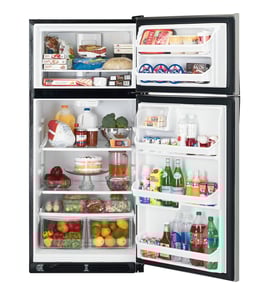




Do you need space on top of the fridge?
Yes. For Kenmore model 10668862891, we recommend leaving ventilation space above the refrigerator so heat can escape and the compressor can run efficiently. The owner’s manual calls for 1/2 inch (1.25 cm) at the top (and on each side), plus additional clearance as needed for door swing and water line connections. See the owner's manual.
Recommended clearances for 10668862891
Use these clearances as your baseline when measuring the opening:
- Top: 1/2 inch (1.25 cm)
- Each side: 1/2 inch (1.25 cm)
- Next to a fixed wall: allow at least 2 inches (5.08 cm) on the hinge side (or as needed) so the door can swing open
- Back (ice maker models): leave extra room for the water line connection
- Keep vents clear: do not block interior air vents with food packages
Quick measurement checklist
Before you slide the refrigerator into place:
- Measure the opening width, height, and depth in multiple spots (floors and walls are rarely perfectly square).
- Confirm the door can open fully without hitting a wall or cabinet.
- Plan a little extra space behind the unit if you have an ice maker water line.
- Avoid installing near heat sources (oven, radiator) or where room temperature drops below 55°F (13°C).
Clearance guide (at a glance)
| Location | Minimum clearance | What it helps prevent |
|---|---|---|
| Top | 1/2 in. | Overheating, long run times |
| Each side | 1/2 in. | Poor airflow, warm cabinet temps |
| By a fixed wall | 2 in. (minimum) | Door not opening fully |
Why it matters
Refrigerators reject heat through airflow around the cabinet. When the top and sides are too tight, the unit can run longer, cool less effectively, and you may notice more operating noise as the system works harder.
Last updated: February 2026
How to tell what model Kenmore refrigerator?
To tell what model Kenmore refrigerator you have, we look for the model and serial number label inside the fresh food (refrigerator) compartment. For this Kenmore top-mount refrigerator, the label is typically on an inside wall of the refrigerator section; it lists the full model number (for example, 10668862891).
Where to find the model number label
Check these common spots first (use a flashlight if needed):
- Inside the refrigerator compartment on a side wall (most common)
- Near the top of the refrigerator compartment behind the control area
- Along the door frame edge (visible when the door is open)
- On the ceiling of the refrigerator compartment on some designs
If you have the paperwork, the model number is also often printed on the sales receipt or warranty documents.
What to write down (and why)
Record these items exactly as shown on the label:
- Model number (example format: 106.XXXXXXXX)
- Serial number
- Purchase date (if available)
Why it matters
The model number is what we use to match the correct parts diagrams and replacement parts (like an ice maker, defrost timer, or door gasket). A single digit difference can change the correct part.
Quick model number check
Use this as a simple guide when you read the label:
| Item on label | What it does for you | Example |
|---|---|---|
| Model number | Identifies the exact refrigerator version | 10668862891 |
| Serial number | Identifies the production unit | (varies) |
| Purchase date | Helps with warranty and service history | (varies) |
Next step after you find it
Once you confirm your model number, use it to pull the right diagrams and instructions in the owner's manual. If you are troubleshooting a specific symptom (no ice, warm fridge, frost buildup), matching the model first prevents ordering the wrong part.
Last updated: February 2026
How to tell cubic feet of Kenmore refrigerator by model number?
For Kenmore refrigerator model 10668862891, the model number alone usually does not state the exact cubic-foot capacity. The most reliable way is to look up the capacity in the specifications section of the owner's manual, or calculate it from the usable interior dimensions.
Fast ways to find the cubic feet
- Check the specifications or product information section in the owner's manual.
- Look for a model and serial label inside the fresh food compartment (commonly on an inside wall); it confirms the exact model so you match the right specs.
- If you cannot find capacity listed, measure and calculate the interior volume (best for an estimate).
How to calculate an estimated capacity
- Measure the inside of the refrigerator compartment (height, width, depth in inches). Do the same for the freezer.
- Multiply each section:
H × W × D = cubic inches. - Convert to cubic feet:
cubic inches ÷ 1728 = cubic feet. - Add refrigerator + freezer results.
Quick reference table
| What you have | What you get | Accuracy |
|---|---|---|
| Manual specs | Listed cubic feet | Highest |
| Interior measurements | Estimated cubic feet | Good estimate |
| Model number only | Model family clues | Low |
Why it matters
Cubic feet helps you choose correctly sized replacement items and accessories (bins, shelves, ice maker options) and compare storage capacity across top-mount refrigerators without guessing.
Helpful tip for this model
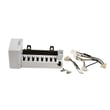
If you are matching parts while you check specs, confirm the full model number on the inside label first; then use the parts list for 10668862891 to select exact-fit items such as the refrigerator glass shelf WP2169921 or ice maker assembly 4317943.
Last updated: February 2026
How to tell if a Kenmore refrigerator compressor is bad?
If your Kenmore refrigerator model 10668862891 is warm and the compressor will not start (or it starts, then quickly clicks off), the compressor or its start components are likely failing. We confirm the basics first (power, controls, airflow) before testing sealed-system parts.
Quick checks before blaming the compressor
Many “bad compressor” symptoms are caused by power, control, or airflow issues.
- Verify the outlet has power and the cord is fully plugged in.
- Make sure the refrigerator control is not set to OFF.
- Wait 30 minutes if the unit is in an automatic defrost cycle (it can pause cooling briefly).
- Clean dusty condenser coils; dirty coils make the compressor run longer and cool poorly.
- Listen for normal operating sounds; some Kenmore units have a higher-pitched, longer-running compressor by design.
For model-specific operating and troubleshooting guidance, use the owner's manual.
Signs that point to a compressor or sealed-system problem
These symptoms are strong indicators when the basic checks above are good:
- Compressor is very hot and you hear repeated clicking every few minutes (start attempt, then overload trips).
- Compressor runs steadily but both compartments stay warm (little or no cooling).
- You hear the fans running, but there is no consistent cooling and the unit runs almost constantly.
- Frost pattern looks abnormal (for example, only a small patch of frost on the evaporator instead of an even coating).
What to check: compressor vs. start components
| What you observe | More likely cause | What we do next |
|---|---|---|
| Clicks, then stops; repeats | Start device/run capacitor issue or compressor locked | Test start components first; replace if failed |
| Runs but won’t cool | Sealed-system issue (compressor efficiency, restriction, leak) | Sealed-system diagnosis by a technician |
| Runs “too much” but still cools | Dirty coils, warm room, frequent door openings | Correct conditions; recheck temps |
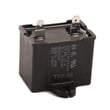
If your diagnosis points to a failed compressor, the replacement for this model is the refrigerator compressor W10309988. If testing shows a weak start circuit, a common related part is the refrigerator run capacitor WP4387764.
Why it matters
A struggling compressor can overheat and cycle on its overload, which leads to food-safety temperature problems and can make the refrigerator run continuously. Ruling out airflow and control issues first prevents unnecessary sealed-system repairs.
Last updated: February 2026
What is the top part of a fridge called?
On a Kenmore top-mount refrigerator like model 10668862891, the top section is the freezer compartment. It’s the colder compartment designed to keep food frozen and, on many models, it also houses the ice maker and freezer controls.
What you’ll typically find in the top (freezer) compartment
- Freezer shelves or a wire rack for frozen foods
- An ice maker (if equipped) and ice bin
- Air vents that send cold air down to the fresh food section
- A freezer light (on some models)
- Door bins for smaller frozen items
Why the “top” matters on a top-mount refrigerator
In a top-mount design, most of the cooling is produced in or near the freezer. Cold air is then routed into the refrigerator section through vents. Keeping those vents clear helps both compartments hold steady temperatures.
Quick terms guide
| Common name | What it means | Where it is |
|---|---|---|
| Freezer | Frozen-food compartment | Top section |
| Fresh food compartment | Main refrigerator area | Bottom section |
| Air return/vent | Airflow path between sections | Usually near the control area |
Helpful tips for best performance
- Keep freezer vents unblocked by boxes or bags.
- Close the freezer door firmly; a poor seal can cause temperature swings.
- If you see frost buildup or warming, check basic airflow and door closure first.
- For model-specific features and control settings, use the owner's manual.
Related repair and parts notes
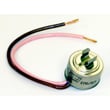
If your freezer is not freezing or you’re troubleshooting ice production, common related parts for this model include the ice maker assembly - refrigerator ice maker by whirlpool 4317943 and the refrigerator defrost timer W10822278.
Last updated: February 2026