Owner’s manual
 Error Codes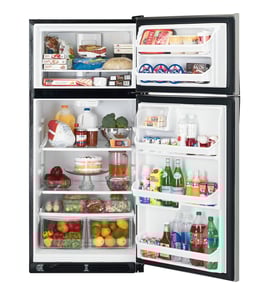

What are the most common issues with 79575952401?
The most common issues we see with the Kenmore 79575952401 top-mount refrigerator are warm temperatures (fresh food or freezer), water leaking or ice buildup from a clogged defrost drain, unusual fan noise, and ice maker or water dispenser problems. Use the owner's manual for the exact control settings and model-specific checks.
- Refrigerator not cold enough: dirty condenser coils, weak condenser fan, airflow blocked by overpacked shelves, or a failing temperature sensor
- Freezer cold but refrigerator warm: restricted airflow, evaporator fan issue, frost buildup from a defrost problem
- Water leaking inside or under the unit: clogged/iced defrost drain or drain tube
- Loud humming, buzzing, or rattling: fan blade hitting ice, worn fan motor, loose panels
- Ice maker not making ice: water supply issue, inlet valve problem, ice maker assembly fault
- Confirm controls are set correctly and vents are not blocked.
- Clean condenser coils and make sure the condenser fan area is clear.
- Look for frost or ice buildup on the freezer back panel (a defrost airflow clue).
- Check for water or ice under the crisper drawers (drain restriction clue).
- Listen for fan noise changes when you open and close the doors.
| Symptom | Common part to inspect | What it affects |
|---|---|---|
| Water under crisper or freezer ice | Refrigerator drain 5251JA3003D | Defrost water routing to the drain pan |
| Warm temps or erratic temps | Refrigerator thermistor 6500JB2002T | Temperature sensing and compressor run time |
| Fan noise or poor airflow | Refrigerator evaporator fan blade 5901JJ1003A | Air circulation across the evaporator |
| No ice or slow fill | Refrigerator water inlet valve 5220JA2009D | Water flow to the ice maker |
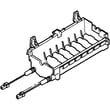
| No ice production | Refrigerator ice maker assembly 5989JA0002Y | Ice harvest and fill cycle |
Catching airflow, drain, and water-supply issues early helps prevent food spoilage, recurring ice buildup, and water damage. Many “not cooling” complaints start with simple airflow restrictions or a drain that is starting to freeze over.
Last updated: March 2026
What is the upper part of a fridge called?
On the Kenmore 79575952401 top-mount refrigerator, the upper part is the freezer compartment. It is the section designed to keep foods frozen and it also supplies cold air that circulates down to help cool the fresh food (refrigerator) compartment; see the airflow diagram in the 79575952401 owner's manual.
- Keeps food at freezing temperatures (commonly around 0°F)
- Sends cold air through vents to the refrigerator section
- Houses ice-making components on models equipped with an icemaker
- Helps the refrigerator maintain stable temperatures when doors stay closed
| Section | Location on this model | Primary job | Typical target temp |
|---|---|---|---|
| Freezer compartment | Top | Freeze and store frozen foods | 0°F (-18°C) |
| Refrigerator compartment | Bottom | Keep fresh foods cold (not frozen) | 37°F (3°C) |
Knowing the correct name helps when you are reading temperature-control instructions, diagnosing cooling problems, or ordering parts like an icemaker assembly, door gasket, or evaporator fan components for the freezer area.
- Set initial temperatures to 37°F for the refrigerator and 0°F for the freezer, then wait 24 hours before adjusting.
- Keep freezer vents clear so air can move between compartments.
- Avoid frequent door openings; temperature swings start in the freezer first.
- If you have an automatic icemaker, keep hands away from moving parts while the refrigerator is plugged in.
Last updated: January 2026
What size is Kenmore refrigerator model 79575952401?
Kenmore top-mount refrigerator model 79575952401 is a full-size top-freezer style refrigerator; most units in this class are about 30 to 33 inches wide, 30 to 34 inches deep, and 66 to 69 inches tall. For the exact dimensions and capacity for your specific configuration, use the 79575952401 owner's manual.
We recommend confirming size using the model-specific spec section in the manual, then measuring your installation space.
- Check the product dimensions and clearance requirements in the manual first.
- Measure width, height, and depth of the cabinet opening.
- Include door swing clearance so doors open fully without hitting a wall.
- Include rear clearance for airflow and the power cord.
- If you have a water/ice setup, allow room for the water line loop behind the refrigerator.
| What to measure | What to include | Why it matters |
|---|---|---|
| Width | Cabinet opening and trim | Prevents binding during install |
| Height | Floor to overhead cabinet | Avoids top clearance issues |
| Depth | Case depth plus door/handle projection | Ensures doors can close |
| Rear clearance | Space behind unit | Helps cooling performance |
“Size” can mean outside dimensions or capacity.
- Outside dimensions: commonly 30 to 33 in. W, 30 to 34 in. D, 66 to 69 in. H
- Capacity: many top-mount refrigerators are roughly 18 to 22 cu. ft. depending on interior layout
Correct sizing prevents installation problems (tight fits, poor door clearance) and helps maintain proper airflow so the sealed refrigeration system and evaporator fan can cool efficiently.
Last updated: January 2026