Owner’s manual
 Error Codes



Are bottom mount fridges better?
A bottom-mount refrigerator like the GE PFCS1PJZASS is better for many households because the fresh-food section sits higher, so you reach everyday items with less bending. The tradeoff is you bend more often for freezer access, and these models can cost more than basic top-freezer designs.
- You use the refrigerator compartment far more than the freezer
- You want fresh food at a more comfortable viewing and reach height
- You prefer wider shelves and easier organization in the fresh-food section
- You are okay bending to access freezer baskets and drawers
- You want a modern layout that often includes ice and water features
Bottom-mount performance depends heavily on installation clearances and airflow. For this GE model, the installation instructions call out typical clearances (for example, about 1/8 inch at the sides and about 1 inch at the top and back for standard-depth setups). We recommend confirming the exact requirements and your doorway width in the owner's manual.
| Feature | Bottom-mount (like PFCS1PJZASS) | Top-freezer | Side-by-side |
|---|---|---|---|
| Fresh-food access | Best (eye level) | Good | Good |
| Freezer access | Requires bending | Best | Good |
| Organization | Strong in fresh-food area | Simple | Strong in freezer |
| Space needs | Often needs more door swing clearance | Usually compact | Narrower shelves |
Choosing the right layout reduces daily strain and helps the refrigerator hold steady temperatures. Good airflow and proper leveling also help prevent issues like warm spots, excess frost, and door sealing problems over time.
Last updated: February 2026
What is the most common problem with GE PFCS1PJZASS refrigerators?
The most common issues we see on the GE PFCS1PJZASS bottom-mount refrigerator are ice maker and water dispensing problems (no ice, slow ice, leaks) and temperature complaints (fresh food too warm or freezer not holding temp). These usually trace back to airflow, defrost, or water-supply components.
- Ice maker not making ice or slow production: restricted water flow, air in the line, or a failing inlet valve
- Water dispenser weak or not dispensing: clogged filter, air in the line, or inlet valve issue
- Fresh food section warm but freezer cold: evaporator fan or air damper problem
- Frost buildup or temperature swings: defrost system issue (thermostat, sensors)
- Long run times: door left open, heavy loading, hot room conditions (often normal on modern units)
For model-specific operating details and control settings, use the PFCS1PJZASS owner's manual.
- Confirm doors are sealing and closing fully (packages can hold a door open).
- Give it time after changes: after plugging in or adjusting settings, allow up to 24 hours to stabilize.
- If the unit seems “off” temporarily: it may be in a defrost cycle; waiting about 30 minutes can restore normal cooling.
- Check for vibration/rattling: adjust the leveling legs if needed.
If your symptoms match, these parts are common fixes for this model:
| Symptom | Common part to check/replace | Why it matters |
|---|---|---|
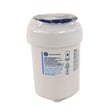
| No ice, weak water flow | GE refrigerator water filter MWFP | A restricted filter reduces water flow to the dispenser and ice maker |
| No water to dispenser/ice maker | Refrigerator water valve WR57X33326 | The inlet valve controls water flow into the refrigerator |
| Temps inaccurate or erratic | Temperature sensor WR55X10025 | A bad sensor can misread temps and cause poor cooling control |
| Frost buildup, warm temps | Refrigerator defrost bi-metal thermostat WR50X10065 | Defrost failures can block airflow with ice |
Ice maker and cooling complaints often share the same root causes: restricted airflow (fan, damper, frost) or restricted water flow (filter, valve). Fixing the underlying cause protects food temperatures, reduces leaks, and helps the compressor avoid excessive run time.
Last updated: February 2026
Is GE PFCS1PJZASS considered high end?
Yes. The GE PFCS1PJZASS is typically considered a premium (high-end) GE refrigerator because it’s part of the GE Profile lineup, which is positioned above standard GE models and commonly includes upgraded design, controls, and feature sets for everyday performance.
In practical terms, “high end” usually refers to a step up in features and build compared to entry-level refrigerators, not necessarily a luxury-tier product.
Common premium indicators you’ll see in GE Profile refrigerators like PFCS1PJZASS include:
- More advanced temperature management and sensors
- Enhanced storage layout (bins, drawers, and pantry-style compartments)
- Added convenience features (door alarms, dispenser features, icemaker options)
- Higher parts and component complexity (more control boards, sensors, and valves)
For model-specific feature descriptions and control details, use the PFCS1PJZASS owner's manual.
| Tier | Typical positioning | What you usually get |
|---|---|---|
| Standard | Value focused | Basic cooling, fewer electronics |
| Premium (GE Profile) | Feature focused | More sensors, more controls, upgraded storage |
| Luxury | Design and pro-level | Specialty materials, pro styling, niche features |
Premium refrigerators often rely more on sensors and electronic controls to regulate temperatures and airflow. That means symptoms like warm fresh food, inconsistent temps, or dispenser issues can be tied to components that are less common on basic models.
If you’re diagnosing temperature swings on PFCS1PJZASS, these model-matched parts are commonly involved:
- Temperature sensor WR55X10025 (helps the control system “read” compartment temperature)
- Refrigerator air damper WR17X12456 (controls airflow into the fresh food section)
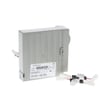
- Board main c WR55X11064 (manages multiple cooling and defrost functions)
Last updated: February 2026