Installation guide
 Owner’s manual
 Error Codes


How to hard reset a Frigidaire dryer?
To hard reset your Frigidaire electric dryer model FAQE7077KA0, we recommend restoring the control to factory settings by pressing and holding Start/Pause and Select together until the signal sounds (about 10 seconds); this clears many control glitches and saved cycle adjustments.
Factory reset steps (FAQE7077KA0)
- Make sure the dryer is idle (not actively running a cycle).
- Press and hold Start/Pause and Select at the same time.
- Keep holding until you hear the signal (typically about 10 seconds).
- Release the buttons.
- Re-select your cycle and options, then start a test load.
For button locations and control panel behavior, use the FAQE7077KA0 owner's manual.
If the dryer still acts up after the reset
These checks solve the most common “won’t start” or “acts frozen” complaints after a reset:
- Confirm the door is fully closed and latching; a weak latch can stop operation.
- Verify the dryer has full power (electric dryers need 240V; a tripped breaker can leave it with partial power).
- Unplug the dryer for 2 minutes, then plug back in (a basic power refresh).
- Clean the lint screen and confirm strong airflow at the outside vent.
- If an error code appears, look it up in Frigidaire dryer error codes.
Quick comparison: reset vs power refresh
| Action | What it does | When to use it |
|---|---|---|
| Factory reset (Start/Pause + Select) | Restores factory settings and clears saved adjustments | Display odd behavior, settings won’t change, cycle options “stuck” |
| Unplug for 2 minutes | Reboots the control by removing power | Control frozen, unresponsive buttons, after a power outage |
Why it matters
A factory reset returns the control to known-good defaults, which helps rule out a settings or control-memory issue before you spend time on deeper troubleshooting (like door switch, power supply, or venting restrictions).
Last updated: January 2026
How to replace a thermal fuse on a Frigidaire Affinity dryer?
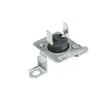
On the Frigidaire electric dryer model FAQE7077KA0, replacing the thermal fuse (thermal limiter) means unplugging the dryer, accessing the fuse on the blower or heater housing, moving the wires one at a time to the new fuse, and reinstalling the mounting screws. Use the FAQE7077KA0 installation guide for electrical safety basics before servicing.
Safety first (do this every time)
- Unplug the dryer; do not rely on the control being “off”.
- Turn off power at the breaker; electric dryers can still have dangerous voltage present.
- Label wires before disconnecting; wiring errors can cause improper and dangerous operation.
- Wear cut-resistant gloves; cabinet edges are sharp.
- Do not bypass the fuse; it is a critical safety device.
Replacement steps (typical for this Frigidaire platform)
- Disconnect power and pull the dryer forward.
- Remove the rear panel (or lower access panel, depending on configuration).
- Locate the thermal fuse/thermal limiter on the blower housing or heater housing.
- Remove the two wires from the fuse terminals (move one wire at a time to avoid mix-ups).
- Remove the mounting screw(s), swap in the new fuse, and reinstall the screw(s).
- Reconnect wires firmly, reassemble panels, restore power, and test a timed dry cycle.
What to fix so the new fuse does not blow again
A thermal fuse usually opens because the dryer overheats from restricted airflow.
| Check | What to look for | What to do |
|---|---|---|
| Lint screen | Film or heavy lint | Wash screen with warm water and a soft brush; dry fully |
| Vent duct | Kinks, crushed flex, long run | Use a short, smooth metal vent; avoid plastic/foil duct |
| Outside hood | Weak flap movement, lint buildup | Clear lint and confirm strong airflow |
| Blower area | Lint packed inside cabinet | Clean lint carefully while panels are open |
Why it matters
The thermal fuse (thermal limiter) is designed to stop the dryer if overheating occurs. Replacing it without correcting airflow problems often leads to repeat failures, longer dry times, and higher energy use.
Last updated: January 2026
Why would a heating element go out in a dryer?
In a Frigidaire electric dryer like model FAQE7077KA0, a heating element typically goes out because it repeatedly overheats (often from restricted airflow) or because a failed safety control lets temperatures climb too high. Fixing the root cause prevents the new element from failing again.
Most common reasons a dryer heating element fails
- Restricted venting or lint buildup: A clogged lint screen, lint screen housing, or exhaust duct traps heat and can overheat the heater.
- Failed temperature safety parts: A bad thermostat, thermal limiter, or thermistor can allow unsafe temperatures.
- Electrical supply issues: Electric dryers need full power; if one leg of the 240V supply is lost, the drum can run but heat may not.
- Normal wear: The element coil can fatigue over time and break.
What to check first (safe, high-impact checks)
- Clean the lint screen and confirm strong airflow at the outdoor exhaust.
- Inspect the vent path for kinks, crushed ducting, or heavy lint.
- Review the airflow and duct length rules in the installation guide.
- Use the troubleshooting section in the FAQE7077KA0 owner’s manual to confirm power supply and common “runs but won’t heat” causes.
Parts that commonly contribute to overheating
If airflow is good, we focus on the temperature-sensing and safety circuit. These parts are commonly involved:
| Part | What it does | Typical failure symptom |
|---|---|---|
| Dryer high-limit thermostat 3204267 | Limits heater temperature | Overheats, cycles poorly, or no heat |
| Dryer inlet thermal limiter 137032600 | One-time safety cutoff | Dryer runs but won’t heat |
| Dryer thermistor 134587700 | Senses temperature for control | Erratic heat, overheating, or error behavior |
Why it matters
Overheating is also a fire risk in any dryer because lint is combustible. Keeping the exhaust duct clear and following the venting requirements protects the heater, improves drying time, and helps prevent repeat failures.
Last updated: January 2026
How much does it cost to replace a heating element in a Frigidaire dryer?
For a Frigidaire electric dryer like model FAQE7077KA0, the total cost to replace a heating element is typically $200 to $450: the part often runs $100 to $250, and labor commonly adds $100 to $200 depending on service rates and access.
What changes the price most
- Service call and labor rate in your area
- Whether the heater is sold as an assembly (element plus housing) or element-only
- Related heat-safety parts that may also need replacement after an overheat
- Vent restriction (a clogged vent can overheat and shorten heater life)
- DIY vs. technician (DIY is usually part cost only)
Before you buy a heating element: quick checks for “no heat”
Our FAQE7077KA0 manual notes that an electric dryer can run but not heat if one of the two house fuses is blown (the drum turns, heater does not). Use this checklist first:
- Confirm the dryer is on a dedicated circuit and reset the breaker(s)
- Check for two fuses / a 2-pole breaker supplying 240V
- Clean the lint screen and verify strong airflow at the exterior vent
- If the dryer overheated, inspect heat-limit devices before replacing the heater
Common “no heat” parts to consider (when overheating is suspected)
If airflow was restricted, a safety device can open and stop heat. These model-compatible parts are commonly involved:
| Symptom | Common cause | Example part for this model |
|---|---|---|
| Runs but no heat | High-limit device opened | Dryer high-limit thermostat 3204267 |
| Runs but no heat after overheat | Thermal limiter opened | Dryer inlet thermal limiter 137032600 |
| Heat cycles erratically | Temperature sensing issue | Dryer thermistor 134587700 |
Why it matters
Replacing only the heating element without fixing a blocked vent or failed thermostat/limiter can lead to repeat failures, longer dry times, and overheating. For safe wiring and correct reassembly steps, follow the FAQE7077KA0 installation guide and the FAQE7077KA0 owner’s manual.
Last updated: January 2026