Owner’s manual
 Error Codes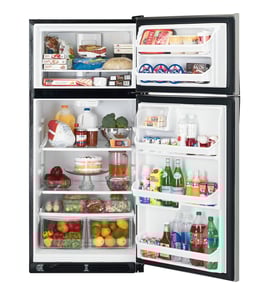





Is a top mount or bottom mount fridge better?
A top-mount (top freezer) refrigerator like the GE GPE12FGKDWW is usually the better choice when you want lower cost, simpler design, and easy freezer access; a bottom-mount is usually better when you want the fresh-food section at eye level because you use it most.
Quick comparison (what changes day to day)
| Feature | Top-mount (top freezer) | Bottom-mount (bottom freezer) |
|---|---|---|
| Fresh-food access | You bend more | You bend less |
| Freezer access | Easiest (at chest height) | Drawer style, can be easier to organize |
| Typical price and complexity | Lower, simpler | Higher, more complex |
| Best for | People who use the freezer often | People who use the fridge section most |
When a top-mount is the better fit
We recommend a top-mount layout when these priorities matter most:
- You use the freezer frequently and want it at a comfortable height.
- You want a simpler refrigerator design with fewer features to maintain.
- You prefer a lighter door and straightforward storage.
- You want a layout that is typically easier to place and level in tight kitchens.
When a bottom-mount is the better fit
A bottom-mount layout is usually the better choice when:
- You access fresh foods many times per day and want them at eye level.
- You store lots of produce and meal-prep items in the refrigerator section.
- You like a pull-out freezer drawer for stacking and visibility.
Why it matters
The “better” style is the one that matches how you actually use your refrigerator. If you open the fresh-food door far more than the freezer, a bottom-mount reduces bending. If you rely on frozen foods, a top-mount keeps the freezer more convenient.
Model-specific tip for GE GPE12FGKDWW owners
Your GPE12FGKDWW owner’s manual includes installation and leveling guidance (including recommended location temperatures and how to adjust the leveling legs). Proper leveling helps doors close easily and seal well, which protects cooling performance in any mount style.
Last updated: February 2026
What are the disadvantages of a top mount fridge?
A top-mount (top-freezer) refrigerator like the GE GPE12FGKDWW is usually affordable and efficient, but the main disadvantages are convenience and organization: fresh-food items sit lower so you bend more, and you typically get fewer built-in storage and dispenser features than higher-end layouts.
Common disadvantages you will notice day to day
- More bending for fresh food: the refrigerator compartment is below the freezer, so you reach down more often.
- Less “eye-level” organization: shelves and drawers can feel simpler than many bottom-freezer designs.
- Fewer premium features: many top-mount models do not include an external ice or water dispenser.
- Freezer access can be less ergonomic: you may need to dig through stacked items to find smaller packages.
- Door-swing clearance matters: in tighter kitchens, door swing and hinge side can affect access (door reversal is often possible; check the owner's manual).
Quick comparison: top-mount vs. bottom-freezer
| Feature | Top-mount (top freezer) | Bottom-freezer |
|---|---|---|
| Fresh-food access | Lower, more bending | Higher, easier access |
| Organization | Often simpler | Often more flexible |
| Ice/water dispenser | Less common | More common |
| Cost and simplicity | Often lower, simpler | Often higher, more complex |
When a “disadvantage” becomes a real problem
These drawbacks matter most when you:
- Use the fresh-food section many times per day
- Have back or knee discomfort
- Need frequent access to produce drawers and deli items
- Prefer built-in ice service and dispenser convenience
Why it matters
Layout affects how well temperatures stay stable (less door-open time), how quickly you can find food, and how comfortable the refrigerator is to use every day. For setup and feature details specific to the GE GPE12FGKDWW, we recommend following the storage and door-swing guidance in the owner's manual.
Last updated: February 2026
What is the average lifespan of a GE refrigerator?
Most GE refrigerators average 12 to 15 years of service life. For your GE GPE12FGKDWW top-mount refrigerator, regular care (cleaning, good door sealing, and stable temperatures) is what most directly determines whether it lands closer to 10 years or pushes past 15. See the gpe12 owner’s manual for model-specific care and cleaning guidance.
Typical lifespan ranges (what to expect)
Refrigerator life varies most with usage, airflow around the cabinet, and how well the doors seal.
- Average range: 12 to 15 years
- Common early-life shorteners: dirty condenser area, torn door gasket, frequent door openings
- Common long-life helpers: consistent temps, clean interior, good door seal, level cabinet
Quick reference table
| Refrigerator type | Typical lifespan | Notes |
|---|---|---|
| Top-mount (top freezer) like GPE12FGKDWW | 12 to 15 years | Often among the longest-lasting styles when maintained |
| Side-by-side | 10 to 14 years | More components and heavier door use can add wear |
| French door | 9 to 13 years | More doors, seals, and features can increase service needs |
Maintenance that extends life the most
These steps reduce compressor run time, prevent moisture problems, and protect food temperatures.
- Keep the doors closing squarely and fully every time
- Clean spills promptly and keep airflow paths inside the cabinet open
- Avoid overpacking; cold air needs space to circulate
- Keep the refrigerator level so doors self-close and seals seat evenly
- If the door seal is loose, torn, or hardened, replace it (a poor seal forces longer run times)
If you are chasing warm temps, sweating, or frost, a worn gasket is a common cause; the refrigerator door gasket WR78X20358 is one gasket option listed for this model.
Why it matters
A refrigerator that is struggling to hold temperature runs longer and hotter, which increases wear on the sealed system and can shorten overall lifespan. Good sealing and basic cleaning are the simplest ways to protect the cooling system.
If you need to order replacement parts for GE GPE12FGKDWW, use the parts list for this model or search by model number on Sears PartsDirect.
Last updated: February 2026
What is the most common problem with GE profile refrigerators?
The most common issues we see on GE Profile refrigerators are ice maker problems and cooling complaints. Even though your GE GPE12FGKDWW is a top-mount (not a Profile model), the same high-frequency trouble areas apply: airflow (evaporator fan), defrost performance, and door sealing. For model-specific checks and settings, use the GPE12FGKDWW owner's manual.
Most common symptoms and what they usually point to
- Not making ice or slow ice production: ice maker module issues, fill problems, or temperature too warm in the freezer.
- Fresh food section warm, freezer OK: restricted airflow or evaporator fan not moving air.
- Both sections warm: cooling system or control issue, or doors not sealing.
- Runs a lot: door left open, warm food load, or airflow/defrost issue.
- Rattling or vibration: leveling legs need adjustment.
Quick checks we recommend first (fast, no parts)
- Confirm doors close easily: the manual notes raising the front slightly helps the door close when opened halfway.
- Check clearances for airflow: typical guidance for this model type is about 1 inch at the sides, 4 inches at the top, and 0 inches at the back for air circulation.
- Give it time after power loss or first plug-in: normal cooling can take up to 24 hours.
- Listen for normal sounds: humming and whooshing can be normal during operation.
Common parts that match these problems on GPE12FGKDWW
| Symptom | Part that often relates | What it does |
|---|---|---|
| No ice or poor ice | GE refrigerator ice maker WR30X30972 | Cycles and harvests ice cubes |
| Warm temps, poor airflow | Fan evap mot WR60X32249 | Moves cold air from the evaporator |
| Frost buildup, warm temps | Defrost heat WR09X31705 | Melts frost off the evaporator |
| Erratic cooling | Refrigerator electronic control board WR55X26266 | Manages cooling and defrost logic |
| Moisture, warm spots near door | Refrigerator door gasket WR78X20358 | Seals the door to prevent air leaks |
Why it matters
Ice maker and cooling complaints usually trace back to temperature control, airflow, or door sealing. Fixing the root cause protects food, reduces run time, and helps prevent repeat failures.
For more DIY troubleshooting and fault patterns, we also use the GE refrigerator error codes guide. If you need to order parts for your GPE12FGKDWW, start with the parts list for this model, or search by model number on Sears PartsDirect.
Last updated: February 2026