 Owner’s manual
 Error Codes



How to tell cubic feet of Kenmore refrigerator by model number?
For Kenmore model 59672239200, the most reliable way to get cubic feet is to look up the capacity in the specifications section of the 59672239200 owner's manual. If you do not have the spec listed, you can estimate capacity by measuring the usable interior space and converting cubic inches to cubic feet.
Best ways to find cubic feet (in order)
- Check the specifications section in the 59672239200 owner's manual.
- Look for a tech/spec label inside the fresh food compartment (often on a side wall or near the crisper area); some units list total volume there.
- Search by the full model number (59672239200) and compare results to the manual specs.
- Estimate capacity by measuring the interior (see steps below).
How to estimate cubic feet by measuring
- Empty the compartment you are measuring (fresh food and freezer are usually counted separately).
- Measure width x depth x height of the usable interior space in inches.
- Multiply to get cubic inches.
- Divide by 1,728 to convert to cubic feet.
- Measure the main box space, not door bins.
- Subtract obvious non-usable areas (large air ducts, big light housings) for a closer estimate.
- If you want “total capacity,” add fresh food + freezer estimates.
Quick conversion table
| What you have | What to do | Result |
|---|---|---|
| Inches (W x D x H) | Multiply | Cubic inches |
| Cubic inches | Divide by 1,728 | Cubic feet |
| Fresh food + freezer cu ft | Add together | Total cu ft |
Why it matters
Cubic feet helps you match the right refrigerator size for your kitchen and compare models accurately. It also helps when choosing storage accessories and setting expectations for ice production and food storage.
Last updated: January 2026
What are the common problems with Kenmore Elite refrigerators?
Kenmore Elite refrigerators (including Kenmore model 59672239200) most often have cooling problems, ice maker and water supply issues, frost buildup from defrost or door-seal problems, and unusual noises from fans or the compressor area. We use the symptoms to narrow the likely part or maintenance fix.
Most common symptoms and what they usually mean
- Not cooling or warm temperatures: dirty condenser coils, evaporator fan issue, airflow blockage, or a sealed-system/compressor problem
- Frost buildup or ice on the back wall: door gasket leak, defrost system issue, or freezer door left ajar
- Water under the refrigerator or in the crisper: clogged/iced drain path, drain funnel issue, or water line leak
- Ice maker not making ice: water supply problem, ice maker failure, or ice buildup in the fill path
- Clicking, buzzing, or humming: condenser fan obstruction, compressor start components, or normal ice maker cycling
Quick checks we recommend first (before replacing parts)
- Set temperatures to typical targets: 37°F fresh food and 0°F freezer.
- Clean condenser coils and confirm the condenser fan area is clear.
- Make sure vents are not blocked by food packages.
- Check door closing and gasket contact all the way around.
- If you have an ice maker, confirm the shutoff arm is down and the water supply valve is fully open.
Parts that commonly relate to these problems on model 59672239200
| Symptom | Commonly involved part | Example part for this model |
|---|---|---|
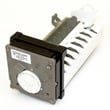
| No ice | Ice maker assembly | Refrigerator ice maker D7824706Q |
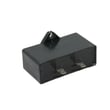
| Warm temps, clicking from compressor area | Start components or compressor circuit | Refrigerator overload WP12555902 |
| Door not closing right or door swings oddly | Door stop/retainer hardware | Refrigerator door stop 67003781 |
Why it matters
Catching airflow, defrost, and water-supply issues early helps prevent food spoilage, repeat icing, and strain on the compressor. A simple maintenance fix (like coil cleaning or door sealing) often restores normal cooling without major repair.
Helpful references
- Use the troubleshooting and temperature-setting guidance in the 59672239200 owner's manual.
- If your refrigerator displays an error code, compare it to the closest Kenmore family guide: Kenmore 106 model refrigerator error codes.
- For ice and water concerns, prevention steps help reduce repeat failures: how to prevent water dispenser and ice maker problems.
Last updated: January 2026
Why is my refrigerator not getting cold at the bottom?
If your Kenmore refrigerator model 59672239200 is warm at the bottom, the most common causes are restricted airflow (blocked vents or overpacked shelves), dirty condenser coils reducing heat removal, or a failing evaporator fan that is not pushing cold air through the fresh-food section. Use the 59672239200 owner's manual to locate vents and cleaning access points.
Quick checks we recommend first
- Make sure air vents in the refrigerator section are not blocked by food containers.
- Reduce overpacking so cold air can circulate from top to bottom.
- Clean the condenser coils and the area around the toe grille (dust and pet hair can cause poor cooling).
- Confirm the doors close fully and the gaskets seal all the way around.
- Listen for the evaporator fan (typically a steady fan sound when the compressor is running).
What to inspect (symptom-based)
| What you notice | Likely cause | What to do next |
|---|---|---|
| Top shelves are colder than bottom | Airflow restriction | Clear vents, reorganize items, allow space between packages |
| Whole fridge is slowly warming | Dirty condenser coils | Vacuum coils and airflow path; recheck temps after 24 hours |
| Freezer is cold but fridge bottom is warm | Evaporator fan or damper airflow issue | Check for fan noise and frost buildup; follow diagnostic steps in the manual |
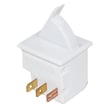
| Light does not turn off when door closes | Door switch issue | Test the door switch; replace if it does not click reliably (refrigerator switch W11396033) |
Why the door switch can matter
If the interior light stays on, it adds heat and can reduce cooling performance, especially in the fresh-food section. A worn switch can also cause inconsistent operation on some designs.
When to stop and get service
- You hear repeated clicking near the compressor area.
- The compressor is not running, or it runs constantly with little cooling.
- You see heavy frost on the freezer back wall (possible defrost or airflow problem).
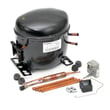
If the compressor is not starting or is overheating, a technician may need to test the start components and sealed system; parts that can be involved include the refrigerator compressor W10160407 and refrigerator overload WP12555902.
Last updated: January 2026





