Installation guide
 Error Codes


How many cubic feet is my upright freezer?
Your Kenmore upright freezer model 1068253080 capacity (cubic feet) is listed on the model’s specifications label and in the installation documentation; that is the most accurate way to confirm the exact size for your unit. Most upright freezers fall into common size ranges you can use as a quick estimate.
Fast ways to find the exact cubic feet
- Check the rating/spec label inside the cabinet (often on a side wall near the top, or behind the lower drawer/basket area).
- Look for “Capacity” or “Total capacity” listed in cubic feet (cu ft).
- Use the 1068253080 installation guide to confirm the published capacity and required clearances.
- If the label is missing or unreadable, match the model number exactly (1068253080) when looking up specs.
Typical upright freezer size ranges (quick estimate)
These ranges help you estimate capacity based on overall size (width x height x depth):
| Size class | Typical capacity | Typical exterior dimensions (approx.) |
|---|---|---|
| Compact | 3 to 5 cu ft | 20 to 24 in W; 31 to 37 in H; 20 to 25 in D |
| Small | 5 to 9 cu ft | 21 to 25 in W; 55 to 60 in H; 22 to 26 in D |
| Medium | 10 to 16 cu ft | 23 to 31 in W; 60 to 73 in H; 27 to 30 in D |
| Large | 17+ cu ft | 27 to 34 in W; 64 to 76 in H; 29 to 30 in D |
Why it matters
Knowing the true cubic feet helps us recommend the right storage accessories, confirm fit in your space (door swing and ventilation clearance), and compare energy use between similar Kenmore and Whirlpool-built upright freezer designs.
Last updated: February 2026
How to clean coils on Kenmore upright freezer?
To clean the coils on your Kenmore 1068253080 upright freezer, we unplug the freezer, expose the condenser area, then brush and vacuum dust off the coils and nearby fan/air passages. Clean coils help the compressor run cooler and keep temperatures steady.
Before you start (safety and access)
- Unplug the freezer (or switch off the breaker) before cleaning.
- Protect floors with a towel or cardboard if you need to pull the unit out.
- If the freezer is built into a tight space, allow room for airflow while you work.
- Use the access steps shown in the 1068253080 installation guide.
Tools and supplies we recommend
- Coil brush (long, flexible)
- Vacuum with crevice tool and soft brush attachment
- Flashlight
- Mild soap and warm water for the grille/kick plate (if applicable)
- Optional: compressed air (use gently and vacuum as you blow)
Step-by-step: cleaning the condenser coils
- Power off: Unplug the freezer.
- Expose the condenser area: Depending on the design, coils are typically behind a lower rear cover or behind a front toe grille.
- Dry brush first: Use a coil brush to loosen packed lint and dust from the coil fins.
- Vacuum thoroughly: Vacuum the coils, the base pan area, and any air channels.
- Clean around the fan: If your model uses a condenser fan, remove dust buildup around the fan blade and guard.
- Reassemble and restore power: Reinstall covers, plug back in, and confirm the freezer starts normally.
How often to clean (typical schedule)
| Home environment | Cleaning interval | Why |
|---|---|---|
| Low dust, no pets | Every 12 months | Prevents gradual efficiency loss |
| Pets or dusty area | Every 3 to 6 months | Hair and lint clog coils quickly |
| Garage or workshop | Every 3 months | Heavy debris reduces airflow |
Why it matters
Dirty condenser coils trap heat; that forces longer run times, can raise cabinet temperatures, and increases wear on the sealed system. Keeping the condenser area clean is one of the simplest ways to protect cooling performance.
When coil cleaning is not enough
If the freezer still runs warm after cleaning, common next checks include:
- Door seal gaps or a torn gasket (air leaks)
- Frost buildup from a defrost issue
- Weak airflow from a failed fan motor
- Temperature control problems
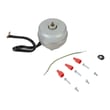
For cooling and airflow issues, we often see customers inspect or replace parts like the fan motor 482469 or the temperature control thermostat.
Last updated: February 2026
What are the disadvantages of an upright freezer?
Upright freezers (including Kenmore model 1068253080) trade floor-space efficiency and easy access for a few common drawbacks: they lose cold air faster when the door opens, can be less energy-efficient than chest freezers, and typically have less usable space for bulky items.
Common disadvantages (upright vs. chest)
- More temperature swing when opened: Cold air spills out when you open a front door, so the compressor may run more.
- Less efficient in power outages: They warm up faster than a packed chest freezer.
- Harder to store oversized items: Shelves and door bins can limit tall or wide packages (large turkeys, big roasts, bulk boxes).
- More frost management on some models: Manual-defrost uprights need periodic defrosting; frost buildup reduces airflow and storage space.
- Usually higher purchase price: Comparable capacity uprights often cost more than chest freezers.
What this means for day-to-day use
If you open the freezer often, an upright is convenient because you can organize food on shelves. If you want maximum capacity and best cold retention, a chest freezer usually wins.
| Feature | Upright freezer | Chest freezer |
|---|---|---|
| Access/organization | Easier (shelves, eye-level) | Harder (stacking, digging) |
| Cold-air loss when opened | Higher | Lower |
| Bulky item storage | Often limited by shelves | Usually better |
| Power outage cold retention | Shorter | Longer |
Tips to reduce the downsides
- Keep the freezer well-stocked (frozen jugs of water help stabilize temperature).
- Minimize door-open time; group items by shelf.
- Set the control to maintain about 0°F for safe frozen storage.
- Check the door seal for gaps; a poor seal increases run time and frost.
- Follow the spacing, leveling, and airflow guidance in the installation guide.
Why it matters
These disadvantages affect energy use, food quality, and how much you can realistically store. Choosing the right style (upright vs. chest) is mostly about how often you access food and whether you store bulky items.
Last updated: February 2026
Where is the model number on a Kenmore upright freezer?
On a Kenmore upright freezer like model 1068253080, the model number is printed on a rating label inside the cabinet or around the front frame area. Common spots include the upper interior wall or ceiling, and sometimes behind the lower kick plate; our 1068253080 installation guide shows where to look for identification labels during setup.
Most common places to check
- Inside the freezer on a side wall (often near the top)
- On the interior ceiling panel
- Around the door opening on the front frame
- Behind or just above the lower kick plate or toe grille
- On the back exterior panel near the bottom
Quick steps to find it fast
- Open the door and scan the upper left and upper right interior walls.
- Look up at the interior ceiling area for a sticker or metal plate.
- Check the front frame around the door opening (especially near the hinge side).
- If you see a kick plate, remove it (if applicable) and look for a label behind it.
What the label usually includes
| Label item | What it’s used for |
|---|---|
| Model number | Matching diagrams and parts to your exact freezer |
| Serial number | Identifying production run and version |
| Electrical ratings | Verifying voltage/amps for safe service |
Why it matters
We use the model number to match the correct Kenmore upright freezer parts and troubleshooting info. Even small model-number differences can change which thermostat, fan motor, or gasket fits.
Last updated: February 2026
Where is the reset button on a Kenmore upright freezer?
Most Kenmore upright freezers, including model 1068253080, do not have a dedicated “reset” button. Resetting is typically done by power-cycling the freezer or using the temperature control interface (if your unit has electronic up/down keys); the exact method for your configuration is shown in the 1068253080 installation guide.
Quick ways to reset (safe, common methods)
- Power reset: Unplug the freezer (or switch the breaker off) for 5 minutes, then restore power.
- Control reset (electronic controls): If your freezer has Up/Down temperature buttons, press and hold both for about 5 seconds to clear a control glitch.
- Alarm reset: If a door or temperature alarm is sounding, close the door fully and press the alarm key (if present) or power-cycle.
- After a reset: Allow 24 hours for temperatures to stabilize after changing settings.
Where to look for the “reset” function on 1068253080
On this Kenmore upright freezer, the reset action is usually tied to one of these locations:
- Inside the cabinet near the top front (common spot for the temperature control panel)
- Behind the toe grille / lower front area (for access to wiring and components, not usually a reset)
- Back near the compressor compartment (no reset button; this is where start components and the condenser area are)
What “reset” fixes (and what it does not)
| Symptom | Reset may help | More likely cause |
|---|---|---|
| Control panel frozen or unresponsive | Yes | Control glitch, power surge |
| Freezer not cooling at all | Sometimes | Failed start components, thermostat/control issue |
| Clicking/humming then stops | Sometimes | Start circuit problem, compressor issue |
| Warm temps after being unplugged | No | Normal recovery time (needs hours) |
Why it matters
A reset clears minor electronic glitches and restarts the cooling cycle. If the freezer still will not cool after a proper reset and recovery time, we focus next on airflow and temperature control parts such as the freezer temperature control thermostat 4389248 or the evaporator fan motor circuit.
Last updated: February 2026
Why is my upright freezer leaking water on the floor?
On Kenmore upright freezer model 1068253080, water on the floor most often comes from a clogged or frozen defrost drain that forces meltwater to overflow inside the cabinet and run out at the bottom. A door seal leak can also create heavy condensation that drips and pools.
Quick checks we recommend first
- Make sure the freezer is level front-to-back and side-to-side so water flows to the drain.
- Look for a sheet of ice on the freezer floor or under the bottom basket (classic drain freeze-up sign).
- Check the door for a tight seal all the way around; look for gaps, rips, or areas that do not “grab” paper.
- Confirm nothing is holding the door open (overpacked shelves, bins out of position).
- Inspect for water trails starting higher up (condensation) versus only at the very bottom (drain/pan).
Clear a clogged or frozen defrost drain (most common)
- Unplug the freezer.
- Remove food from the bottom area and take out the lower bin/shelf.
- Find the drain opening in the bottom rear area of the interior (location varies by design).
- Melt ice with warm water (turkey baster works well) until water flows freely.
- Flush again to push debris through the drain tube.
For model-specific access steps and panel removal guidance, use the 1068253080 installation guide.
Drain issue vs. door seal issue: what it looks like
| What you see | Most likely cause | What to do |
|---|---|---|
| Ice sheet on freezer floor, then water at front | Frozen/clogged defrost drain | Thaw and flush drain; recheck in 24 hours |
| Water droplets on door liner/shelves | Warm air leak at door | Clean gasket, check alignment, reduce door openings |
| Water only after a defrost cycle | Partial drain restriction | Flush drain more thoroughly |
| Water appears underneath unit | Drain pan shifted/cracked | Inspect pan area and reposition/replace if needed |
Why it matters
If meltwater cannot reach the drain path, it refreezes and builds up. That leads to recurring leaks, thicker ice, longer run times, and temperature swings that can affect frozen food quality.
Last updated: February 2026