Installation guide
 Owner’s manual
 Error Codes


Where to find the model number on a GE side-by-side refrigerator?
On the GE ZISS480DMA side-by-side refrigerator, we find the model and serial number label inside the fresh food compartment, on the lower right-hand side beneath the climate control drawer. This tag is the most reliable way to match parts and documentation to your exact unit.
Look in these spots in this order:
- Fresh food (refrigerator) compartment, lower right side, beneath the climate control drawer (primary location)
- Upper left interior wall of the fresh food compartment (common alternate location)
- Interior ceiling of the fresh food compartment (common alternate location)
- If your unit is built-in with panels, check for a label that is still visible when drawers are pulled out fully
The tag typically lists both numbers you need for parts and service.
| What to record | Why it matters | Example format |
|---|---|---|
| Model number | Ensures parts fit your exact configuration | ZISS480DMA |
| Serial number | Helps identify production run details | Letters and numbers |
GE built-in side-by-side refrigerators can have similar-looking variants with different door hardware, controls, and cooling components. Using the model number from the cabinet label helps us match the correct diagrams, parts list, and procedures in the owner's manual.
To avoid ordering the wrong part, we recommend:
- Copy the model number exactly as printed (including any dashes or suffixes if shown)
- Take a clear photo of the label for reference
- Use the model number when selecting parts like the refrigerator water filter MWFP or refrigerator water inlet valve assembly WR57X33326
Last updated: February 2026
Are GE side-by-side refrigerators good?
Yes. GE side-by-side refrigerators like model ZISS480DMA are a solid choice when you want easy access to both fresh food and frozen items, strong organization, and built-in convenience features such as an ice and water dispenser. Long-term performance depends most on installation, airflow, and routine maintenance.
A side-by-side design tends to be a good fit when you prioritize daily usability over maximum wide-shelf space.
- Narrower door swing than many French-door models, which helps in tighter kitchens
- Eye-level access to freezer shelves and bins
- Typically consistent temperatures when vents are kept clear
- Convenient dispenser features (water and ice) when the filter and water system are maintained
- Lots of adjustable storage options for everyday items
For built-in GE units, small maintenance habits make a big difference in temperature stability, ice production, and water taste.
- Replace the water filter on schedule and reset the filter indicator (your control panel may have a reset pad)
- After installing a new filter, dispense water to clear air and reduce sputtering
- Keep door seals clean and ensure doors close fully
- Avoid blocking interior air vents with large containers
- If you do not have a filter available, use the bypass plug so the ice maker can still operate (as designed)
| Category | Side-by-side strength | Common tradeoff |
|---|---|---|
| Access | Easy access to both compartments | Less wide shelf space for large platters |
| Organization | Many shelves and bins | Can feel narrower for bulky items |
| Dispenser use | Convenient daily water and ice | More parts to maintain (filter, valve, chute) |
Most “good vs bad” experiences come down to setup and upkeep. A correct built-in installation (leveling, water line connection, anti-tip support) and regular filter care help your ZISS480DMA run quieter, cool more evenly, and dispense water and ice more reliably.
For model-specific operating and care details, use the owner's manual.
Last updated: February 2026
How to order GE appliance parts?
You can order replacement parts for your GE ZISS480DMA side-by-side refrigerator by matching your model number and the exact part ID to the parts list for this model, then ordering the part you need. Use the diagrams and part descriptions to avoid ordering the wrong item.
- Confirm the full model number on the rating label: ZISS480DMA.
- Identify the failed system first (cooling, ice and water, lighting, door hardware).
- Use the parts diagram to find the exact part ID and description.
- Compare your original part to the listing (connectors, mounting points, and shape).
- Order by the exact part ID, not just a description like “sensor” or “valve.”
If you are ordering for cooling or dispenser issues, these are frequently needed items shown for ZISS480DMA:
- Refrigerator water filter MWFP
- Refrigerator water inlet valve assembly WR57X33326
- GE profile refrigerator temperature sensor WR55X10025
| If your symptom is | Part type to check | Example part on this model |
|---|---|---|
| Warm fridge or freezer, temperature swings | Temperature sensing or airflow | Temperature sensor, damper |
| No water at dispenser or no ice fill | Water supply control | Water inlet valve assembly |
| Bad taste, slow flow, filter light on | Filtration | Refrigerator water filter |
Ordering by the exact model number and part ID helps prevent fitment problems, repeat repairs, and delays. Built-in refrigerators like the ZISS480DMA often use model-specific components, especially in the water and temperature-control systems.
For part identification details and model-specific diagrams, use the owner's manual and the parts breakdown for ZISS480DMA.
Last updated: February 2026
What is the most common problem with a GE refrigerator?
The most common issue we see with GE refrigerators like model ZISS480DMA is a cooling complaint: the fresh food section or freezer runs too warm or temperatures do not match the setting. In many cases, the cause is airflow, door sealing, or a component such as a fan or temperature sensor. See the owner's manual for model-specific troubleshooting steps.
- Too warm in fresh food or freezer: confirm vents are not blocked by food packages.
- Runs a lot or cycles often: this can be normal; built-in units may run longer to maintain even temperatures.
- Door not closing: check for a package holding the door open and inspect the door gasket seating.
- Vibration or rattling: slight vibration is normal; make sure the refrigerator is level.
- Temperature not equal to set temperature: allow time for stabilization after changes or door openings.
| Likely cause | What you notice | What to do first |
|---|---|---|
| Dirty condenser coils (common) | Warmer temps, longer run time | Clean coils and ensure good airflow around the unit |
| Evaporator fan issue | Warm fridge, uneven temps, weak airflow | Listen for fan noise; inspect fan area for ice buildup |
| Door gasket or door alignment | Moisture, frost, warm temps | Reseat gasket, remove obstructions, level the unit |
| Temperature sensing problem | Temps drift or don’t match setting | Check sensor-related diagnostics; replace if failed |
If basic checks do not fix the problem, these model-compatible parts are commonly involved in temperature and airflow issues:
- GE profile refrigerator temperature sensor WR55X10025 (temperature feedback to controls)
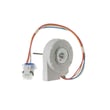
- Dc evaporator motor WR60X10185 (moves cold air through compartments)
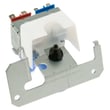
- Refrigerator air damper assembly WR60X10063 (controls airflow into fresh food section)
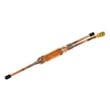
- Thermostat evaporator WR50X29776 (supports defrost/temperature regulation)
A refrigerator that is even a few degrees too warm can spoil food faster, increase frost and moisture problems, and make the compressor run longer than necessary. Addressing airflow, door sealing, and temperature control early prevents bigger performance issues.
Last updated: February 2026