 Owner’s manual
 Error Codes



What is the best temperature for a Kenmore Elite refrigerator?
For the best everyday performance on Kenmore model 59655669500, we recommend setting the fresh food (refrigerator) section to 38°F and the freezer to 0°F. Those are the factory preset, recommended starting temperatures shown in the owner's manual.
Recommended settings and what they do
- 38°F refrigerator: keeps most foods safely cold without freezing produce
- 0°F freezer: supports proper ice production and long-term frozen food storage
- Allow 24 hours after a change for temperatures to stabilize
- Use an appliance thermometer in a glass of water (center shelf) to verify actual temperature
- Avoid overcrowding shelves; airflow issues can cause warm spots
Quick reference table
| Compartment | Recommended setting | Typical “too warm” sign | First adjustment to try |
|---|---|---|---|
| Refrigerator | 38°F | Food spoils quickly, milk turns early | Lower 1 to 2 degrees, wait 24 hours |
| Freezer | 0°F | Soft ice cream, slow ice making | Lower 1 to 2 degrees, wait 24 hours |
How to fine-tune the temperature (without overcorrecting)
- Check door closure and gasket seal; warm air leaks mimic a temperature problem.
- Confirm vents are not blocked by large containers.
- Make small changes only; big swings can cause freezing in the fresh food section.
Why it matters
Keeping the refrigerator near 38°F and the freezer near 0°F helps maintain food quality, supports steady compressor run times, and helps the ice maker perform correctly (ice production can drop if the freezer runs warmer than about 0°F to 2°F).
Last updated: February 2026
What are the most common problems with Kenmore refrigerators?
The most common issues we see on Kenmore refrigerators like model 59655669500 are cooling problems (often dirty condenser coils or airflow restrictions), doors not sealing, water leaks, and ice maker or dispenser troubles. Many symptoms match the troubleshooting steps in the 59655669500 owner's manual.
Most common symptoms and what usually causes them
- Not cooling or warm temperatures: dirty condenser coils, blocked rear air grille, doors opened too often, controls set too warm
- Runs too frequently: dirty coils, door not closing, warm room conditions, recently added food
- Compressor not running but lights are on: unit may be in defrost mode (wait about 40 minutes and recheck)
- Odors: uncovered foods, interior needs cleaning
- Noises that seem “new”: often normal operation, especially around the ice maker and cooling system
Quick checks we recommend first (fast, no parts)
- Confirm the refrigerator is plugged in and controls are not set to “-” (off).
- Clean the condenser coils and make sure the rear air grille is not blocked.
- Check door closing: look for bins, drawers, or containers preventing a full seal.
- Reduce door-open time and allow time for temperatures to stabilize after loading groceries.
- If the compressor is off but lights are on, wait 40 minutes to see if it restarts (defrost cycle).
Common problems and typical fixes (at-a-glance)
| Problem you notice | Most common cause | Typical fix |
|---|---|---|
| Food too warm | Dirty coils, blocked airflow, frequent door opening | Clean coils, clear vents, adjust controls |
| Runs constantly | Door not sealing, dirty coils, warm environment | Improve door seal, clean coils, level unit |
| Odor inside | Spills, uncovered foods | Clean interior, cover foods |
| Ice maker not working | Water supply issue or ice maker failure | Check water supply; replace ice maker if needed |
When a part is commonly involved
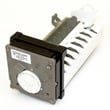
If your issue is specifically “no ice” or inconsistent ice production after you confirm water supply and temperature, the ice maker assembly is a frequent replacement item. For this model, we list the refrigerator ice maker D7824706Q.
Why it matters
Most “not cooling” and “runs too much” complaints come down to airflow and heat removal. Clean coils, clear vents, and a tight door gasket help the compressor run less, protect food temperatures, and reduce energy use.
Last updated: February 2026
Where is the model number on a Kenmore side by side refrigerator?
On Kenmore side-by-side refrigerator model 59655669500, the model number is on the model and serial number sticker inside the fresh food (refrigerator) compartment on the left wall. Use that label when ordering parts or checking your manual.
What to look for on the label
The sticker typically includes several fields; the model number is the one you want for parts lookup.
- Model number (for example: 59655669500)
- Serial number (unique to your unit)
- Sometimes a manufacturing date or other codes
- Brand name (Kenmore)
Quick steps to find it
- Open the refrigerator (fresh food) door.
- Look along the left interior wall.
- Find the model and serial number sticker and write the model number exactly as shown.
Why it matters
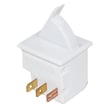
Using the exact model number helps us match the correct Kenmore parts diagrams and compatible replacement parts (like an ice maker, light switch, or water filter housing) for your specific refrigerator.
Common label locations (comparison)
| Refrigerator style | Most common model/serial label location |
|---|---|
| Side-by-side (like 59655669500) | Inside fresh food section, left wall |
| Top freezer | Inside fresh food section, side wall or ceiling |
| Bottom freezer | Inside fresh food section, side wall near crisper |
For the official location and product record section, see the 59655669500 owner's manual.
Last updated: February 2026
What causes a side-by-side refrigerator to stop cooling?
A Kenmore side-by-side refrigerator like model 59655669500 usually stops cooling because power is interrupted, the temperature controls are set too warm (or to “-”), airflow is blocked, the unit is in a normal defrost cycle, or the sealed-system components are not starting. Use the troubleshooting steps in the 59655669500 owner's manual to pinpoint the cause.
Quick checks we recommend first
- Confirm the refrigerator is plugged in and the outlet has power (reset tripped breaker if needed).
- Verify both temperature controls are not set to “-” and are set to normal cooling temperatures.
- Make sure doors close fully and gaskets seal; warm air leaks can stop proper cooling.
- Check for blocked vents or a blocked rear air grille; rearrange food to restore airflow.
- Look for dirty condenser coils; cleaning them can restore cooling efficiency.
- If the compressor is not running, wait about 40 minutes; the refrigerator may be in defrost mode.
What the symptoms usually mean
| What you notice | Most likely cause | What to do next |
|---|---|---|
| Lights on, but compressor not running | Normal defrost mode | Wait 40 minutes, then recheck cooling |
| Freezer cold, fresh food warm | Airflow blocked or door not sealing | Clear vents, check door closure and gasket seal |
| Both sections warm after a door was left open | Door left open, heavy warm load | Close doors, reduce door openings, allow time to recover |
| Cooling weak and run time long | Dirty condenser coils | Clean coils and improve airflow around the cabinet |
Parts that can be involved (when symptoms match)
If your diagnosis points to a specific failure, these model-matched parts are commonly involved:
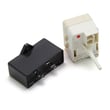
- Refrigerator overload release W10613606 (helps the compressor start and protects it)
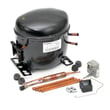
- Compressor-t W10160407 (sealed-system component; replacement is an advanced repair)
Why it matters
Running warm for even a few hours can push food into unsafe temperatures and can also make the compressor work harder than normal. Restoring airflow, correct control settings, and clean condenser coils often fixes “no cooling” complaints without replacing major parts.
Last updated: February 2026
How wide is a Kenmore side by side refrigerator?
For Kenmore model 59655669500, the correct way to confirm width is to use the installation dimension chart in the 59655669500 owner's manual. Side-by-side refrigerators in this series are typically built in the 35-inch class, but you should verify cabinet width versus doors and handles before moving it into the opening.
What width to confirm (so you do not get surprised)
When people say “width,” they may mean different measurements. We recommend checking all of these:
- Cabinet (case) width: the metal box only
- Overall width with doors closed: doors can extend past the cabinet
- Overall width with handles: often the widest point
- Required opening width: the space your cabinetry provides
- Hinge-side clearance: extra room if the unit sits against a wall
How to measure your opening correctly
Use a tape measure and check for out-of-square walls and flooring.
- Measure the opening at the top, middle, and bottom
- Measure wall-to-wall, not trim-to-trim
- Confirm the floor is level; leveling changes how the refrigerator sits
- Plan clearance for door swing so bins and drawers can be removed
Typical “35-inch class” widths (what you will commonly see)
These ranges help you sanity-check your measurements; the manual gives the exact numbers for 59655669500.
| Measurement you are checking | Typical range for 35-inch class side-by-side | What it affects |
|---|---|---|
| Cabinet width | 35 to 36 in. | Fit between cabinets |
| Doors closed (no handles) | 35 to 37 in. | Door-to-cabinet interference |
| With handles | 36 to 38 in. | Tight hallways and final placement |
Why it matters
A refrigerator that “almost fits” can still fail installation if the doors cannot open fully or if ventilation clearances are too tight; that leads to poor usability and can affect cooling performance.
Last updated: February 2026





