 Owner’s manual
 Error Codes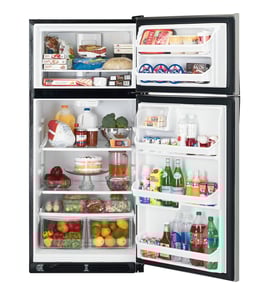

What are the disadvantages of a top mount fridge?
Top-mount refrigerators like Kenmore model 3639761514 are reliable and efficient, but the main disadvantages are less convenient fresh-food access (you bend more), fewer organization features than many bottom-freezer designs, and fewer built-in dispenser options on many models. See the owner's manual for your model’s features and setup details.
Common disadvantages (what most owners notice)
- Fresh-food items sit lower, so you bend more for everyday use.
- Freezer is at eye level, which is convenient for frozen foods but not for produce and drinks.
- Less flexible organization in many top-mount layouts (fewer wide drawers and adjustable bins).
- Fewer exterior features on many models (water and ice through the door is less common).
- Smaller freezer opening can make bulky items harder to load.
Quick comparison: top-mount vs. bottom-freezer
| Feature | Top-mount refrigerator | Bottom-freezer refrigerator |
|---|---|---|
| Fresh-food access | Lower, more bending | Higher, easier reach |
| Freezer access | Higher, easy reach | Lower, often pull-out drawer |
| Organization | Often simpler shelving | Often more flexible storage |
| Typical cost/complexity | Often lower/simpler | Often higher/more complex |
Why it matters
If you use fresh-food compartments more than the freezer, a top-mount design can feel less ergonomic day to day. On the other hand, the simpler layout can be easier to maintain, and good airflow and clearances help any refrigerator run efficiently.
Setup tips that reduce day-to-day frustration
We recommend these practical adjustments for a top-mount refrigerator like 3639761514:
- Level the refrigerator so doors close easily (front slightly raised).
- Keep clearances for airflow (sides, top, and back) to support steady cooling.
- Avoid overcrowding; it increases run time and can create warm spots.
- Clean the condenser area yearly to maintain efficiency.
Last updated: February 2026
What is the average lifespan of a Kenmore 3639761514 refrigerator?
A Kenmore 3639761514 top-mount refrigerator typically lasts 12 to 15 years. Regular care (cleaning, good airflow, and tight door seals) helps it reach the high end of that range, while heavy use, poor ventilation, or cooling-system issues can shorten service life. See the owner's manual for model-specific care and maintenance guidance.
What affects lifespan the most
- Condenser cleanliness and airflow: Dust buildup and tight clearances make the compressor work harder.
- Door gasket condition: Air leaks cause longer run times and temperature swings.
- Defrost system health: Frost buildup can restrict airflow and reduce cooling.
- Power quality and outages: Repeated hard restarts stress start components.
- Water and ice maker upkeep (if equipped): Leaks and clogs can create secondary damage.
Quick maintenance checklist (best return on effort)
- Keep vents inside the fresh food and freezer sections unblocked.
- Clean spills and deodorize with a mild baking soda solution (the manual recommends about 1 tablespoon per quart of water).
- Inspect and clean the door seal; replace it if it is torn, hardened, or won’t hold a paper strip.
- If the door gasket is clean but sticking or drying out, apply a thin layer of petroleum jelly at the hinge side (a common manual-recommended tip for smoother sealing).
- Confirm temperatures stay near 37°F (fresh food) and 0°F (freezer).
Common “end-of-life” symptoms and what they usually mean
| Symptom | Most common cause | Typical fix path |
|---|---|---|
| Warm fridge, freezer OK | Airflow/defrost issue | Check frost pattern, fan airflow, defrost components |
| Clicking, won’t start | Start device/capacitor issue | Test/replace start parts, then evaluate compressor |
| Runs constantly | Dirty coils, gasket leak, low airflow | Clean, reseal, improve ventilation |
| Water under fridge | Drain or water supply issue | Clear drain, inspect valve and lines |
Why it matters
Knowing the typical 12 to 15-year lifespan helps you decide when a repair makes sense. For example, replacing a wear item like a light bulb or door gasket is usually worthwhile, while major sealed-system repairs become a value decision as the unit ages.
Last updated: February 2026
What are the most common problems with Kenmore refrigerators?
The most common problems we see with Kenmore refrigerators like model 3639761514 are cooling issues, water leaks, ice maker troubles, frost buildup, and interior light failures. Many of these start with airflow restrictions, dirty condenser coils, door seal gaps, or a failing defrost or start component; the 3639761514 owner's manual also lists quick checks you can do before scheduling service.
Common symptoms and what usually causes them
- Not cooling or warm temperatures: dirty condenser coils, blocked vents, failed fan motor, start relay/capacitor issues
- Freezer frost or ice buildup: defrost system problem (heater, thermostat, timer/control)
- Water leaking or puddles: clogged/iced defrost drain, loose water line, failing inlet valve
- Ice maker not making ice: shutoff arm in STOP (up) position, frozen fill tube, low water supply, inlet valve issue
- Noisy operation or vibration: fan blade interference, worn fan motor, unit not level
- Interior light not working: burned-out bulb, door switch problem, no power at outlet
Quick checks we recommend first (no parts needed)
- Confirm the unit has power (test the outlet with a lamp).
- Set controls to normal settings (avoid leaving it on the coldest setting after “quick chill”).
- Keep doors closed as much as possible; frequent openings add moisture and warm air.
- Check for blocked air vents inside the fresh food and freezer sections.
- If it was just delivered or unplugged, allow up to 24 hours to fully cool.
Parts that commonly fix these problems (when a component has failed)
| Problem area | Common fix | Example part for this model |
|---|---|---|
| No cool or hard starting | Start components | Capacitor WR55X24064 or refrigerator relay protector WR07X10055 |
| Frost buildup | Defrost system | Refrigerator defrost thermostat WR50X10010 or refrigerator defrost heater WR51X465 |
| No ice or water fill issues | Water supply control | Water valve WR57X10033 |
| Light not working | Bulb or switch | 40A15/22 40A15 or light switch WR23X37285 |
Why it matters
Catching the root cause early prevents food temperature swings and reduces strain on the compressor. For example, a defrost failure can block airflow with ice, and a weak start relay or capacitor can keep the compressor from running reliably.
Last updated: February 2026
What size is a Kenmore 3639761514 refrigerator?
Kenmore model 3639761514 is a top-freezer (top-mount) refrigerator. The exact capacity (cubic feet) and the exact exterior dimensions vary by the specific unit configuration; use the specifications section in the owner's manual to match your model’s listed measurements.
How to identify the “size” you need
Refrigerator “size” usually means one of these:
- Capacity (cu. ft.): total food storage space
- Exterior dimensions: width, height, depth (for fitting an opening)
- Door swing space: room for doors to open without hitting a wall
- Ventilation clearance: space around the cabinet for airflow
What we can use from the model documentation
The manual for this model family covers top-freezer, no-frost refrigerators in the 18 to 25 cu. ft. class, and it includes installation guidance such as minimum clearances and leveling.
Common clearance guidance (from the manual)
| Area | Typical minimum clearance |
|---|---|
| Sides | 3/4 in (19 mm) |
| Top | 1 in (25 mm) |
| Back | 1 in (25 mm) |
Practical measuring tips (before you buy or move it)
Measure your space and the refrigerator with doors closed:
- Measure width at the tightest point (often between cabinets)
- Measure height to the lowest overhead cabinet or trim
- Measure depth from the back wall to the front of the doors/handles
- Add space for door opening and airflow clearance
Why it matters
Correct sizing prevents poor airflow (warm temps), doors that cannot open fully, and installation headaches when leveling or sliding the refrigerator into place.
Last updated: February 2026





