 Error Codes


Why does my GE dryer keep saying clean lint filter?
On the GE DBXR453ET0WW electric dryer, the “Clean Lint Filter” message usually means airflow is restricted or the dryer is sensing poor drying performance. Cleaning the lint screen is step one, but the alert can keep returning when the lint chute, blower area, or venting is partially blocked.
- Remove the lint screen and wash it with warm water and a soft brush; dryer sheet residue can block airflow.
- Vacuum the lint screen housing (lint chute) as far down as you can reach.
- Check the outside vent hood; make sure the flap opens fully and lint is not packed in the outlet.
- Run a timed dry cycle for 10 to 15 minutes and confirm you feel strong airflow at the outside vent.
- If loads are still taking too long, inspect the vent duct behind the dryer for kinks, crushing, or long runs.
Restricted airflow is the most common reason, but these issues also contribute:
- Lint buildup on the blower wheel or in the internal exhaust ducting
- A slipping drum belt causing longer dry times (the dryer “thinks” airflow is poor)
- Overheating from a clogged vent that can trip safety controls
- A control or timer issue that doesn’t advance cycles normally
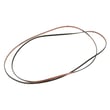
If the drum is not turning consistently, inspect the drive belt WE03X29897.
| What you notice | Most likely cause | What we recommend |
|---|---|---|
| Long dry times, weak airflow outside | Clogged vent or lint chute | Clean chute, shorten/straighten vent, clear outside hood |
| Burning smell or very hot cabinet | Severe vent restriction | Stop using, clear venting before running again |
| Drum stops, squeals, or slips | Belt or drum support wear | Check belt and drum glides |
| Cycle doesn’t progress normally | Timer/control issue | Test timer operation and wiring connections |
A restricted vent makes the DBXR453ET0WW run hotter and longer, which increases energy use and can damage components like the heating system and safety thermostat.
Last updated: February 2026
Is 7.4 cubic feet a large dryer?
Yes. A 7.4 cubic foot dryer is a large to extra-large capacity size, which means it handles bigger loads and bulky items with fewer cycles. For a GE electric dryer like model DBXR453ET0WW, that capacity is typically aimed at family-size laundry and comforter-sized items.
A 7.4 cu. ft. drum usually fits:
- A full family load (multiple towels, jeans, and shirts)
- Bulky items like a queen comforter (drying time depends on fabric and venting)
- Larger mixed loads without packing the drum tight
| Dryer capacity | Common label | Best for |
|---|---|---|
| 5.0 to 6.5 cu. ft. | Standard | Singles, couples, smaller loads |
| 6.6 to 7.3 cu. ft. | Large | Regular family laundry |
| 7.4 cu. ft. and up | Extra-large | Bulky items, fewer loads per week |
Even with a big drum, airflow is what dries clothes. We recommend:
- Fill the drum loosely; don’t compress loads
- Clean the lint screen before every load
- Check that the exhaust vent is clear and not crushed behind the dryer
- Use timed dry for heavy items if auto cycles end too soon
- If drying is slow, follow the steps in dryer takes a long time to dry
A larger capacity dryer can save time and energy by reducing the number of loads, but only if the dryer can move air freely. If the drum turns but drying is inconsistent, issues like restricted venting or worn drive components (such as the drive belt WE03X29897) can affect performance.
Last updated: February 2026
How to replace GE dryer sensor?
On the GE DBXR453ET0WW electric dryer, the most commonly replaced “sensor” customers mean is a door switch or a temperature safety device. Replacement is straightforward: unplug the dryer, access the component, move wires one at a time to the new part, then reassemble and test.
- Unplug the dryer (or switch off the breaker) before opening any panels.
- If the dryer was running, let it cool for 30 minutes.
- Take a quick photo of wire locations so you can match them exactly.
- Use a small container for screws so nothing gets lost.
A failed door switch can prevent the dryer from starting or make it stop when the door is bumped.
Basic steps
- Disconnect power.
- Open the door and locate the switch area at the door opening.
- Remove the mounting screws, then pull the switch forward.
- Transfer wires to the new switch one at a time.
- Reinstall the switch and confirm the door “clicks” the actuator.
Recommended part for this model: door switch WE4M415
If the dryer runs but overheats, shuts off mid-cycle, or will not heat, a thermostat can be involved.
Common checks and fixes
- Clean lint screen and inspect the vent path for restrictions.
- Check for a crushed or excessively long vent run.
- Inspect the blower housing area for lint buildup.
Model-matched parts you may need:
| Symptom | Part to consider | Part ID |
|---|---|---|
| Overheats or trips safety | Dryer safety thermostat | WE4M160 |
| No heat or cycles heat oddly | Dryer high-limit thermostat | WE4M137 |
| No heat (element open) | Heater & H | WE11M23 |
A “sensor” issue is often a simple switch or thermostat failure, but airflow problems (lint and venting) can cause repeat failures. Fixing venting at the same time helps protect the heating element, thermostats, and motor.
Helpful DIY reading: electric dryer wont heat troubleshooting video
Last updated: February 2026
Where to find part number on GE dryer?
On a GE electric dryer like model DBXR453ET0WW, the model and serial tag is typically on the door opening (door frame) or just inside the door. Once you have the model number, we match the correct replacement parts for your exact dryer.
The tag usually lists several items. Use these to identify parts correctly:
- Model number (for this dryer: DBXR453ET0WW)
- Serial number (helps confirm production details)
- Electrical rating (volts/amps, useful for diagnosing power and heat issues)
- Manufacturing information (date code or similar)
GE parts often have more than one identifier. Here is how we recommend using them:
| What you see | Example from this model | What it means | Best use |
|---|---|---|---|
| Part name | Drive belt | The part description | Helps you confirm you picked the right item |
| Part ID | WE03X29897 | Sears PartsDirect part identifier | Best for finding the exact part page |
| Manufacturer part number | WE12M22 | GE reference number | Useful for cross-referencing |
If you are replacing a common wear item, using the part ID is the fastest way to get the exact match for DBXR453ET0WW (for example, the drive belt WE03X29897).
- Write the model number exactly as shown on the tag (letters and numbers matter).
- If the tag is worn, take a clear photo and zoom in to read it.
- Match the part by function (belt, timer, thermostat) and symptom (no heat, won’t start, squealing).
- For performance issues, maintenance matters; see how to keep a dryer clean and economical.
GE can use different components across similar-looking dryers. Using the DBXR453ET0WW model number from the door area ensures the drive belt, heating element, timer, and thermostats you choose fit and work correctly.
Last updated: February 2026
What is the most common problem with a GE dryer?
For the GE DBXR453ET0WW electric dryer, the most common problems we see are no heat or long dry times, won’t start, and loud squealing or thumping. In many cases, restricted airflow (lint buildup in the venting) is the root cause, and worn drive components can create noise.
- Dryer runs but no heat: failed heating circuit parts such as the heater & h WE11M23
- Dryer takes too long to dry: clogged lint screen, crushed/blocked vent duct, weak airflow
- Dryer won’t start: failed door switch WE4M415, timer issue, or power supply problem
- Squealing or rumbling noise: worn drum support parts such as drive belt WE03X29897 or drum glides
- Overheating or shutting off: airflow restriction or a thermostat issue
- Clean the lint screen completely (including any film from dryer sheets).
- Check the outside vent hood for strong airflow while the dryer runs.
- Inspect the vent path for kinks, crushing, or heavy lint buildup.
- Confirm the dryer has the correct power supply (electric dryers typically need full 240V to heat).
- If the drum is noisy or not turning, inspect the belt and drum support surfaces.
| Symptom | Most likely area | Example part for this model |
|---|---|---|
| Runs, no heat | Heating system | Heater & H (WE11M23) |
| Won’t start | Door circuit | Door switch (WE4M415) |
| Squeals/thumps | Drum drive/support | Drive belt (WE03X29897) |
| Long dry times | Airflow/venting | Venting and lint system (maintenance) |
Airflow problems do more than slow drying; they can overheat the dryer, shorten the life of heating parts and thermostats, and make cycles inconsistent. Fixing venting first often prevents repeat failures.
Related help: dryer takes a long time to dry
Last updated: February 2026
Where is my thermal fuse located on my GE dryer?
On the GE DBXR453ET0WW electric dryer, the thermal fuse is mounted on the blower housing inside the cabinet, near the exhaust outlet where the vent duct connects. You access it by disconnecting power and removing the rear panel to reach the blower area.
On this GE dryer design, the thermal fuse is found in the airflow path at the blower:
- On the blower housing (the housing the blower wheel sits in)
- Close to the exhaust outlet where the vent duct attaches
- Identified as a small, flat safety device with two wires on a bracket
Before opening the cabinet, use these standard steps:
- Unplug the dryer (or switch off the breaker)
- Pull the dryer forward and disconnect the vent hose
- Remove the rear access panel screws and lift the panel off
- Locate the blower housing at the lower rear area (near the vent connection)
- Look for the fuse mounted to the housing with two terminals and two wires
A blown thermal fuse is usually caused by overheating from restricted airflow. While diagnosing, it helps to inspect related heat-safety parts and airflow restrictions.
- Clean the lint screen and lint chute
- Check the vent hose for kinks or crushing
- Confirm the outside vent hood opens freely
- Inspect the blower wheel for lint buildup
- If you are also checking heat-limit protection, see the dryer high-limit thermostat WE4M137
| Symptom | Most common direction | First checks |
|---|---|---|
| Dryer will not start | Safety circuit open | Thermal fuse continuity, door switch |
| Runs but no heat | Heating circuit issue | Heating element, thermostats, airflow |
| Long dry times | Airflow restriction | Lint screen, vent duct, outside hood |
The thermal fuse is a one-time safety device; when it opens, it stops operation (or heat) to prevent overheating. Restoring airflow is the key step so the replacement fuse does not blow again.
Last updated: February 2026





