Error Codes


How do I tell what model my Kenmore dryer is?
Your Kenmore dryer’s model number is printed on the appliance ID tag; for Kenmore electric dryers like model 11096590100, it’s most often found around the door opening or on the back panel. Once you have the full model number, we can match the correct parts and diagrams for your exact dryer.
Check these common locations on Kenmore dryers:
- Inside the dryer door opening (on the cabinet frame)
- On the back panel of the dryer
- Along the door opening edge near the latch area
- On the lower front area behind the toe panel (some designs)
- Near the lint screen housing (some designs)
Kenmore model numbers are usually a long string of numbers (sometimes with a dot in older formats). For example, 11096590100 identifies the exact build of your dryer so we can pull the right part list for items like a heating element, thermal fuse, or drive motor.
| What you see on the tag | What it tells us | Why you need it |
|---|---|---|
| Full model number (example: 11096590100) | Exact dryer version | Ensures correct part fit |
| Serial number | Production run info | Helps confirm configuration |
| Electrical ratings | Voltage/amps | Helps with safe troubleshooting |
- Write down the full model number exactly as shown (all digits, no missing zeros).
- Use the model number from the dryer tag, not the number on a receipt or manual cover.
- If the tag is worn, take a clear photo with good lighting and zoom in.
If you’re troubleshooting or seeing a code on an electronic-control Kenmore 110-series dryer, use our Kenmore 110 series electronic control model dryer error codes reference to narrow down the likely failed part.
Kenmore dryers often share similar styling across many models, but parts like the dryer heating element, operating thermostat, and thermal fuse can vary by model. Using the exact model number prevents ordering the wrong replacement.
Last updated: February 2026
How do I know if my Kenmore dryer thermal fuse is blown?
On Kenmore electric dryer model 11096590100, a blown thermal fuse usually shows up as a dryer that will not run at all (most common) or runs but has heat problems after an overheating event. The sure way to know is a continuity test on the fuse with the dryer unplugged; a blown fuse reads open.
- Dryer does not start; no drum tumble even though the control is set correctly
- Timer advances but the motor never runs (varies by cycle design)
- Dryer stopped mid-cycle and will not restart after cooling down
- You recently had poor airflow (clogged lint screen, crushed vent, long vent run)
- Burning smell or very hot cabinet before the failure
- Unplug the dryer (or switch off the breaker) before opening any panels.
- Access the thermal fuse (commonly on the blower housing or exhaust duct area).
- Remove at least one wire from the fuse terminal.
- Set the meter to continuity or lowest ohms.
- Test across the fuse terminals.
| Meter result | What it means | What to do next |
|---|---|---|
| Beep or near 0 ohms | Fuse is good | Keep troubleshooting (door switch, belt switch, motor, power) |
| No beep or OL/open | Fuse is blown | Replace the fuse and fix the airflow problem |
For this model, the correct replacement is the dryer thermal fuse WP3390719. If overheating damaged other heat-safety parts, you may also need the cut-off kit 279769.
A thermal fuse is a one-time safety device; it opens when the dryer overheats. Replacing the fuse without correcting airflow (lint screen, vent pipe, outside hood) often leads to another blown fuse and longer dry times.
Last updated: February 2026
What are common problems with Kenmore dryers?
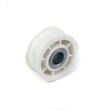
Common problems on Kenmore electric dryers like model 11096590100 include no heat, long dry times, the drum not turning, and unusual noises. Most issues trace back to airflow restrictions (lint and venting) or normal wear on heating and drive components such as a thermal fuse, heating element, idler pulley, or blower wheel.
- Dryer runs but won’t heat: failed thermal fuse, heating element, or operating thermostat
- Long drying times or overheating: clogged lint screen, restricted exhaust duct, or damaged blower wheel
- Drum won’t turn: worn idler pulley, motor problem, or drum seal drag
- Squealing, thumping, or rumbling: idler pulley wear, blower wheel damage, or drum/baffle issues
- Door won’t stay closed or won’t start: door latch/catch problems
- Clean the lint screen fully and wash off any fabric softener film.
- Confirm strong airflow at the outside vent hood.
- Check the vent path for kinks, crushed flex duct, or heavy lint buildup.
- Verify power: most electric dryers need 240V to heat (it can run on 120V but not heat).
- Listen for changes: scraping, squealing, or a “whoosh” change can point to blower or drum issues.
| Symptom | Likely area | Model-matched part examples |
|---|---|---|
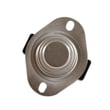
| No heat | Heating circuit safety/control | Dryer thermal fuse WP3390719, dryer operating thermostat WP3387134 |
| No heat (open heater) | Heater assembly | Dryer heating element WP3387747 |
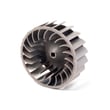
| Long dry times | Airflow / lint path | Dryer blower wheel WP697772 |
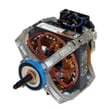
| Drum not turning | Drive system | Dryer idler pulley 279640, drive motor (279827) |
Airflow problems can cause long dry times and can also overheat the dryer, which commonly leads to a blown thermal fuse. Fixing venting and lint buildup first often prevents repeat failures after replacing parts.
Last updated: February 2026
What size is a Kenmore Model 11096590100 dryer?
Most Kenmore electric dryers like model 11096590100 are full-size units that measure about 27 inches wide, 27 to 29 inches deep, and 43 to 44 inches tall. For the exact footprint, we match dimensions to the model’s product label and cabinet style, which can vary by series.
These are the most common exterior size ranges for a standard 27-inch Kenmore (110-series) electric dryer:
- Width: ~27 inches
- Height: ~43 to 44 inches
- Depth (cabinet): ~27 to 29 inches
- Depth (with door/handle): often 1 to 3 inches more than cabinet depth
- Clearance behind dryer: plan at least 4 inches for venting and cord space
Use these quick checks to lock in the right measurement before ordering a pedestal, stacking kit, or planning a closet install:
- Measure width at the widest point of the cabinet (side to side).
- Measure height from floor to the top rear corner of the cabinet.
- Measure depth from the back panel to the front edge (then add door/handle projection).
- Confirm whether your dryer is rear-vented or side-vented, since vent routing changes required clearance.
- If you are changing vent direction, a side-vent kit can change how tight the install can be.
| Measurement | What to measure | Typical for 11096590100 class |
|---|---|---|
| Width | Cabinet side to side | ~27 in. |
| Height | Floor to top | ~43 to 44 in. |
| Depth | Back panel to front (plus door) | ~27 to 29 in. (plus 1 to 3 in.) |
Dryer “size” affects more than fit. Tight clearances can restrict airflow, which increases dry times and can overheat components like the thermal fuse and operating thermostat. If you are troubleshooting heat or airflow issues while planning an install, start with venting and lint filtration.
- If your dryer is running hot or shutting off, check the dryer thermal fuse WP3390719.
- For temperature regulation issues, the dryer operating thermostat WP3387134 is a common wear item.
- For control-panel fault readouts on some Kenmore lines, use our Kenmore 110 series electronic control model dryer error codes guide.
Last updated: February 2026