Owner’s manual
 View engine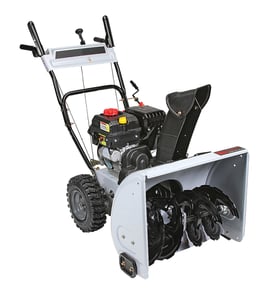



How many years should a snowblower last?
A Craftsman gas snowblower like model 536881400 should last 15 to 20 years with normal residential use and consistent maintenance. In heavy, wet-snow conditions or with skipped upkeep, lifespan commonly drops closer to 10 to 15 years.
What most affects lifespan on model 536881400
We see longevity come down to maintenance and wear items more than the engine itself. Follow the service intervals in the 536881400 operator’s manual.
- Use fresh fuel and stabilize fuel before storage
- Change engine oil at least yearly (or about every 50 hours)
- Keep the auger area clean and dry after each use to prevent corrosion
- Replace worn wear parts promptly (scraper, belts, cables)
- Store indoors or covered; avoid moisture trapped under plastic
Typical lifespan by use pattern
| Use pattern | What we typically see | Notes |
|---|---|---|
| Light residential (few storms/season) | 18 to 20 years | Storage and fuel care matter most |
| Average residential | 15 to 18 years | Regular oil changes and tune-ups |
| Heavy use (long driveway, frequent storms) | 10 to 15 years | Faster wear on belts, auger, scraper |
When it is usually worth repairing vs replacing
A snowblower is often worth repairing when the issue is a normal wear part and the machine is otherwise solid.
- Worth repairing: chute components, belts, cables, scraper blade
- Consider replacement: repeated engine fuel-system problems, major housing damage, persistent severe vibration
- If snow discharge performance drops, inspect the auger system and wear surfaces first
Example wear part that can extend performance
If your machine is leaving snow behind or scraping poorly, replacing the scraper 55323MA can restore clean clearing and reduce strain on the auger.
Why it matters
A longer-lasting snowblower is usually the result of preventing fuel varnish, reducing rust, and keeping the auger drive system properly adjusted. Those steps reduce hard starting, poor throwing distance, and premature belt or auger wear.
Last updated: January 2026
How to tell if a snowblower auger belt is bad?
On the Craftsman 536881400 snow thrower, a bad auger drive belt usually shows up as poor snow discharge (auger slows, slips, or stops under load) and visible belt damage like cracking, fraying, glazing, or missing chunks. The manual also notes belt stretch can require cable adjustment.
Quick checks (safe and fast)
- Shut the engine off, remove the key (if equipped), and disconnect the spark plug wire.
- Remove the belt cover to view the belt and pulleys (procedure is shown in the Craftsman 536881400 operator's manual).
- Inspect the belt surface for cracks, frayed cords, glazing (shiny/slick), or burnt spots.
- Check for rubber dust inside the cover; it often indicates belt slip.
- With the auger lever engaged, look for obvious slack or the belt riding incorrectly on pulleys.
Symptoms that strongly point to a worn belt
- Auger turns at idle but stalls or slows when it hits deeper or wetter snow.
- Snow throws only a short distance even with the engine running normally.
- Burning rubber smell during operation (belt slipping on the pulley).
- Auger engagement feels “soft” at the handle, or engagement point changes over time.
Belt vs. cable adjustment (what’s different?)
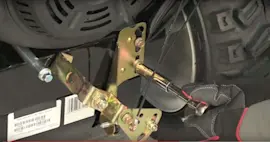
The 536881400 uses an auger control cable; if the belt has stretched, the manual describes moving the cable end to a different hole to restore proper engagement.
| What you notice | More likely cause | What to do next |
|---|---|---|
| Belt looks damaged or glazed | Belt worn out | Replace the belt (use the belt specified for this model) |
| Belt looks OK but slips | Cable out of adjustment or belt stretched | Adjust auger control cable per manual |
| Auger won’t stop quickly | Brake/cable issue | Check brake clearance and cable adjustment |
Why it matters
A slipping auger belt reduces throwing performance and can overheat, glaze, and fail suddenly. Catching belt wear early also helps protect pulleys, idlers, and the auger brake system.
For step-by-step visuals, we also recommend how to replace a snowblower belt video.
Last updated: January 2026
Is it cheaper to repair or replace a snowblower?
For the Craftsman snow thrower model 536881400, it’s usually cheaper to repair when the problem is limited to normal-wear items (belt, scraper, chute parts) and the total cost stays well below the price of a comparable replacement machine. We recommend replacing when a major engine or drive issue pushes repair cost to about 50% or more of a new unit.
Quick decision checklist (repair vs replace)
- Repair if the issue is isolated (one symptom, one part) and the machine is otherwise reliable.
- Repair if you can do the work yourself using the steps in the 536881400 operator’s manual.
- Repair if the fix is a common wear item like a belt, scraper, or chute component.
- Replace if the engine has persistent hard-starting, low power, or internal damage after tune-up attempts.
- Replace if you’re paying for repeated shop visits in the same season.
- Replace if multiple systems are failing at once (auger, drive, chute, and engine).
Typical “repairable” problems on this model
These are common, cost-effective repairs on a single-stage Craftsman snowblower like the 536881400:
- Worn scraper blade causing poor clean-down on pavement
- Chute issues (won’t rotate smoothly, won’t hold position)
- Auger or drive performance problems caused by belt wear or cable adjustment
- Primer bulb wear leading to hard cold starts
Parts that often make sense to replace
| Symptom | Likely area | Example compatible part |
|---|---|---|
| Poor scraping, leaves snow behind | Scraper/shave plate area | Scraper 55323MA |
| Chute won’t aim or binds | Chute/rotation components | Chute ring 1501846MA |
| Auger damage or severe vibration | Auger system | Auger assembly 327072MA |
Why the 50% rule matters
Once repair cost approaches half the cost of a replacement snowblower, you’re often paying for labor and major components without gaining the benefits of a newer machine (updated features, easier starting, and fewer near-term repairs). Keeping repairs focused on wear parts usually delivers the best value.
Tips to keep repair costs low
- Follow the maintenance schedule and oil/fuel guidance in the 536881400 operator’s manual.
- Address small issues early (belt slip, loose fasteners, chute binding) before they cause secondary damage.
- Stock common seasonal items before winter hits.
Last updated: January 2026