Owner’s manual
 Error Codes


How to realign bottom freezer door?
On Kenmore Elite model 79579753905, you realign the bottom freezer drawer by adjusting the drawer-front alignment screws (typically one on each side) in small, equal turns until the gaps look even and the drawer seals smoothly. Use the steps in the 79579753905 owner's manual as your reference.
Quick alignment steps
- Pull the freezer drawer open and remove heavy items so the drawer sits naturally.
- Locate the left and right drawer-front adjustment screws (usually accessible with the drawer open).
- Turn each side in small increments (about 1 to 2 turns at a time), then close the drawer and recheck the gaps.
- Adjust both sides evenly to keep the drawer level; adjust one side only if one gap is clearly larger.
- Close the drawer fully and confirm it seals without rubbing or popping back open.
What to check before you adjust
A drawer that looks “crooked” is often caused by something simple. Check these first:
- Food packages or an overfilled basket preventing full closure
- Ice buildup along the rails or at the back of the freezer compartment
- A bin or basket not seated correctly on the supports
- The refrigerator not level front-to-back (a common cause of uneven gaps)
Common symptoms and what they usually mean
| Symptom | Most common cause | Best next step |
|---|---|---|
| Gap is larger on one side | Drawer front needs leveling | Adjust the higher side down in small turns |
| Drawer rubs or feels tight | Rail alignment issue or ice buildup | Clear ice, verify rails move freely |
| Drawer will not stay closed | Cabinet not level or seal interference | Level the refrigerator, then recheck gaps |
Why it matters
A misaligned bottom freezer drawer can leak cold air, create frost, and make the compressor run longer than necessary. Getting the gaps even helps the door gasket seal correctly and keeps temperatures stable.
Last updated: January 2026
How to raise a refrigerator off the floor?
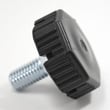
To raise your Kenmore Elite refrigerator model 79579753905 off the floor, we level it by turning the front leveling legs down (which lifts the cabinet) and then fine-tuning the rear leveling system if your unit has one. Follow the step-by-step procedure in the owner's manual.
Safe way to lift and level the refrigerator
- Unplug the refrigerator (or switch off power at the breaker) before working near wiring or the condenser fan area.
- Remove heavy items from the doors to reduce strain on hinges and help the cabinet sit square.
- Use a helper; bottom-mount refrigerators are heavy and can tip if pulled too far.
- Protect the floor with cardboard or a thin plywood sheet if you need to slide the unit.
- Raise the front by turning the leveling legs clockwise (typical direction) until the cabinet clears the floor.
- Recheck door swing and gasket contact after each adjustment.
What “raised enough” looks like
Most bottom-mount refrigerators are set so the cabinet is stable and the doors self-close slightly when opened partway.
| Check | What you want | Why it helps |
|---|---|---|
| Front clearance | Legs firmly on the floor, cabinet slightly lifted | Prevents rocking and vibration |
| Side-to-side level | Bubble centered (or close) | Helps doors align and seal |
| Slight backward tilt | Front a bit higher than the rear | Helps doors close and reduces warm air leaks |
If the refrigerator still sits too low
If the leveling legs are fully extended and you still need more height, we use a solid shim under the leveling foot (never under the thin cabinet edge).
- Use a non-compressible shim (plastic or composite)
- Keep shims small and fully supported
- Avoid stacking multiple soft shims
- Confirm the unit does not rock after shimming
Why it matters
Correct height and leveling reduce door seal leaks, frost buildup, and noisy vibration; they also help the ice maker and water dispenser work more reliably.
Last updated: January 2026
What are the common problems with Kenmore Elite refrigerators?
Common problems on the Kenmore Elite 79579753905 bottom-mount refrigerator include warm temperatures (airflow or sealed-system issues), frost buildup (defrost or door-seal problems), water leaks (drain or water-line issues), and unusual noises (fan, relay, or compressor-related). We use the symptoms to narrow the likely part and fix.
Most common symptoms and what usually causes them
- Not cooling or weak cooling: dirty condenser area, failed evaporator fan, bad temperature sensor, compressor start issues
- Frost or ice buildup: defrost heater problem, door not sealing, door left ajar
- Water under the fridge or in the freezer: clogged/iced drain system, cracked drain tube, leaking water tubing
- No ice or no water dispensing: water inlet valve issue, frozen/blocked water line, dispenser or ice maker fault
- Lights not working or door alarm issues: door switch or light board problem
Parts that commonly fix these issues on model 79579753905
If your symptoms match, these model-matched parts are common repair starting points:
| Symptom | Common part to check | What it affects |
|---|---|---|
| Warm fridge, noisy airflow | Lg refrigerator evaporator fan motor 4681JB1027C | Circulates cold air through the fresh food section |
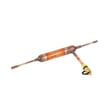
| Frost buildup, warm temps | Lg refrigerator defrost heater 5300JK1005D | Melts frost off the evaporator so air can flow |
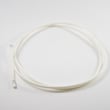
| Puddles or water leaks | Refrigerator drain tube 5251JA3003D | Routes defrost water to the drain pan |
| No water/ice, slow fill | Refrigerator water inlet valve MJX41178908 | Opens to supply water to dispenser and ice maker |
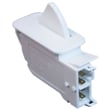
| Interior lights or door sensing | Refrigerator door switch 6600JB1010A | Tells the control when the door is open/closed |
Quick checks we recommend before replacing parts
- Confirm temperature settings; allow 24 hours after changes for stabilization.
- Make sure doors close fully and bins are not preventing closure.
- Listen for the evaporator fan; it typically runs when cooling is needed.
- Check for frost on the freezer back panel; heavy frost points to a defrost/airflow issue.
- Inspect for water trails or ice at the bottom of the freezer; that often points to a drain problem.
Why it matters
Cooling, defrosting, and water delivery all depend on airflow and clear drain and water paths. Catching a weak fan, iced drain, or leaking valve early helps prevent food spoilage, recurring ice buildup, and floor damage.
For model-specific operating details and feature behavior, use the 79579753905 owner's manual.
Last updated: January 2026