Owner’s manual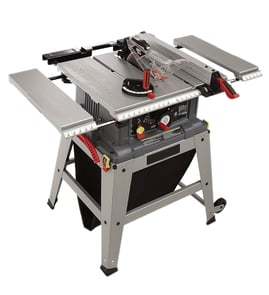

What size blade is a craftsman 137218070 table saw?
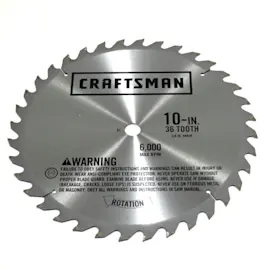
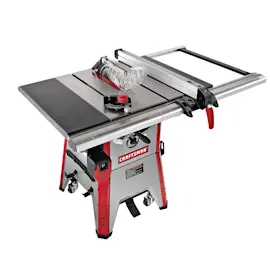
The Craftsman table saw model 137218070 uses a 10-inch table saw blade. This is confirmed in the operator documentation for the 10-in. table saw with leg set; use a 10-inch blade that matches the saw’s arbor and speed rating listed in the owner's manual.
How to make sure the replacement blade fits
Even with the correct diameter, a blade must match the saw’s mounting and operating requirements.
- Confirm the blade diameter is 10 in.
- Match the arbor (center hole) size to your saw’s arbor
- Choose a blade with an RPM rating at or above your saw’s no-load speed
- Pick the right tooth count for the job (rip, crosscut, combination)
- Use a thin-kerf blade only if it’s compatible with your splitter/riving knife setup
Blade selection quick guide
| Cut type | Typical tooth count (10 in.) | What you get |
|---|---|---|
| Ripping (with the grain) | 24 to 30T | Faster cuts, rougher finish |
| Crosscutting | 60 to 80T | Cleaner cuts, slower feed |
| General purpose | 40 to 50T | Balanced speed and finish |
Why it matters
Using the correct 10-inch blade helps your Craftsman 137218070 table saw cut accurately and reduces binding, burning, and kickback risk. A mismatched arbor size or under-rated RPM blade can also cause vibration and unsafe operation.
Safety notes we recommend before changing the blade
- Unplug the saw before any service
- Use the correct wrenches and tighten the arbor nut securely
- Verify the blade rotates in the correct direction before cutting
- Check guard and anti-kickback components after installation
Last updated: February 2026
What not to do with a table saw?
Never cut freehand, never stand in line with the blade, and never use unsafe setups (like miter gauge and rip fence together) on your Craftsman 137218070 table saw; these mistakes are major causes of kickback and severe hand injuries. Follow the safety rules and cut methods in the owner's manual.
Biggest “don’ts” that cause kickback and injuries
- Do not cut freehand (using only your hands to guide the work); always guide the work with the rip fence or miter gauge.
- Do not use the miter gauge and rip fence simultaneously; this can trap the workpiece and launch it back.
- Do not stand directly behind the blade path; keep your body out of the line of fire.
- Do not rip warped, twisted, or bowed lumber, or stock without a straight edge against the fence.
- Do not reverse out of a cut with the blade running.
- Do not leave the saw running unattended; wait until the blade stops completely.
Safe setup checks we recommend before every cut
- Set the rip fence parallel to the blade.
- Keep the blade sharp to reduce binding.
- Keep the riving knife, anti-kickback pawls, and blade guard in place, aligned, and working for through-cuts.
- Support long or wide boards at the rear and sides of the table.
- Raise the blade to about 1/8 inch above the workpiece for typical ripping.
Quick guide: correct guide tool for the cut
| Operation | Use this guide | Do not use |
|---|---|---|
| Ripping (with the grain) | Rip fence | Miter gauge |
| Crosscutting (across) | Miter gauge | Rip fence as a cutoff gauge |
| Non-through cuts (grooves/rabbets) | Push block, auxiliary fence, featherboard | Blade guard and anti-kickback pawls installed |
Why it matters
Most table saw accidents come from kickback (the workpiece gets pinched and thrown back) or from hands drifting into the blade path. Using the correct guide (fence or miter gauge), keeping guards aligned, and avoiding warped stock prevents binding and sudden movement.
Last updated: February 2026
How to get rid of an old table saw?
If your Craftsman 137218070 table saw still runs, the best way to get rid of it is to sell or donate it; if it’s unsafe or non-working, remove the blade and accessories, then recycle the metal and dispose of the remaining components through your local waste or recycling program.
Safe prep before disposal
Before you move, donate, or scrap a table saw, we recommend making it safe to handle and transport.
- Unplug the saw and remove the switch key (if equipped)
- Remove the blade, blade guard assembly, anti-kickback pawls, rip fence, and miter gauge
- Lower the blade height to the minimum setting
- Vacuum or blow out sawdust from the cabinet and motor area
- Coil and secure the power cord so it can’t snag during lifting
For model-specific handling and storage details (including moving it on its wheels), follow the steps in the owner's manual.
Best options (from most to least value)
Here are practical routes depending on condition:
- Sell: Working saws with a straight rip fence and intact blade guard usually sell fastest.
- Donate: Donate only if it’s complete and safe (guard and anti-kickback parts included).
- Give away: Listing it as “free, you haul” is often the quickest option.
- Recycle/scrap: Scrap yards typically take the steel/aluminum frame and stand.
- Municipal disposal: Use a local bulky-item pickup or drop-off site for what can’t be recycled.
What to do with blades and small metal parts
Saw blades are sharp and should be handled like scrap metal, not loose trash.
| Item | What to do | Safety tip |
|---|---|---|
| Saw blade | Recycle as metal where accepted | Wrap teeth in cardboard and tape securely |
| Fence, miter gauge, stand hardware | Recycle as metal | Bag small parts so nothing spills |
| Power cord | Recycle if your area accepts cords | Cut only if required by your recycler |
Why it matters
A table saw has sharp edges, heavy cast/steel parts, and fine sawdust buildup; basic disassembly and cleanup reduces injury risk during transport and helps recyclers handle the material safely.
Last updated: February 2026
Does Craftsman make a good table saw?
Yes. Craftsman table saws are a solid choice for DIY and homeowner use when you set them up carefully and follow safe cutting practices. For the Craftsman 137218070 10-inch table saw with leg set, you can get reliable everyday ripping and crosscutting performance, especially for light to medium projects, but precision depends heavily on alignment and technique (see the owner's manual).
What “good” means for the Craftsman 137218070
Most owners judge a table saw on three things: cut accuracy, repeatability, and safety.
- Accuracy: Strongly tied to fence alignment, blade condition, and a straight workpiece edge.
- Repeatability: Improves when you lock the rip fence consistently and keep the table clean.
- Safety: Depends on using the right method for the cut (push stick, hand position, and correct accessories).
Setup and use tips that make the biggest difference
The manual’s operating guidance is the key to getting good results from this saw.
- Use the rip fence for ripping; remove and store the miter gauge when ripping.
- Keep the workpiece flat and straight; do not rip warped, twisted, or bowed stock.
- Set blade height about 1/8 inch above the top of the workpiece for most rips.
- Keep hands out of the blade path; use a push stick for narrow rips.
- Never use more than one rip fence during a single cut.
Push stick basics (simple, effective upgrade)
The Craftsman 137218070 manual includes a push stick pattern; using one improves control and safety.
| Item | Typical guidance |
|---|---|
| Material | 1/2-inch or 3/4-inch plywood or solid wood |
| Thickness | Must be thinner than the material being cut |
| Feature | Notch to help prevent your hand from slipping |
Why it matters
A “good” table saw is one you can use confidently and consistently. With the Craftsman 137218070, careful setup, a sharp 10-inch blade, and correct ripping technique are what turn it into a dependable shop tool.
Last updated: February 2026
Can you use an 8 inch blade on a 10 inch table saw?
Yes, you can use an 8-inch blade on the Craftsman 137218070 table saw as long as the blade is compatible with the saw’s arbor and is approved for the saw’s riving knife and guard setup. For this model, the operator guidance also limits dado use to stackable sets up to 6 inches in diameter.
What matters most on model 137218070
Blade diameter alone is not the only fit requirement. Before installing any blade, confirm these basics in the owner's manual:
- Arbor hole size matches the saw arbor (most table saw blades are 5/8 inch, but always confirm)
- Blade body and kerf work with the riving knife requirement (riving knife cannot be thicker than the cut groove and cannot be thinner than the blade body)
- Blade speed rating meets or exceeds the saw’s no-load RPM rating
- Blade type matches the operation (rip, crosscut, combination)
- Guard and riving knife can be installed and aligned correctly after the blade change
8-inch blades: what changes compared to a 10-inch blade
An 8-inch blade typically reduces maximum cut depth, but it can still be useful for certain tasks.
| Item | 10-inch blade (typical) | 8-inch blade (typical) |
|---|---|---|
| Max cut depth | Higher | Lower |
| Guard/riving knife alignment | Standard | Must still align correctly |
| Best use | General ripping and crosscutting | Shallower cuts, some specialty setups |
Dado blade guidance for this saw
If your real goal is dadoes or grooves, follow the model-specific accessory limits:
- Use only stackable dadoes
- Maximum dado width is 1/2 inch
- Do not use adjustable (wobble) dadoes
- Do not use carbide-tipped dado blades
- Do not use a dado larger than 6 inches in diameter
Why it matters (safety and cut quality)
Using a blade that does not match the riving knife and guarding requirements increases kickback risk and can lead to binding or a stalled blade. Keeping the blade sharp and the fence parallel also helps prevent kickback during ripping.
Last updated: February 2026