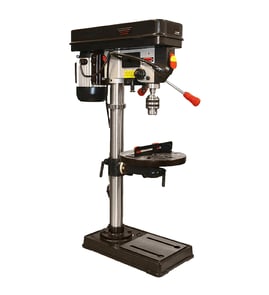

What are the parts of a drill press?
A drill press is built from a few main assemblies that keep the tool stable, align the bit, and control drilling depth. On a Craftsman drill press stand model 33525986, you will typically see a base and column, a height-adjustable table, and a head assembly that contains the spindle and feed mechanism.
- Base: Supports the entire drill press; it is the foundation for accuracy and vibration control.
- Column: Vertical post that supports the head and table; keeps everything aligned.
- Table: Work surface that supports the material being drilled.
- Table clamp and table support: Locks the table height and angle (on tilting tables).
- Head: Upper housing that holds the drive system and the quill/spindle assembly.
- Quill: Moves up and down during drilling; guides the spindle.
- Spindle: Rotating shaft that drives the chuck.
Many drill presses also include these items (varies by model and setup):
- Chuck: Holds the drill bit.
- Feed handles: Levers you pull to lower the quill.
- Depth stop: Limits how deep the bit can drill.
- On/off switch: Power control (on powered drill presses).
- Fence or vise: Helps position and secure the workpiece.
| Part | Primary job | Why it matters |
|---|---|---|
| Base | Stability | Reduces vibration and improves hole accuracy |
| Column | Alignment | Keeps head and table square to the base |
| Table | Work support | Prevents shifting and tear-out |
| Quill/spindle | Drilling motion | Controls straight, repeatable drilling |
Knowing the names of drill press parts helps you troubleshoot issues like wobble, inaccurate holes, slipping table height, or inconsistent drilling depth. It also makes it easier to identify what you need when you are searching diagrams and replacement components.
Last updated: February 2026
What is a 33525986 drill press?
The Craftsman 33525986 is a drill press stand model (not a complete drill press). It’s the stationary base and support structure used to hold and align a drill press head, table, and column so you can drill accurate, repeatable holes in wood or metal.
A drill press stand like Craftsman 33525986 is designed to keep the spindle and work surface stable and square. In practical terms, it helps you:
- Drill straighter holes with less wobble than a handheld drill
- Set consistent drilling depth using a depth stop (when equipped)
- Support larger workpieces on the table
- Improve safety by keeping the tool anchored and the work supported
Because “33525986” refers to the stand, the exact features depend on the drill press components installed on it. Use these quick checks:
- Look for the model tag on the stand frame or base casting
- Confirm whether your unit is bench-mounted or floor-standing
- Measure the column diameter and note the table style (round vs. rectangular)
- Check the chuck type on the drill press head (keyed vs. keyless)
- Verify the motor plate details (HP/amps and voltage) if your drill press includes a motor
| Item to verify | What it affects | Why it matters |
|---|---|---|
| Stand model number (33525986) | Stand compatibility | Ensures the base/frame matches your parts list |
| Drill press head model | Speeds, quill travel, chuck size | Determines drilling capacity and performance |
| Column and table style | Fit and alignment | Impacts accuracy and available work support |
Ordering the right replacement parts depends on matching the stand model (33525986) and, when applicable, the drill press head model. That prevents issues like misaligned tables, incorrect column fit, or mounting holes that do not line up.
Use our guide on how to find your appliance model number (and what it means for parts) to confirm the model identification details before selecting parts.
Last updated: February 2026
How to remove chuck from Craftsman drill press?
On the Craftsman 33525986 drill press stand, the chuck is typically removed by lowering the quill, releasing the taper fit, and knocking the chuck arbor loose with the correct wedge or a firm, controlled tap. This is a friction-fit connection, not a threaded one.
- Unplug the drill press (or lock out power) before touching the chuck or spindle.
- Remove the drill bit and any chuck key.
- Lower the table or remove the workpiece so you have clear access.
- Support the chuck with a block of wood or your free hand so it does not drop.
- Wear eye protection; small metal chips can dislodge during removal.
Many Craftsman drill presses use a Jacobs taper (JT) chuck on an arbor, and the arbor seats into the spindle with a Morse taper (MT). To remove it:
- Lower the quill to expose the spindle slot (if your spindle has one).
- Insert the correct drift key (wedge) into the slot.
- Tap the drift key with a hammer until the arbor pops free.
Some chucks are threaded on. Typical removal steps:
- Open the jaws fully.
- Look for a retaining screw inside the chuck (often left-hand thread); remove it.
- Hold the spindle and unthread the chuck (direction depends on thread style).
| What you see | Most likely type | What to do |
|---|---|---|
| Slot in spindle/quill for a wedge | Taper-fit | Use a drift key to pop the arbor loose |
| Retaining screw inside chuck | Threaded (with screw) | Remove screw, then unthread chuck |
| No slot, no screw | Varies | Check for arbor joint line; try taper method first |
Using the correct removal method prevents bent spindles, damaged bearings, and a chuck that will not run true (wobble). A clean, undamaged taper also helps the chuck stay seated during drilling.
- Apply penetrating oil at the arbor joint and wait 10 to 15 minutes.
- Keep the quill lowered and supported; use sharper, lighter taps (not heavy blows).
- Clean the taper surfaces before reinstalling.
For general DIY tool and repair readiness, we recommend reviewing are diy appliance repairs safe.
Last updated: February 2026
How to repair a drill press spindle?
On the Craftsman 33525986 drill press stand, spindle repair usually means removing the quill assembly, replacing worn bearings or a bent spindle, then reassembling and re-tramming the setup so the chuck runs true. This is a precision repair; take photos as you disassemble so parts go back in the same order.
- Unplug the drill press and remove the key from the chuck.
- Lower the table and remove the bit.
- Mark the depth stop and return spring housing positions (paint pen helps).
- Support the quill so it cannot drop when retainers are removed.
- Keep small parts organized (snap rings, washers, spacers).
These steps fit most bench and floor drill presses that use a quill, spindle, and bearings:
- Remove the chuck (often with a wedge/key or by lowering the quill and releasing the taper).
- Remove the quill return spring tension (control the spring so it does not unwind suddenly).
- Remove the quill retaining hardware (commonly a retaining ring or snap ring).
- Separate the quill and spindle and note the order of spacers and washers.
- Press off the bearings from the spindle (a small arbor press is best).
- Install new bearings on the spindle (press on the correct race to avoid damage).
- Reinstall the spindle into the quill, then reinstall the retaining ring.
- Reassemble and adjust: set spring tension, verify quill travel, and check runout.
| What you see | Likely cause | What to do |
|---|---|---|
| Chuck wobble, but spindle feels smooth | Chuck taper dirty or damaged | Clean taper; reseat chuck; replace chuck if taper is scored |
| Grinding noise, heat, or rough feel | Worn spindle bearings | Replace bearings; avoid hammering bearings on/off |
| Quill sticks or returns slowly | Dry quill, burrs, or misadjusted spring | Clean and lightly lubricate quill; reset spring tension |
| Persistent runout after repair | Bent spindle or damaged taper | Replace spindle; verify alignment and mounting |
A worn spindle or bearing set causes runout, oversized holes, and vibration that can damage bits and workpieces. A careful spindle repair restores accuracy and reduces stress on the motor and pulleys.
For general repair readiness and tool prep (press, pullers, multimeter basics), we recommend reviewing must have tools for appliance repair.
Last updated: February 2026