 Owner’s manual


How to read Kenmore washer model numbers?
Kenmore washer model numbers are read left to right: the first 3 digits identify the manufacturer, the middle digits identify the base design, and the final digits show the specific version or feature set. For your Kenmore washer model 11027112600, the 110 prefix is the key identifier.
Where to find the model number on this washer
On Kenmore 11027112600, the model and serial tag is typically on a plate under the lid. Our owner's manual also references this location.
- Lift the washer lid and look along the underside of the top panel
- Write down the full model number and serial number exactly as shown
- Keep the purchase date with your records (helpful for service history)
- Use the full model number when selecting parts like a drain pump or lid
How the number breaks down (simple guide)
Here is a practical way to interpret most Kenmore model numbers:
| Section | Example from 11027112600 | What it tells you | Why it matters |
|---|---|---|---|
| Manufacturer prefix | 110 | Who built it | Helps match the correct parts diagrams |
| Base model digits | 27112 | Core platform/design | Narrows down compatible assemblies |
| Version digits | 600 | Revision/feature variation | Prevents ordering a similar but wrong part |
Why it matters when ordering parts
Using the complete model number helps us match the correct fit and wiring, especially for parts that vary by revision.
Common examples on this model include:
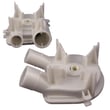
- Washer drain pump WP3363394 if the washer will not drain
- Washer water inlet valve WP8578343 if it will not fill correctly
- Lid (white) WP3398848 if the lid is damaged or will not close properly
Quick tips to avoid mix-ups
- Use all digits (do not stop at “110”)
- Match letters and numbers exactly (no spaces)
- If a part looks the same, still confirm by model number before ordering
Last updated: February 2026
How many cubic feet is a Kenmore Model 11027112600 washer?
The exact tub capacity (cubic feet) for Kenmore washer model 11027112600 is typically listed in the specifications section of the product literature; for many Kenmore 110-series top-load, agitator-style washers, capacity commonly falls in the about 3.2 to 3.5 cu. ft. range. For the most accurate figure for your unit, check the 11027112600 owner's manual.
How to confirm capacity for model 11027112600
We recommend using one of these reliable methods:
- Look for a “Capacity” or “Specifications” section in the 11027112600 owner's manual
- Check the model/serial plate under the lid (the manual notes the plate location under the lid)
- Compare your washer’s basket size to typical “standard” vs “super capacity” top-load baskets
- If you are measuring: measure the inside tub diameter and depth to the overflow/maximum fill line, then calculate volume
Typical capacity ranges (helpful benchmark)
These ranges help you sanity-check what you find in the manual:
| Washer type (top-load) | Typical capacity range | What you’ll notice |
|---|---|---|
| Standard capacity | ~2.9 to 3.3 cu. ft. | Smaller loads, less bulky bedding |
| Large/super capacity | ~3.4 to 3.8 cu. ft. | More towels/jeans per load |
| Extra-large (newer designs) | ~4.0+ cu. ft. | Often different platform/features |
Why it matters
Capacity affects how much you can load without poor wash results. Overloading can reduce agitation, increase vibration, and contribute to wear on drive components like the drive block, clutch, and suspension.
Parts that often relate to load size and performance
If your washer struggles with heavy loads (poor agitation, slipping, off-balance), these model-matched parts are commonly involved:
- Agitator dog 80040 (worn dogs can cause weak or one-direction agitation)
- Washer drive block WP389140 (can strip and cause basket/agitator drive issues)
- Clutch washer WP8299642 (can contribute to spin performance problems)
- Washer suspension spring WP63907 (helps control tub movement)
Last updated: February 2026
How to unclog drain hose on Kenmore washer?
To unclog the drain hose on your Kenmore washer model 11027112600, unplug the washer, remove as much water as possible, then disconnect and flush the drain hose and check the drain pump inlet for debris. Reinstall the hose securely so it cannot leak or siphon.
Safety and prep
- Unplug the washer (or switch off the breaker).
- Turn off both water faucets.
- Bail out the tub or use a wet/dry shop vacuum to remove water.
- Keep towels and a shallow pan ready.
- Pull the washer forward carefully to avoid kinking hoses.
Step-by-step: clear the clog
- Check the standpipe or laundry tub first. A slow household drain can look like a washer clog.
- Inspect the external drain hose for kinks, crushing, or a sock lodged near the end.
- Disconnect the drain hose from the washer outlet and drain any remaining water into a pan.
- Flush the hose with hot tap water; push a flexible brush or small drain snake through to remove lint buildup.
- Check the pump inlet and impeller area for coins, hair pins, small socks, or lint clumps.
- Reinstall the hose using the clamp method in the owner's manual; the hose should seat fully against the washer drain connector stop.
If it still will not drain
A clog often sits in the pump housing or the pump can be worn. If flushing the hose does not restore draining, the next common fix is replacing the pump.
- Listen for the pump running during drain.
- If the pump hums but does not move water, check for a jam.
- If the pump is noisy, leaking, or seized, replace it.
Common related part
| Symptom | Most likely area | What to check first |
|---|---|---|
| Won’t drain at all | Pump or blockage | Pump inlet for debris |
| Drains slowly | Hose or household drain | Hose kink, standpipe restriction |
| Leaks during drain | Hose connection/clamp | Hose fully seated and clamped |
If you need the replacement, use the model-matched washer drain pump WP3363394.
Why it matters
A partially clogged drain path can cause long cycle times, poor spin performance, odors, and water left in the basket. Correct hose installation also helps prevent leaks and siphoning (water draining out when it should not).
Last updated: February 2026
How to reset a Kenmore 11027112600 washer?
To reset your Kenmore 11027112600 washer, we use a basic power reset: stop the cycle, remove power for 1 minute, then restore power and restart a cycle. This clears many temporary control interruptions and stuck-cycle conditions.
Reset steps for model 11027112600
- Press Pause/Cancel once to stop the current cycle.
- Unplug the washer (or turn the breaker OFF).
- Wait 60 seconds.
- Restore power (plug in or turn breaker ON).
- Select a cycle and press Start.
- If the washer is still unresponsive, open and close the lid once, then press Start again.
For model-specific cycle and control details, follow the 11027112600 owner's manual.
If the reset does not fix it
A repeat problem after a reset usually points to a specific system (power, lid switch, draining, or drive). Check these items in order:
- Power: confirm the outlet works by testing a lamp or small appliance.
- Lid closure: make sure the lid closes fully and nothing is catching.
- Drain: if water remains in the tub, clear the drain hose and standpipe.
- Load: reduce an oversized load and redistribute items evenly.
- Cycle selection: try a simple Drain/Spin (or Spin) to confirm basic operation.
Symptom guide
| What you see | What it usually means | What to check next |
|---|---|---|
| No response at all | Power issue or control not resetting | Outlet, breaker, power cord seating |
| Fills but will not drain | Drain restriction or weak pump | Hose/standpipe clogs; pump |
| Drains but will not spin | Lid switch or drive issue | Lid closure; drive components |
| Agitates poorly | Worn agitator drive parts | Agitator components |
If the washer will not drain or drains slowly, the washer drain pump WP3363394 is a common fix for this model.
Why it matters
A power reset is the fastest safe way to clear a stalled cycle without disassembly. If the same symptom returns, the pattern (no power, no drain, no spin, weak agitation) helps pinpoint the repair and the correct replacement part.
Last updated: February 2026





