Error Codes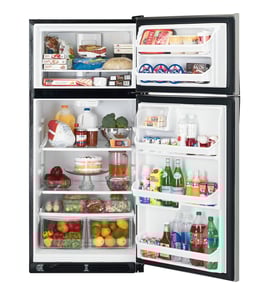




How do I tell what model Kenmore fridge I have?
Your Kenmore refrigerator’s model number is printed on a rating label inside the fresh food section or freezer. On many top-mount units, it’s easiest to spot on an inside wall, along the door frame, behind the crisper drawers, or near the front kickplate area.
Where to look first (fastest checks)
- Inside the refrigerator compartment on a side wall near the top shelf
- On the door frame (open the door and check the vertical frame area)
- Behind or just above the lower crisper drawers (you may need to slide drawers out)
- Inside the freezer compartment on a side wall or back wall
- Near the front base area (kickplate or lower grille area)
What the label looks like and what to write down
The label usually includes several identifiers. For parts lookup, the model number is the most important.
| Label item | What it’s used for | Example format |
|---|---|---|
| Model number | Finds the correct parts diagrams and part list | 106.9710613 or 1069710613 |
| Serial number | Identifies production run and date | Letters and numbers |
| Electrical info | Confirms voltage/amps for service | 115V, amps |
Tips to avoid common mix-ups
- Copy the model number exactly as printed; include all digits and any dots.
- If the label is worn, take a clear photo and zoom in to confirm characters.
- If you’re already on the parts page for Kenmore 1069710613, match your label to 1069710613 before ordering parts.
Why it matters
Kenmore model numbers control which diagrams and parts fit your refrigerator. Even small differences can change items like the ice maker, water valve, or door gasket.
If you need help after you find the model number, our Kenmore 106 model refrigerator error codes guide can also point you toward the right troubleshooting path.
Last updated: February 2026
How many cubic feet is my Kenmore refrigerator by model number?
For Kenmore model 1069710613, the most accurate way to get cubic feet is to read the capacity listed on the refrigerator’s rating plate (usually inside the fresh food compartment). Model numbers don’t reliably encode capacity, so the rating plate is the best source.
Where to find the cubic feet on the refrigerator
Check these common rating plate locations on a Kenmore top-mount refrigerator:
- Inside the fresh food section on a side wall (often upper right)
- On the ceiling of the fresh food compartment near the light
- Behind the crisper drawers on the side liner
- Inside the freezer on a side wall (less common)
What the rating plate will tell you
The rating plate typically lists multiple specs; look for wording like “Capacity”, “Total volume”, or “Cu. Ft.”.
| What you see | What it means | What to do |
|---|---|---|
| “Total capacity” or “Total volume” | Combined refrigerator + freezer space | Use this as your cubic feet |
| Separate “Refrigerator” and “Freezer” volumes | Split capacity by compartment | Add them for total cubic feet |
| Only electrical data (amps/volts) | Not the spec label you need | Check another location inside the cabinet |
If you cannot locate the rating plate
Use these practical alternatives to estimate or confirm capacity:
- Compare your model 1069710613 to similar Kenmore 106 top-mount units; many fall in a typical 14 to 22 cu. ft. range
- Measure interior usable space (approximate): width x depth x height (in inches), then divide by 1,728 to estimate cubic feet
- If you are troubleshooting cooling or airflow issues while you are checking specs, review Kenmore 106 model refrigerator error codes
Why it matters
Knowing cubic feet helps us match the right refrigerator parts and accessories (like an ice maker kit, door gasket, or water inlet valve) and it also helps set expectations for cooling recovery time and food storage layout.
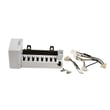
If you are also checking ice production or water supply while identifying your model, the refrigerator ice maker 4317943 is a common replacement part for this Kenmore model family.
Last updated: February 2026
What are the common problems with Kenmore Elite refrigerators?
Common problems we see on Kenmore Elite refrigerators include warm temperatures (cooling failure), ice maker not making ice, water leaks, frost buildup from defrost issues, and doors not sealing well. On Kenmore model 1069710613, these symptoms often trace back to airflow restrictions, defrost components, or ice maker and water-supply parts.
Most common symptoms and what usually causes them
- Not cooling or weak cooling: dirty condenser coils, failed start components, or airflow problems
- Freezer cold but fridge warm: blocked vents, frost-clogged evaporator area (defrost problem)
- Ice maker not working: no water supply, frozen fill tube, failed ice maker assembly or thermostat
- Water leaking: clogged defrost drain, cracked tubing, or a leaking inlet valve
- Door not sealing: torn or warped gasket, door out of alignment
Quick checks you can do first (no special tools)
- Set controls to a normal mid-range setting and give the unit 24 hours to stabilize.
- Make sure food packages are not blocking air vents between the freezer and fresh-food section.
- Clean condenser coils and confirm the condenser fan area is clear of dust.
- Look for a sheet of frost on the freezer back wall (a strong clue of a defrost problem).
- If you have an ice maker, confirm the household shutoff valve is fully open and the supply line is not kinked.
Parts that commonly solve these problems on model 1069710613
| Symptom | Likely part area | Example part for this model |
|---|---|---|
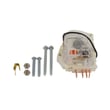
| Frost buildup, fridge warming | Defrost system | Refrigerator defrost bi-metal WP4387503 |
| No ice production | Ice maker system | Refrigerator ice maker 4317943 |
| Water not filling ice maker, leaks at back | Water inlet | Valve 4318047 |
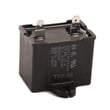
| Clicking, won’t start, intermittent cooling | Start components | Refrigerator compressor start relay 2154436 |
| Door sweating, poor cooling, moisture | Door seal | Refrigerator door gasket 2188460A |
Why it matters
Cooling, ice, and leak complaints often share the same root causes: restricted airflow, a failing defrost system, or a small water-supply issue. Catching those early helps prevent food spoilage, ice buildup, and floor damage.
Helpful DIY reference
If your Kenmore has a display showing an error, use our Kenmore 106 model refrigerator error codes guide to match the code to the most likely failure area.
Last updated: February 2026
What is the average lifespan of a Kenmore Elite refrigerator?
A Kenmore Elite refrigerator typically lasts 10 to 15 years. With steady maintenance (clean condenser coils, good door sealing, and stable temperatures), many units reach the upper end of that range before major sealed-system or compressor-related repairs become more likely.
Typical lifespan and what affects it
Most Kenmore Elite refrigerators fall into the same lifespan range as other modern refrigerators, but these factors make the biggest difference:
- Condenser coil cleanliness (dust buildup raises compressor workload)
- Door gasket condition (air leaks cause longer run times and frost issues)
- Ice maker and water system health (valves, tubing, and ice maker components)
- Room conditions (hot garages and tight clearances shorten life)
- Usage habits (frequent door openings, overpacking, warm food loads)
Maintenance that helps you reach 15 years
These steps reduce strain on the compressor, evaporator fan, and defrost system:
- Vacuum and brush coils every 6 to 12 months
- Keep freezer at 0°F and fresh food at 37°F to 40°F
- Confirm doors close on their own and shelves are not blocking closure
- Replace a torn or warped gasket; see refrigerator door gasket 2188460A
- Address ice maker leaks or slow fills early; the valve 4318047 is a common water-supply control part on many Kenmore 106 models
Quick “repair vs. replace” guide
Use this as a practical decision tool when your Kenmore model 1069710613 starts acting up:
| Situation | Usually worth repairing? | Why |
|---|---|---|
| Minor leak, gasket not sealing, ice maker not working | Yes | Lower-cost parts often restore normal operation |
| Repeated warm temps, compressor won’t start, frequent clicking | Sometimes | Could involve start components or compressor load |
| Sealed-system cooling loss (low refrigerant, restriction) | Often no | Repairs are typically high-cost compared to unit age |
Why it matters
A refrigerator that runs longer to hold temperature uses more energy and wears out key components faster. Fixing airflow, sealing, and water/ice issues early helps your Kenmore Elite stay reliable through its normal service life.
Last updated: February 2026