Owner’s manual
 Error Codes




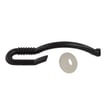
How to remove bottom grille on GE refrigerator?
On the GE GFE28HMHDES bottom-mount refrigerator, the bottom grille (base grille/toe grille) typically comes off by removing any retaining screws (if present) and then pulling the grille straight out to release the clips. This gives you access for cleaning and basic service checks.
Steps to remove the bottom grille
- Unplug the refrigerator (or switch off power at the breaker) for safety.
- Look along the top edge or ends of the grille for Phillips-head screws.
- If you see screws, remove them and set them aside.
- Grip the grille at both ends and pull straight outward; use steady, even pressure to pop the clips free.
- If it feels stuck, slide your hands toward the center and try again; avoid twisting so you do not crack the plastic.
What to check while the grille is off
- Vacuum dust and pet hair from the condenser area (improves cooling efficiency).
- Confirm the grille clips are not broken or missing.
- Make sure the grille is not rubbing the floor (leveling legs may need adjustment).
- Look for signs of water dripping or a puddle under the front of the refrigerator.
Reinstalling the grille
Align the grille tabs/clips with the slots, then push it straight in until it snaps into place. Reinstall any screws you removed.
| What you see | What it usually means | What to do |
|---|---|---|
| Screws holding the grille | Screw-retained grille | Remove screws first, then pull outward |
| No screws, grille won’t budge | Clip tension or debris | Pull evenly at both ends; clean edges |
| Grille won’t sit flush after reinstall | Misaligned tabs or floor contact | Re-seat tabs; check leveling legs |
Why it matters
A clean, properly installed base grille helps airflow across the condenser area, which supports stable temperatures, reduces run time, and can help prevent warm-fridge complaints.
For model-specific illustrations and access points, use the GFE28HMHDES manual.
Related help: how to get rid of refrigerator puddles.
Last updated: January 2026
What is the most common problem with a GE refrigerator?
The most common issue we see on GE refrigerators like model GFE28HMHDES is a cooling problem (fresh food section warm, freezer not holding temp, or temps swinging). In many cases, the root cause is restricted airflow, a defrost system problem, or a control or sensor issue.
Most common causes to check first
- Dirty condenser coil (poor heat release, weak cooling)
- Evaporator fan not running or noisy (air not circulating)
- Frost buildup from a defrost failure (airflow blocked)
- Temperature sensor reading wrong (unit cools inconsistently)
- Control board problem (erratic operation, wrong temps)
- Door not sealing (warm air leaks in, moisture and frost increase)
Quick troubleshooting steps (in order)
- Confirm settings: Set fresh food to about 37°F and freezer to about 0°F.
- Check door seal and door closing: Look for gaps, torn gasket, or bins preventing closure.
- Listen for the evaporator fan: You should typically hear it when the compressor is running.
- Look for frost patterns: Heavy frost on the back wall inside can point to a defrost issue.
- Clean airflow paths: Vacuum dust from vents and around the condenser area.
- Check for error codes: Use the display and reference the GE refrigerator error codes guide.
Common symptom-to-part match
| Symptom | Most likely system | Example part for GFE28HMHDES |
|---|---|---|
| Fresh food warm, freezer OK | Fresh food airflow/evap cover | Refrigerator fresh food evaporator cover assembly WR17X27084 |
| Both sections warm | Sensor/control/compressor start | Refrigerator temperature sensor WR55X10025 |
| Frost buildup, weak airflow | Defrost system | Refrigerator defrost heater WR51X10131 |
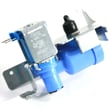
| No ice or slow ice | Water supply/ice maker | Refrigerator water inlet valve WR57X10098 |
Why it matters
Cooling problems usually get worse over time. Catching a simple airflow restriction or a failing defrost component early helps protect food, reduces compressor run time, and can prevent secondary issues like ice buildup and water leaks.
Helpful reference
For model-specific operating details (controls, alarms, and care steps), use the GFE28HMHDES manual.
Last updated: January 2026
How do I find the model number on my GFE28HMHDES?
Your GE refrigerator’s model number is printed on the appliance’s rating label; on the GFE28HMHDES, it’s typically found inside the fresh food compartment along the side wall or near the ceiling. Use that exact model number to match diagrams and order the correct parts.
Where to look on the refrigerator
Check these common label locations first:
- Inside the refrigerator section on the left or right side wall
- On the ceiling area inside the fresh food compartment
- Along the door opening frame (cabinet face) behind the door gasket area
- On the back exterior panel near the bottom (less common)
- Near the crisper drawer frame area (sometimes visible when drawers are removed)
What the label looks like and what to copy
The rating label usually includes the model and serial information. For parts lookup, we recommend copying the model number exactly as printed.
| Label item | What it’s used for | Example for this page |
|---|---|---|
| Model number | Identifies the exact refrigerator version for parts and diagrams | GFE28HMHDES |
| Serial number | Helps identify production details for service history | (varies) |
Tips to avoid ordering the wrong part
Small differences in letters can change the correct water filter, ice maker, or control board.
- Write the model number exactly, including any letters
- Take a clear photo of the label before you start a repair
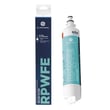
- Match the model number to the parts list before ordering items like the GE refrigerator water filter RPWFE
- If you are troubleshooting, use the model number to reference the GFE28HMHDES owner’s manual
Why it matters
GE refrigerators often have multiple revisions that look identical but use different components (for example, an ice maker assembly, water inlet valve, or electronic control board). Using the correct model number keeps the part fit and electrical connections correct.
Last updated: March 2026