Installation guide
 Owner’s manual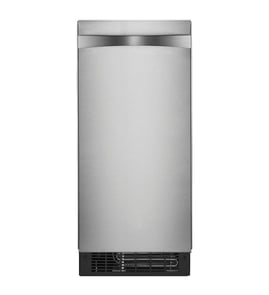








How to reset the ice maker on a KitchenAid refrigerator?
For the KitchenAid KUIX305ESS2 freestanding ice maker, the practical “reset” is restarting the control: press ON/OFF to stop operation, wait about 10 seconds, then press ON/OFF again and allow time for a new cycle to begin (up to 24 hours for first ice after a restart). See the KUIX305ESS2 owner’s manual for control and cycle details.
Quick reset steps (control restart)
- Press ON/OFF once to turn the ice maker off (this stops operation but does not remove power).
- Wait 10 seconds.
- Press ON/OFF again to turn the ice maker on.
- If the bin is full, remove ice so the unit can call for ice.
- If you just installed the unit or restored power, allow 24 hours for the first batch; discard the first 2 batches.
If it still will not make ice after a reset
These checks solve most “no ice” complaints on this style of KitchenAid undercounter ice maker:
- Confirm the unit is plugged into a grounded 3-prong outlet; reset the house breaker if needed.
- Make sure room temperature is above 45°F (7°C); colder rooms can keep the bin thermostat satisfied.
- Check the water supply valve is fully open and the supply line is not kinked.
- If water is not filling correctly, replace the water filter and confirm the filter is seated; use refrigerator water filter F2WC9I1 if your unit uses that filter.
- If the bin has standing water, inspect the drain hose for kinks; on drain-pump models, a weak pump can prevent proper draining.
What “reset” means on KUIX305ESS2 (vs. a refrigerator ice maker)
| Type of ice maker | Typical reset method | What you should expect |
|---|---|---|
| Undercounter/freestanding (KUIX305ESS2) | ON/OFF control restart | Unit resumes its normal freeze and harvest cycles |
| Refrigerator in-door/freezer ice maker | Often a test/reset button or arm switch | A forced harvest or diagnostic cycle |
Why it matters
A control restart clears minor logic hiccups, but ice production still depends on water flow, proper draining, and room temperature. Fixing those basics prevents thin ice, no ice, and frequent shutoffs.
Last updated: February 2026
Why is my KitchenAid ice maker not producing ice?
If your KitchenAid KUIX305ESS2 runs but makes no ice, the most common causes are the control being off, the water supply being closed, or the water filter not being fully locked in. This model also reduces or stops production when room temperature is too low or too high.
Quick checks (most fixes)
- Press ON/OFF to confirm ice production is turned on (power still stays to the unit even when OFF).
- Verify the household water supply valve is fully open and the supply line is not kinked.
- Reseat the filter; if it is not locked into the housing, the ice maker will not produce ice.
- Tighten the drain cap; a loose cap can empty the water pan and cause thin ice or no ice.
- Confirm the drain tube and drain line are clear and not kinked.
- Allow time after setup; plan on up to 24 hours for the first batch, and discard the first 2 batches.
Water filter issues (very common on this model)
The KUIX305ESS2 filter sits in the control area; it must align with the housing notch and be turned clockwise until it locks. If the filter is even slightly mis-seated, water flow can be blocked and ice production stops.
Use these parts and references:
Temperature and airflow conditions that reduce ice
Higher room and water temperatures reduce how much ice this unit can make and store. Also, lint or dirt blocking condenser airflow can cut production.
| Condition | What you’ll notice | What to do |
|---|---|---|
| Room below about 45°F | Unit may shut off early | Warm the space; restart ice maker |
| Room above about 90°F | Slow or low production | Improve ventilation; reduce room heat |
| Dirty condenser area | Low output over time | Clean lint and dust from airflow path |
Why it matters
This freestanding ice maker drains mineral-heavy water after each freeze cycle and refills for the next cycle. If water cannot enter (filter/valve/supply) or cannot stay in the pan (drain cap/drain issues), the freeze cycle cannot form cubes.
Last updated: February 2026
How to fix E2 error code on ice maker?
On the KitchenAid KUIX305ESS2 freestanding ice maker, an E2 code is typically cleared by correcting the condition that stops normal water flow or circulation, then power-cycling the unit. Start with the basics: confirm the control is ON, water supply is ON, and the drain system is not restricting operation; then follow the reset steps in the KUIX305ESS2 owner’s manual.
Quick checks that fix most E2 situations
- Unplug the ice maker (or switch off the breaker) for 1 minute, then restore power.
- Verify the water supply valve to the ice maker is fully open.
- Check the inlet water line for kinks or pinches behind the cabinet.
- Make sure the drain cap is tight; a loose cap can cause thin ice or no ice.
- If your unit has a drain pump, check the drain hose for kinks, pinches, or damage.
- Clean the condenser if airflow is restricted (lint and dust reduce capacity and can lead to overheating).
Water filter and water flow (common cause)
If the filter is not seated and locked, the ice maker may not produce ice. Remove and reinstall the filter so it locks in place, or replace it if it is due.
| What you see | What it points to | What to do |
|---|---|---|
| Runs but no ice | Water supply/filter issue | Confirm supply ON; reseat or replace filter |
| Very little ice | Airflow or high room temp | Clean condenser; keep room above 45°F and below 90°F |
| Water not clearing | Drain restriction | Straighten drain hose; clean drain tube |
Recommended replacement if you are due for a filter: refrigerator water filter F2WC9I1.
Why it matters
E2-style faults are often triggered by conditions that prevent steady water movement through the reservoir and drain path. Fixing kinks, a loose drain cap, or a misinstalled filter restores normal ice thickness and protects components like the recirculation pump and drain pump.
Last updated: February 2026
Are home ice makers worth it?
Yes, a home ice maker is worth it when you use a lot of ice or entertain often because it delivers steady, automatic ice production without trays or frequent store runs; for lighter use, the added space, electricity, and routine cleaning can outweigh the convenience, especially with a freestanding unit like KitchenAid model KUIX305ESS2.
When a freestanding ice maker is a good buy
- You go through multiple drinks per day and want ice always ready.
- You host regularly and need consistent ice volume.
- You prefer clearer, more uniform ice than trays.
- You want a dedicated bin with an ice level sensor monitoring fill.
- You have a proper water supply connection and a drain setup.
What you are signing up for (real-world ownership)
KitchenAid KUIX305ESS2 is designed to run in cycles at preset temperatures and it rinses itself for about 5 minutes at startup. To keep performance high, the ice making system and the air-cooled condenser need regular cleaning; this helps prevent reduced output and premature component wear (details are in the KUIX305ESS2 owner’s manual).
Typical pros vs cons
| Factor | Dedicated freestanding ice maker | Trays or bagged ice |
|---|---|---|
| Convenience | Automatic, always available | Manual refills or store trips |
| Output consistency | High when maintained | Varies |
| Maintenance | Cleaning, filter checks, occasional parts | Minimal |
| Space and install | Needs cabinet space, water, drain | Little to none |
Costs and maintenance that affect “worth it”
- Cleaning time: scale and airflow restrictions reduce ice production.
- Water quality: a clogged or misinstalled filter can cut output; use the correct refrigerator water filter F2WC9I1 when your setup calls for it.
- Common performance killers: kinked drain line, loose drain cap, dirty condenser, room temps above about 90°F.
- Repairability: key service parts (pump, valve, control board) are replaceable if needed.
Why it matters
“Ice maker worth it” usually comes down to reliability over time. With KUIX305ESS2, routine cleaning and correct water and drain conditions are what keep ice production steady and prevent the “runs but makes little or no ice” situation described in the troubleshooting guidance.
Last updated: February 2026