Installation guide
 Owner’s manual
 Error Codes

Does my Kenmore top load washer have a filter?
Yes, Kenmore top load washer model 11028732700 uses a drain pump system and does not have a customer-cleanable lint filter like many front-load washers. For this design, we focus on keeping the drain path clear and the load balanced to prevent drain and spin problems; see the 11028732700 owner's manual.
What to check first (no “filter” required)
- Make sure the lid fully closes; the washer will not spin with the lid open.
- Confirm the drain hose is installed correctly and not sealed into the standpipe (it needs an air gap).
- Verify the top of the drain hose is at least 39 in. (99 cm) above the floor.
- Check the household drain or laundry tub for slow draining or clogs.
- Avoid overloading; loads should move freely for proper draining and spinning.
Where clogs usually happen on this washer
Most “filter” symptoms on a top-load Kenmore like 11028732700 come from restrictions in the drain system.
| Area to inspect | What you might notice | Common fix |
|---|---|---|
| Drain hose | Slow drain, backing up | Reposition hose, clear kink, keep air gap |
| Pump inlet/outlet | Hums but won’t drain | Clear debris, replace pump if damaged |
| Household plumbing | Water backs up at standpipe/tub | Clear the drainpipe or tub trap |
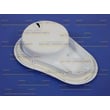
If you suspect the pump is blocked or failing, the replacement part for this model is the washer drain pump WP3363394.
Why it matters
When the drain path is restricted, the washer can stall during drain, leave water in the tub, or fail to spin out water. Keeping the drain hose and pump area clear solves the same problem a “filter cleaning” would on other washer styles.
Last updated: February 2026
How to do a hard reset on a Kenmore washer?
For Kenmore washer model 11028732700, a hard reset is a simple power reset: unplug the washer (or switch off the breaker) for 1 minute, then restore power and restart the cycle. This clears minor control glitches and stuck cycle behavior; use the steps in the 11028732700 owner's manual for model-specific control details.
Hard reset steps (power reset)
- Press the cycle control knob in to stop the washer.
- Unplug the power cord (or turn the laundry breaker off).
- Wait 60 seconds.
- Restore power.
- Close the lid, select a cycle, then pull the cycle control knob out to start.
If the washer still will not start or stops mid-cycle
These checks fix the most common “looks dead” or “won’t spin” situations on this style of Kenmore top-load washer.
- Confirm the lid is fully closed; many cycles will not run with an open lid.
- Push the cycle control knob in, then pull it out again to restart.
- If the washer drains but will not spin, check for a load that is off-balance.
- If you suspect a lid-sensing problem, inspect the washer lid switch assembly WP8318084.
- If the motor runs but the washer will not agitate or spin, a worn coupling 285753A is a common cause.
Quick symptom-to-next-step guide
| What you see | What it usually means | What to do next |
|---|---|---|
| No response at all | Power interruption or control stuck | Do the 1-minute hard reset; verify outlet/breaker |
| Fills but will not agitate | Drive system not transferring motion | Check coupling and agitator components |
| Drains but will not spin | Lid sensing or out-of-balance | Rebalance load; check lid switch |
| Hums or gurgles while draining | Normal drain pump sound | Let it finish draining; check for slow drain only if water remains |
Why it matters
A hard reset is the fastest way to clear a temporary control “hang” without replacing parts. If the problem returns right away, the symptom pattern (no start, no spin, no agitate, drain issues) points to the next most likely part or adjustment.
Last updated: February 2026
How to identify a Kenmore washer model?
For Kenmore washer model 11028732700, the model and serial number label is located under the washer lid. Use that full model number when ordering replacement parts or looking up troubleshooting steps in the 11028732700 owner's manual.
Where to look on the washer
On this Kenmore top-load design, lift the lid and check the underside area around the opening for the model/serial label.
- Lift the washer lid fully and look under the lid area first
- Write down the complete model number and serial number exactly as shown
- Take a clear photo of the label for future reference
- Use the model number to match parts like the lid switch, drain pump, or motor coupling
- Keep the information with your purchase date for service records
What the model number looks like
Kenmore model numbers often start with 110. and may be shown with or without the dot.
| On the label | What it means | Example |
|---|---|---|
| Model number | Identifies the exact washer design | 11028732700 (may appear as 110.28732700) |
| Serial number | Identifies your specific unit | Varies by unit |
| Purchase date | Helps with records and maintenance | Your date |
Why it matters
Kenmore washers can look similar across many series, but parts and procedures can differ by model. Using the exact model number helps us match the correct diagrams and parts the first time.
If you are ordering common wear items for this model, examples include the washer lid switch assembly WP8318084 or the washer drain pump WP3363394.
Last updated: February 2026
What is the capacity of Kenmore model 11028732700?
The Kenmore washer model 11028732700 has a 3.2 cu. ft. wash basket capacity, which is the usable space inside the tub for clothing and water. For cycle-by-cycle loading guidance and fabric recommendations, use the 11028732700 owner's manual.
What 3.2 cu. ft. means for everyday loads
A 3.2 cu. ft. top-load washer is a mid-size capacity that handles typical household laundry without needing oversized loads.
- Everyday mixed load: about 2 to 3 baskets of clothes
- Towels/jeans: fewer items per load to keep agitation strong
- Bulky items: wash one large item at a time (comforter, heavy blanket)
- Best results: items should move freely during the wash
Quick loading guide (practical sizing)
Use this as a simple rule-of-thumb for a 3.2 cu. ft. Kenmore top-load washer.
| Load type | Typical fill level | Notes |
|---|---|---|
| Light/small | 1/3 full | Best for delicates and quick washes |
| Medium | 1/2 full | Most day-to-day loads |
| Large | 2/3 full | Avoid packing; allow movement |
| Extra-large/bulky | 1 item at a time | Prevents imbalance and poor cleaning |
Why it matters
Capacity affects cleaning and wear: overloading reduces agitation, can leave detergent residue, and increases out-of-balance spinning. Keeping loads loose also helps protect drive components like the coupling 285753A and reduces strain on the suspension.
Tips to get the best performance from this washer
- Load items loosely, not pressed down
- Mix large and small items to balance the basket
- Use the right water level for the load size
- If the washer shakes, stop and redistribute the load
- Replace inlet hoses every 5 years as part of routine care (per the manual)
Last updated: February 2026
What is the life expectancy of a Kenmore washer?
A Kenmore washer typically lasts 10 to 12 years with normal household use and basic maintenance. For your Kenmore model 11028732700, following the care and operating guidance in the 11028732700 owner's manual helps you get the longest, most reliable service life.
What affects washer lifespan most
- Load size and balance: loads should move freely and stay balanced to reduce strain on the drive system.
- Routine care: cleaning and basic upkeep prevent avoidable wear.
- Installation conditions: a level, sturdy floor and proper hookups reduce vibration and stress.
- Operating environment: avoid freezing conditions; water left inside can cause damage.
- Wear items: some components are designed to wear over time (for example, couplers, clutches, pumps).
Quick maintenance checklist (high impact)
- Keep loads balanced and avoid overloading.
- Use the correct amount of detergent and additives.
- Periodically inspect hoses for bulges, cracking, or leaks.
- If you notice slow or no draining, check for pump or drain restrictions.
- If agitation becomes weak or inconsistent, inspect common agitator wear parts.
Common wear parts and what they usually cause
| Symptom | Commonly involved part | What you may notice |
|---|---|---|
| Won’t drain or drains slowly | Washer drain pump WP3363394 | Water left in tub, humming, intermittent draining |
| Won’t spin or agitates poorly | Coupling 285753A | Motor runs but tub does not move normally |
| Agitator “ratchets” or won’t move clothes well | Agitator dog 80040 | Top of agitator slips, poor rollover |
Why it matters
A washer that is overloaded, unlevel, or run in poor conditions wears out the drive components faster and can develop leaks, vibration, and draining problems. Keeping the washer stable, using proper load habits, and replacing wear parts early typically extends the usable life.
Last updated: February 2026