Installation guide
 Owner’s manual
 Error Codes


How do I know if my Kenmore dryer thermal fuse is blown?
On the Kenmore gas dryer model 11076002011, a blown thermal fuse commonly shows up as a dryer that will not start or runs but won’t heat. The sure way to confirm is to unplug the dryer and test the fuse for continuity with a multimeter, following the safety steps in the 11076002011 installation guide.
Common symptoms you can check first
- Dryer will not start even though the door is closed
- Motor hums but drum does not tumble (varies by failure and model design)
- Dryer tumbles but there is no heat (gas burner never lights)
- Cycle stops early or seems to run with weak airflow (often a venting issue that can lead to fuse failure)
- Burning smell or very hot cabinet (stop using the dryer and correct airflow problems)
How we test the thermal fuse (basic continuity check)
- Disconnect power: Unplug from a grounded outlet (do not use an extension cord).
- Access the thermal fuse (location varies; typically on the blower housing or exhaust duct).
- Remove at least one wire from the fuse terminal.
- Set a multimeter to continuity or lowest ohms.
- Probe the fuse terminals.
Interpreting the meter
| Meter result | What it means | What to do next |
|---|---|---|
| Beep or near 0 Ω | Fuse is good | Keep troubleshooting (door switch, motor circuit, gas heat system) |
| No beep or OL | Fuse is blown | Replace the fuse and fix the airflow cause |
Why it matters (and what usually causes it)
A thermal fuse is a one-time safety device; it opens when the dryer overheats. Overheating is most often caused by restricted airflow, such as a clogged lint screen, crushed vent, or blocked exterior vent hood. The installation checklist for this dryer also stresses making sure the vent is not crushed or kinked and verifying heat after startup.
Related quick checks for “won’t start” complaints
- Confirm the dryer is plugged into a grounded 3-prong outlet
- Check the house fuse or circuit breaker
- Make sure the door fully closes; a failed door switch can prevent starting (see dryer door switch WP3406107)
- If it runs but won’t heat, confirm the gas shutoff valve is open
Last updated: February 2026
How do I know what model my Kenmore dryer is?
Your Kenmore dryer’s model number is printed on the model and serial rating plate. On Kenmore gas dryers like model 11076002011, that plate is typically in the door opening (door well). Once you have the full model number, we can match the correct parts and documentation.
Where to look for the model number
Check these common locations on Kenmore dryers:
- Inside the dryer door opening on the door well (most common)
- On the back panel of the dryer cabinet
- Along the door frame area near the latch
- On the lower front area behind the toe panel (on some designs)
For this model, the installation literature references the rating plate in the door well; see the 11076002011 installation guide.
What the model number looks like (and why it matters)
A Kenmore model number is a full string of numbers (sometimes with a dot on some Kenmore formats). Use the entire model number exactly as shown on the plate.
Why it matters
- Ensures you get the right fit for parts like a door switch, drum support roller, or igniter
- Helps confirm gas type and burner information shown on the rating plate
- Prevents ordering look-alike parts that do not match your exact series
Quick checklist before you order parts
Use this checklist to avoid mix-ups:
- Write down the model number and serial number from the same plate
- Take a clear photo of the plate for reference
- Match the model number exactly (all digits, no spaces)
- Use the model number to select parts, then verify the part name and ID
Common examples of parts you can match by model
Here are a few parts on this Kenmore 11076002011 gas dryer page that depend on the correct model match:
| Part type | Example part on this model page | What it affects |
|---|---|---|
| Door safety switch | Dryer door switch WP3406107 | Dryer starts and runs only with door closed |
| Drum support | Dryer drum support roller WPW10314173 | Squealing, thumping, drum support |
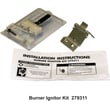
| Gas ignition | Igniter 279311 | No-heat symptoms on gas cycles |
If the label is hard to read
- Wipe the plate gently with a damp cloth and mild soap; dry it fully
- Use your phone camera zoom and good lighting
- Copy the characters exactly as printed
Last updated: February 2026
How much does it cost to replace a heating element in a Kenmore dryer?
For the Kenmore gas dryer model 11076002011, you typically do not replace an electric heating element; heat is produced by a gas burner assembly. Most “no heat” repairs on this model run about $30 to $350 total, depending on which gas-heat part failed and whether you hire service.
What you’ll usually pay (parts vs. labor)
Gas dryers commonly need an igniter, sensor, or valve related part rather than a heating element.
- DIY parts cost (common range): $25 to $250
- Professional labor (typical): $100 to $250
- Service call/diagnostic (often): $75 to $150 (may be applied to repair)
- Total typical repair: $150 to $350
| Repair scenario | Typical parts cost | Typical total cost |
|---|---|---|
| Simple “no heat” fix (ignition/sensing) | $25 to $60 | $150 to $300 |
| Gas valve related repair | $150 to $250 | $250 to $450 |
| Multiple wear items addressed at once | $40 to $100 | $200 to $400 |
Quick checks before you buy parts
Follow the heat-check procedure in the installation guide. If the dryer runs but doesn’t heat:
- Run the dryer for 5 minutes, then open the door and feel for heat
- Confirm the gas shutoff valve is fully open
- Make sure the door fully closes and the house fuse/breaker is OK
- Clean lint from the lint screen and verify airflow is strong at the vent outlet
- If gas is on and there’s still no heat, plan on diagnosing the burner system
Parts that commonly affect heat on this model
These are model-compatible parts we stock that often resolve “no heat” symptoms:
- Igniter 279311 (burner ignition)
- Dryer radiant sensor WP338906 (flame sensing)
- Gas valve WPW10118347 (gas flow control)
- Dryer thermistor WP8577274 (temperature sensing)
Why it matters
Pricing varies because “replace the heating element” can mean very different things on a gas dryer. Correctly identifying the failed burner component prevents repeat breakdowns and helps restore safe, consistent drying performance.
Last updated: February 2026