Installation guide
 Owner’s manual


Where to find part number on GE dryer?
On your GE dryer model GFD45GSSM1WW, the model and serial tag (which you will use to match the correct replacement part number) is typically located on the inside of the dryer door opening or on the door frame. Confirm the exact tag location and labeling details in the GFD45GSSM1WW owner's manual.
What to look for on the label
The tag usually includes several identifiers; the most useful ones for ordering parts are:
- Model number (use this to ensure parts fit your exact dryer)
- Serial number (helps confirm production series and compatible revisions)
- Electrical ratings (volts/amps; helpful for diagnosing power issues)
- Gas information (on gas models; helpful for burner and valve parts)
- Manufacturing date code (sometimes shown; useful for cross-referencing)
Quick steps to find it
- Open the dryer door.
- Check the door frame first (around the opening).
- Check the inside edge of the door next.
- Wipe dust off the sticker so all characters are readable.
- Write the model and serial numbers exactly as shown.
Why it matters when ordering parts
GE often uses similar-looking parts across multiple dryer series. Using the model tag prevents ordering a part that looks right but does not match mounting points, wiring connectors, or revisions.
| You have this | Use it for | Example (from this model page) |
|---|---|---|
| Model number | Confirm fit for your dryer | GFD45GSSM1WW |
| Part ID | Find the exact part listing | WE03X29897 |
| Part number | Manufacturer reference | WE12M29 |
Example: how the label helps you pick the right part
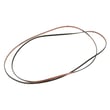
If you are replacing a worn belt, you would match your dryer model first, then select the correct belt listing such as the dryer drum belt WE03X29897.
Last updated: February 2026
Where is my thermal fuse located on my GE dryer?
On the GE GFD45GSSM1WW dryer, the thermal fuse is typically mounted on the blower housing or exhaust duct area inside the cabinet, near where air exits the drum. You’ll access it by unplugging the dryer and removing the appropriate panel as shown in the GFD45GSSM1WW installation guide.
Where to look (most common locations)
On GE dryers like the GFD45GSSM1WW, we usually find the thermal fuse in one of these spots:
- On the blower housing (near the lint duct path)
- On the exhaust duct inside the cabinet
- Near the outlet thermistor/thermostat area (components clustered on the air outlet path)
- Behind a rear access panel or after removing the front panel, depending on the design
Safe access steps (before you remove panels)
Follow these basics before checking the fuse:
- Turn off the breaker (30 amp) or remove the dryer’s circuit fuse
- Unplug the dryer from the wall receptacle
- Pull the dryer out enough to work safely and avoid stressing the gas line (gas model)
- Remove the panel needed for access (rear or front, depending on your configuration)
- Keep track of screws and reinstall all covers before operating
For panel removal guidance and electrical safety notes, use the GFD45GSSM1WW installation guide.
Quick diagnostic: what the thermal fuse does
A thermal fuse is a one-time safety device. If it blows, the dryer often won’t run at all (or may run with no heat on some designs). It usually blows because of restricted airflow.
Common causes to correct at the same time
- Clogged lint screen or lint screen housing
- Crushed, kinked, or overly long vent duct
- Blocked exterior vent hood flap
- Lint buildup in the internal ducting or blower area
What to check while you’re in there
These airflow and temperature-related parts are often inspected together:
| What you’re checking | Why it matters |
|---|---|
| Exhaust duct and hood | Restrictions overheat the heater/burner area |
| Blower housing area | Lint buildup reduces airflow |
| Thermistor(s) | Bad sensing can cause poor temperature control |
If you’re troubleshooting heat or temperature issues, the dryer heating element control thermistor WE4M398 is one of the model-listed temperature sensing parts.
Why it matters
Finding the fuse is only half the fix. If you replace a blown thermal fuse without correcting the airflow restriction, the replacement commonly fails again and drying times get worse.
Last updated: February 2026
How to replace GE dryer sensor?
On the GE GFD45GSSM1WW dryer, “sensor” usually means the moisture sensor bars (dryness sensing) or a temperature sensor (thermistor). Replacement is a panel-off repair; we follow the disassembly steps and wiring diagram in the GFD45GSSM1WW owner’s manual and disconnect power before servicing.
Before you start (safety and prep)
- Unplug the dryer (or switch off the breaker) before removing any panels.
- For gas models, shut off the gas supply valve before opening the cabinet.
- Take a photo of wire connections before you remove the sensor.
- Label connectors so they go back on the same terminals.
- Use work gloves; sheet metal edges inside the dryer are sharp.
Which “sensor” are you replacing?
Use this quick check so you buy and replace the right part.
| What you notice | Most likely part | Where it is | Common symptom |
|---|---|---|---|
| Clothes stop early or stay damp on Auto cycles | Moisture sensor | Inside drum area near lint duct/front bulkhead | “Dry” too soon, inconsistent drying |
| Dryer runs but heat is erratic or shuts off | Thermistor (temperature sensor) | On/near blower housing or heater/burner ducting | Overheats, no heat, long dry times |
If your dryer is showing a fault code, we use the GE gfd model series error codes guide to identify whether the code points to a moisture sensor circuit or a thermistor circuit.
General replacement steps (most GE dryers)
- Disconnect power (and gas if applicable).
- Remove the top and/or control console as shown in the manual; GE often stores the wiring diagram in the control console.
- Remove the front panel or lower access panel to reach the sensor location.
- Disconnect the sensor wire harness.
- Remove mounting screws or release locking tabs; swap in the new sensor.
- Reconnect wiring, reassemble panels, restore power (and gas), then test a timed cycle and an auto cycle.
Why it matters
A failed moisture sensor or thermistor can cause long dry times, overheating, or cycles that end too soon. Fixing the correct sensor helps the GFD45GSSM1WW dry efficiently and protects components like the drum belt and blower system.
Last updated: February 2026