 Installation guide
 Owner’s manual


Where to find model number on a Frigidaire washer?
On the Frigidaire FAFW3001LW4 front-load washer, the model and serial number label is typically on the door opening area; open the washer door and look around the inner door frame and front panel opening for the sticker or metal tag. Confirm the exact label location in the FAFW3001LW4 installation guide.
- Inner door frame (around the opening where the door seals)
- Front cabinet lip just inside the opening
- Along the hinge side of the opening
- Along the latch side of the opening
- Behind the door boot (bellow) edge if the label is slightly tucked back
The tag usually includes both identifiers. Record them exactly as shown.
| Item | What it’s used for | Example format |
|---|---|---|
| Model number | Matching parts and diagrams | FAFW3001LW4 |
| Serial number | Manufacturing date and service history | Letters and numbers |
- Wipe the door opening area with a damp cloth; detergent film can hide the print
- Use a flashlight and look from the side; labels can be on the cabinet lip
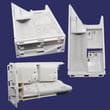
- Check for a technical sheet location: a wiring diagram and tech data sheet are commonly stored under the top panel near the detergent dispenser housing (helpful for service information)
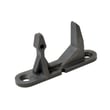
Using the exact model number (FAFW3001LW4) prevents ordering the wrong Frigidaire washer parts such as a washer door lock assembly 131763256 or a water inlet valve, which can vary by revision.
Last updated: February 2026
What is the error code E4 on a Frigidaire washing machine?
On a Frigidaire washer, error code E4 means the washer is out of balance during the spin cycle. On your FAFW3001LW4, the fix is usually to redistribute the load and make sure the washer is level and stable.
- Press Pause/Cancel, then wait for the drum to stop.
- Redistribute the load; mix large and small items (avoid washing one bulky item by itself).
- Remove a few items if the drum is tightly packed.
- Run Drain/Spin (or a spin cycle) again.
- If the load is a single heavy item (blanket, rug), use a lower spin option.
An E4 imbalance code is usually caused by load or installation conditions.
| What you notice | Most likely cause | What we recommend |
|---|---|---|
| Washer bangs or “walks” during spin | Washer not level or not stable | Level the legs and re-check stability |
| E4 happens with bulky items | Load cannot balance at high RPM | Reduce spin speed, add a few towels |
| E4 happens often with normal loads | Installation or suspension issue | Confirm shipping hardware was removed; inspect for loose parts |
From the FAFW3001LW4 setup steps, excessive noise and vibration are prevented by properly leveling the washer and confirming it is stable corner-to-corner.
- Place a level on top of the washer; level front-to-rear and side-to-side.
- Press down on alternate corners; adjust legs until there is no rocking.
- Confirm all shipping bolts/spacers were removed (they must be removed for normal operation).
- Keep the washer within its supported installation conditions and re-check after moving.
For the exact leveling and shipping-hardware steps, follow the installation guide.
Running out of balance can trigger repeated stops, poor spin-out (wetter clothes), and extra vibration that loosens fasteners over time. Correct loading and leveling restores normal spin performance and reduces wear.
Last updated: February 2026
Is Frigidaire a good brand for washers?
Frigidaire is a good brand choice for many washer shoppers because it typically delivers solid everyday cleaning performance and practical features at a reasonable price. For the Frigidaire FAFW3001LW4 washer, long-term results depend most on correct installation, leveling, and routine maintenance.
We judge washer brands on a few real-world factors that affect ownership, not just features.
- Cleaning and rinsing performance for normal loads
- Reliability of high-wear parts (door lock, drain pump, inlet valve)
- Ease of service (access to tech sheet, common repairs)
- Operating noise and vibration when properly leveled
- Parts availability over the life of the washer
Front-load washers are sensitive to setup. The installation instructions for this model emphasize removing shipping hardware and leveling to prevent excessive noise and vibration.
- Remove and save all shipping bolts/spacers before use
- Install the hole plugs in the rear panel after removing shipping hardware
- Level the washer front-to-rear and side-to-side; confirm it is stable corner-to-corner
- Run a complete cycle after install and check for leaks
- Keep the door area clean and dry to reduce odor and residue buildup
Reference: FAFW3001LW4 installation guide
If performance issues show up later, these parts are frequent culprits on front-load washers.
| Symptom | Often related to | Example part for FAFW3001LW4 |
|---|---|---|
| Door will not lock or start | Door lock assembly | Washer door lock assembly 131763256 |
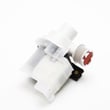
| Won’t drain, water left in tub | Drain pump | Water pump 137221600 |
| Leaks at the door opening | Door boot (bellow) or clamp | Bellow 137566001 |
A “good brand” is only part of the story. With a front-load washer like the Frigidaire FAFW3001LW4, correct installation and leveling prevent vibration-related wear, and basic upkeep helps avoid odor, residue, and leak complaints.
Last updated: February 2026
Why is my Frigidaire washer leaking from the bottom?
A bottom leak on a Frigidaire FAFW3001LW4 washer usually comes from the drain system (pump, hoses, or a restriction) or from the door boot area letting water run down the cabinet. We start by checking for loose hose connections, then inspect the pump and door boot for drips.
- Unplug the washer and turn off both water supplies.
- Pull the washer forward and look for the first wet spot (front-left often points to the drain pump area).
- Check inlet hose connections at the wall and at the washer; tighten by hand, then about 2/3 turn with pliers (do not overtighten).
- Confirm the drain hose is not shoved too far into the standpipe and that the standpipe height is 24 to 96 inches.
- Run a short rinse and drain while watching underneath with a flashlight.
| Where you see water | Most likely cause | What to inspect |
|---|---|---|
| Front bottom (near door) | Door boot tear or clamp issue | Door boot folds, inner lip, clamp seating |
| Front-left bottom | Drain pump or pump hose leak | Pump body seam, hose clamps, cracks |
| Back bottom | Fill hoses or drain hose leak | Hose washers, kinks, standpipe splash-out |
- If you see dripping during drain or spin, the water pump 137221600 is a top suspect.
- If water tracks down from the door opening area, inspect the door boot; a damaged boot often needs the bellow 137566001.
- If the boot is fine but the retaining ring is loose or popped off, the washer door boot spring clamp 134527100 can be the fix.
A small leak can quickly lead to repeated drain errors, musty odors, and floor damage. Finding the first drip point (not the puddle) prevents replacing the wrong part.
The drain setup matters as much as the washer parts. In the FAFW3001LW4 installation guide, confirm:
- Standpipe can handle high flow (the guide calls out a drain capable of 17 gallons per minute).
- Standpipe diameter is at least 1-1/4 inch.
- Standpipe height stays within the specified range.
Last updated: February 2026


