Owner’s manual


How do I know what model my Kenmore dryer is?
Your Kenmore dryer’s model number is printed on the model and serial number plate. On Kenmore model 11060912990, that plate is on the dryer cabinet (commonly in the door opening area). Record the full model and serial numbers so you can match the correct parts and instructions.
Check these common locations on Kenmore electric dryers like 11060912990:
- Inside the dryer door opening on the cabinet frame
- On the back panel of the dryer cabinet
- Near the lint screen housing area (depending on the exact console and top design)
- On a metal plate or durable label (not a paper sticker)
For the exact plate location and how it’s referenced for service, use the 11060912990 owner's manual.
Kenmore model numbers are long on purpose; each section helps identify the correct design family.
| What you see | What it means | Why you need it |
|---|---|---|
| Model number (example: 11060912990) | Identifies the exact dryer design | Ensures parts like thermostats, fuses, and timers match |
| Serial number | Identifies your specific unit | Helps with production details and service history |
| “110” prefix (common on many Kenmore dryers) | Indicates a specific manufacturing source family | Helps narrow down compatible parts diagrams |
Using the full model number prevents wrong-part returns and speeds up diagnosis.
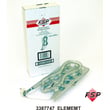
- Heating problems often point to the dryer heating element WP3387747 or temperature controls
- No-heat or no-run symptoms can involve the dryer thermal fuse WP3390719
- Timer and cycle issues can involve the dryer timer WP3976576
- Copy the model number exactly as shown (all digits, no spaces)
- Copy the serial number exactly (letters and numbers)
- Use the model number first, then match the part by name and part ID
Last updated: February 2026
How much does it cost to replace a heating element in a Kenmore dryer?
For Kenmore electric dryer model 11060912990, replacing the heating element typically costs $70 to $110 for the part plus $0 to $250 for labor, so most total repairs land around $100 to $350 depending on who does the work and whether wiring or thermostats also need replacement.
- DIY (parts only): usually $70 to $110
- Service call + labor: commonly $100 to $250 (varies by area and access)
- Total typical range: $100 to $350
- Extra parts sometimes needed: heater wiring, thermal fuse, operating thermostat
| Scenario | What you pay for | Typical total |
|---|---|---|
| DIY replacement | Heating element only | $70 to $110 |
| DIY plus extra safety parts | Element + fuse/thermostat | $90 to $160 |
| Pro repair | Parts + labor | $150 to $350 |
If the dryer overheated or airflow was restricted, the element may fail along with a safety device. These are common related parts for this model:
- Dryer heating element WP3387747
- Dryer thermal fuse WP3390719
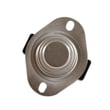
- Dryer operating thermostat WP3387134
- Dryer heating element wire kit 279457
A new heating element can fail early if the dryer is overheating from poor venting or restricted airflow. The manual emphasizes proper exhaust setup and avoiding crushed or kinked venting; fixing airflow issues protects the new element and helps drying performance.
- Confirm the dryer has proper power (electric dryers need full 240V supply to heat).
- Check and clean the lint screen and exhaust duct.
- Use the troubleshooting and safety guidance in the 11060912990 owner's manual.
Last updated: February 2026
What is the average lifespan of 11060912990?
The average lifespan of the Kenmore 11060912990 electric dryer is 13 years. You can often reach (or exceed) that lifespan by keeping airflow strong, cleaning lint regularly, and fixing heat or drum-noise issues early using the maintenance steps in the owner's manual.
A dryer’s life is mostly determined by heat management, airflow, and wear parts (belt support, idler, motor).
- Restricted venting and lint buildup shorten heater and fuse life
- Overloading accelerates drum support and idler wear
- Running with poor airflow increases drying time and operating temperature
- Ignoring squealing or thumping can lead to bigger repairs
The manual emphasizes airflow checks and lint removal; these steps directly reduce overheating and long dry times.
- Clean the lint screen every load; wash the screen residue off periodically
- Inspect the outside exhaust hood for blockage
- Keep the vent run as short and smooth as possible; avoid screws that catch lint
- Disconnect and clean the exhaust vent periodically to remove accumulated lint
- Stop using the dryer if it overheats or shuts off mid-cycle; diagnose before continuing
| Item | Best practice | Why it matters |
|---|---|---|
| Vent material | 4-inch heavy metal vent when possible | Better airflow, less lint trapping |
| Joints | Use clamps, not screws | Screws snag lint and restrict flow |
| Elbows/turns | Fewer 90° turns | Each turn reduces allowable vent length |
If performance drops, these model-compatible parts are common fixes:
- No heat or intermittent heat: dryer thermal fuse WP3390719, dryer heating element WP3387747
- Long dry times with good heat: check venting first; then inspect blower area (lint buildup)
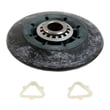
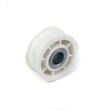
- Squealing or drum not turning smoothly: dryer idler pulley 279640
A dryer that runs hot because of restricted airflow dries slower, wastes energy, and stresses safety devices like thermal fuses. Keeping the venting and lint system clean is the most effective way to protect the heater circuit and extend service life.
Last updated: March 2026