Installation guide
 Owner’s manual
 Error Codes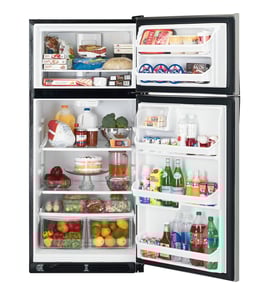



What are the disadvantages of a top mount fridge?
A top-mount refrigerator like the Frigidaire FGHT1832PF2 typically costs less and is simple to maintain, but the main disadvantages are less convenient fresh-food access (more bending), fewer premium storage/organization features, and fewer dispenser options compared with many bottom-freezer designs. For model-specific setup tips, use the FGHT1832PF2 owner's manual.
Common disadvantages (what you will notice day to day)
- Fresh-food items sit lower, so you bend more for produce, drinks, and leftovers.
- Freezer is at eye level, which is convenient for frozen foods but shifts daily-use items lower.
- Organization can be simpler, with fewer built-in dividers, pantry drawers, and specialty zones on many top-mount models.
- Fewer external features are common (for example, many top-mounts do not include an in-door water/ice dispenser).
- Door swing clearance matters; if the hinge side is against a wall, you may need extra space to open the door wider.
Setup details that help reduce the downsides
Proper installation and leveling improves door closing, temperature stability, and day-to-day usability.
- Keep required airflow clearances: 3/8 inch at sides and top, 1 inch at the back.
- Level the cabinet so it is tilted about 1/4 inch front-to-back; this helps doors close freely.
- Do not block the toe grille; airflow is critical for efficient cooling.
- After changing temperature controls, wait 24 hours before making another adjustment.
| Concern | Top-mount impact | What helps most |
|---|---|---|
| Bending for fresh food | Higher | Store daily-use items on upper shelves; keep produce bins organized |
| Door closing/alignment | Can be sensitive | Correct leveling and clearances |
| Feature set | Often simpler | Add bins/organizers; keep airflow paths clear |
Why it matters
When doors seal and close correctly and airflow clearances are maintained, a top-mount refrigerator runs more efficiently and holds steadier temperatures. That reduces frost buildup risk and helps food stay fresh longer.
Last updated: January 2026
Are top mount or bottom mount fridges better?
A top-mount refrigerator like the Frigidaire FGHT1832PF2 is usually the better pick if you want strong efficiency and a simpler, lower-cost design; a bottom-mount is usually better if you want fresh-food items at eye level and less bending. “Better” depends on how you use the refrigerator daily.
Quick comparison (what most homeowners notice)
| Feature | Top-mount (freezer on top) | Bottom-mount (freezer on bottom) |
|---|---|---|
| Fresh-food access | More bending | Less bending, more convenient |
| Energy use | Typically lower | Typically higher |
| Repairs and parts | Often simpler | Often more complex |
| Price | Often lower | Often higher |
When a top-mount is the better choice
- You want a straightforward refrigerator layout with fewer features to maintain.
- You prioritize energy efficiency and steady cooling performance.
- You use the freezer frequently (it is at a comfortable height).
- You want easier installation flexibility; the FGHT1832PF2 installation guidance calls for about 3/8 inch clearance at the sides and top and 1 inch at the back for airflow.
For setup details that affect performance (clearances, leveling, door swing), follow the FGHT1832PF2 owner’s manual.
When a bottom-mount is the better choice
- You use the refrigerator section far more than the freezer and want it at eye level.
- You have back or knee issues and want to reduce bending for everyday items.
- You prefer wider refrigerator drawers and easier access to produce.
Why it matters (performance and daily comfort)
Choosing the right style affects both comfort and food temperature stability. Proper airflow clearances and correct leveling help the compressor maintain temperatures and help doors close reliably, which reduces warm spots, frost, and energy waste.
Last updated: January 2026
Is Frigidaire Professional high end?
Frigidaire Professional is positioned as a premium line within the Frigidaire brand, offering higher-end styling and features than standard Frigidaire models. For your Frigidaire FGHT1832PF2 top-mount refrigerator, “Professional” branding is less relevant than the model’s specific features and performance listed in the FGHT1832PF2 owner's manual.
What “high end” usually means for Frigidaire Professional
In appliance shopping, “high end” typically refers to a mix of performance, materials, and feature set. Frigidaire Professional products commonly emphasize:
- More premium finishes and design details
- Higher-output cooking or cooling performance features (model-dependent)
- More advanced controls and convenience features
- A step up from entry-level lines, without luxury-brand pricing
How to judge your refrigerator model (FGHT1832PF2)
Because refrigerators vary widely by configuration, the best way to decide if your unit feels “high end” is to compare real-world features and ownership factors.
- Temperature stability and recovery after door openings
- Noise level during normal operation
- Storage flexibility (shelves, drawers, door bins)
- Ice maker and water supply setup (if equipped)
- Energy use and day-to-day usability
For model-specific operation details (controls, normal sounds, care/cleaning, and troubleshooting), use the FGHT1832PF2 owner's manual.
Quick comparison: brand tier vs. what you get
| Category | What “premium” usually adds | What to check on FGHT1832PF2 |
|---|---|---|
| Design | Upgraded handles/finishes | Door/handle style and fit |
| Features | More settings and convenience | Control options and storage layout |
| Performance | Better consistency, faster recovery | Temps, airflow, frost control |
| Ownership | Better experience, not always more complex | Noise, maintenance, reliability |
Why it matters
“High end” is subjective; what matters most is whether the refrigerator meets your needs for cooling performance, storage, and maintenance. Using the correct model information prevents buying the wrong accessories or expecting features that are not included.
Last updated: January 2026
What is the most common problem with a Frigidaire refrigerator?
The most common Frigidaire refrigerator issue we see (including on model FGHT1832PF2) is not cooling well, often caused by airflow problems (frost buildup), a failed fan, or a defrost-system fault. Start by confirming the controls are set correctly and the unit has steady power per the FGHT1832PF2 owner’s manual.
Quick checks before replacing parts
- Make sure the refrigerator is plugged in firmly and the outlet has power.
- Confirm the temperature controls are not set to “0” (cooling off).
- Allow 24 hours after any control change for temperatures to stabilize.
- Listen for the evaporator fan running when the compressor is on.
- Check for heavy frost on the freezer back wall (a classic defrost problem sign).
- Verify doors close fully and gaskets seal all the way around.
Most common symptoms and what they usually point to
| Symptom | Most likely cause | What to check first |
|---|---|---|
| Refrigerator warm, freezer also warm | Airflow or sealed-system issue | Condenser fan running, coils clean, compressor running |
| Freezer cold but refrigerator warm | Air damper or evaporator airflow issue | Frost buildup, evaporator fan operation |
| Heavy frost on freezer back wall | Defrost system problem | Heater, defrost thermostat, defrost timer |
| Runs constantly | Poor airflow or warm air leaks | Dirty coils, door gasket gaps, frequent door opening |
Parts that commonly fix “not cooling” and frost buildup
If you find heavy frost or weak airflow, these model-compatible parts are common fixes:
- Refrigerator defrost heater 242044008 (melts frost off the evaporator)
- Refrigerator defrost bi-metal thermostat 5303918634 (controls defrost heater operation)
- Refrigerator defrost timer 215846604 (initiates defrost cycles on timer-controlled systems)
- Refrigerator evaporator fan motor 241854501 (moves cold air through freezer and fresh food section)
Why it matters
A refrigerator that is not cooling correctly can lead to unsafe food temperatures and can also overwork the compressor. Catching airflow and defrost issues early helps restore normal temperatures and reduces strain on major components.
Helpful DIY reference
For display or diagnostic codes on Frigidaire units, use Frigidaire refrigerator error codes.
Last updated: January 2026