
How to find out garage door opener type?
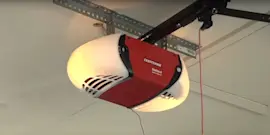
To identify the type of your Craftsman garage door opener model 139664053, check the drive system (chain, belt, or screw) and the motor/control style (AC vs DC) by looking at the rail, trolley, and the opener head label. This quickly tells you what parts and troubleshooting steps fit.
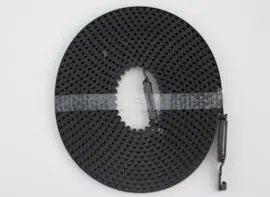
- Look at the rail: a chain is metal links; a belt is a rubber-like reinforced belt.
- Check for a screw drive: a long threaded steel rod running down the rail.
- Read the opener head label: model number, electrical rating, and sometimes “AC” or “DC.”
- Listen and feel: belt drives are typically quieter than chain drives.
- Check the wall control: some Craftsman units use a “smart” wall control that pairs differently than older push-button controls.
| Opener drive type | What it looks like | Common symptoms when worn | Typical maintenance |
|---|---|---|---|
| Chain drive | Metal chain on the rail | Rattling, jerky travel | Tighten chain, inspect sprocket/gear |
| Belt drive | Black/gray belt on the rail | Slipping, squealing, door stops | Inspect belt tension and pulley wear |
| Screw drive | Threaded rod on the rail | Binding, loud grinding | Lubricate screw (if applicable), check carriage |
Many Craftsman troubleshooting steps depend on the control board feedback (blinking lights or diagnostic codes) more than the rail style. Use the diagnostic info first, then confirm the drive type.
- If you see blinking light patterns or a diagnostic code, start with Craftsman error codes.
- If the door reverses, stops short, or won’t close, force and safety sensor checks are usually next.
- If the motor runs but the door doesn’t move, the drive gear/sprocket area is the common inspection point.
Your opener “type” determines which repair steps apply (force settings, travel limits, sensor behavior) and which parts fit (rail components, trolley, drive gear assembly). Identifying it first prevents ordering the wrong components and speeds up diagnosis.
Last updated: February 2026
Can you get a universal remote for an old garage door opener?
Yes. For an older Craftsman garage door opener like model 139664053, you can typically use a universal remote, but compatibility depends on the opener’s radio frequency and “learn” technology. If the opener is too old to pair directly, adding an external receiver is the standard universal fix.
Most “universal” garage door remotes work in one of two ways: they either pair directly to the opener’s learn button, or they pair to an add-on receiver that you wire to the opener.
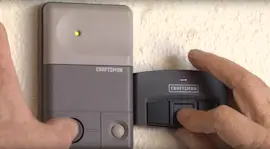
- Check whether your opener has a learn button (usually under the light cover or on the back panel).
- Identify the learn button color (common colors include red/orange, purple, green, or yellow) because it often indicates the radio system.
- Confirm the remote supports your opener’s frequency (many older units use 390 MHz or 315 MHz; some very old units use different frequencies).
- If your opener uses DIP switches (tiny switches in the remote and/or opener), buy a universal remote that supports DIP-switch programming.
- If pairing fails, plan on an external receiver kit plus a compatible remote.
An add-on receiver is the most reliable way to modernize remote control on older openers.
| Situation | Best solution | What you gain |
|---|---|---|
| No learn button and no working original remote | External receiver + new remote | Modern compatibility |
| DIP switches present | Universal DIP-switch remote | Simple setup |
| Learn button present but universal remote will not pair | External receiver | Bypasses radio incompatibility |
- Replace the remote battery and retry programming.
- Stand 3 to 10 feet from the opener when pairing.
- Clear the opener’s memory (if supported) and reprogram remotes.
- Verify the wall control works; if it does not, fix power/control issues first.
- Check for LED bulb interference in the opener light (swap to a standard bulb for testing).
Using the correct pairing method prevents “dead remote” frustration and avoids repeated reprogramming. With older openers, the external receiver approach is often the fastest path to reliable operation.
For programming steps and compatibility tips, use our how to program garage door opener remotes video.
Last updated: February 2026
How to reset garage door opener from previous owner?
To reset a Craftsman garage door opener model 139664053 from a previous owner, we clear the opener’s stored remote codes using the LEARN button on the motor unit, then immediately program only your remotes and keypad. This removes old access and restores control to you.
- Close the garage door and keep people and pets clear of the opening.
- On the motor unit, locate the LEARN button (often near the antenna wire and indicator LED).
- Press and hold LEARN until the indicator light turns off (commonly about 6 to 15 seconds).
- Release the button; the opener memory is cleared.
- Press and release LEARN once (the LED typically turns on or blinks).
- Within about 30 seconds, press the button on the remote you want to use.
- For a keypad, enter your desired PIN and follow the keypad’s program sequence (varies by keypad style).
- Test: run a full open and close cycle using the wall control and each remote.
- Replace the remote battery and try again.
- Stand 3 to 10 feet from the opener when pairing.
- Confirm the wall control works; if not, check power to the opener.
- If the door reverses or won’t close, inspect and align the safety sensors.
- If the opener lights flash a pattern, look up the meaning in Craftsman error codes.
| Item | After reset | What you do next |
|---|---|---|
| Remote controls | Erased | Reprogram each remote |
| Wireless keypad | Usually erased | Reprogram PIN/keypad |
| Travel/force settings | Not typically erased | Adjust only if door won’t fully open/close |
Resetting the memory prevents a previous owner’s remote or keypad code from operating your garage door, which is a key security step when you move into a new home.
Last updated: February 2026
Is it cheaper to repair or replace a garage door opener?
Repairing a Craftsman garage door opener like model 139664053 is usually cheaper when the problem is small (safety sensor alignment, remote issues, loose wiring) and the opener is under 10 to 12 years old. Replacing is typically the better value when the opener is older, unreliable, or the repair total approaches $300 to $500.
Use these checkpoints to decide fast:
- Repair when the door won’t close due to photo-eye sensor issues, minor wiring problems, or a bad remote battery.
- Repair when the opener runs but the door behavior points to force or travel adjustment.
- Replace when the opener has repeated failures (intermittent operation, frequent reversals, random stops).
- Replace when the motor/drive system is noisy, slipping, or the unit struggles to lift a properly balanced door.
- Replace when you want modern upgrades (Wi-Fi control, quieter operation, battery backup).
Costs vary by area, but these ranges are common for garage door opener service decisions:
| Option | Typical total cost | Best when | What you gain |
|---|---|---|---|
| Repair | $100 to $500 | One clear, isolated failure | Lowest short-term cost |
| Replace opener | $200 to $1,000+ | Older unit or multiple issues | Better reliability and newer features |
These checks often identify a low-cost fix before you commit to replacement:
- Watch the opener lights and note any blink patterns; match them to Craftsman error codes.
- Inspect and align the safety sensors; clean the lenses and confirm both LEDs are steady.
- Test the door balance (with the opener disconnected); a heavy door can mimic opener failure.
- Verify the wall control and wiring connections are tight and not pinched.
- If the door reverses or stops, review force/travel adjustment guidance in how to make force adjustments if a garage door wont open or close video.
A garage door opener can look “bad” when the real issue is door balance, sensor alignment, or incorrect force settings. Fixing those first prevents unnecessary replacement and helps protect the opener’s motor and drive components.
Last updated: February 2026
What are the common problems with Craftsman garage door openers?
Common problems on a Craftsman garage door opener like model 139664053 usually fall into three buckets: drive system wear (chain/belt/gear issues), safety sensor problems (misalignment or obstruction), and control or power issues (wall control, remote, logic board). These show up as grinding noises, flashing lights, or a door that reverses or won’t move.
- Door won’t close and opener lights blink: safety sensors blocked, misaligned, or wiring issue.
- Door starts down then reverses: travel/force settings off, binding door, or sensor interruption.
- Grinding or rattling from the motor head: worn drive gear/worm gear, loose sprocket, or dry chain.
- Remote/keypad doesn’t work but wall button does: dead remote battery, lock/vacation mode on, or receiver/logic issue.
- Opener runs but door doesn’t move: broken trolley connection, stripped gear, or door is jammed.
- Intermittent operation: loose wiring at terminals, failing capacitor/board, or overheating motor.
- Clear the photo-eye path and wipe the sensor lenses; confirm both sensor LEDs are steady.
- Test the door by hand (pull emergency release, lift door): it should move smoothly and stay about halfway.
- Inspect the rail and trolley for a loose chain/belt, missing fasteners, or a disengaged trolley.
- Check power and controls: verify outlet power, wall control wiring connections, and lock feature status.
- Review diagnostic flashes to match the symptom to a likely cause using Craftsman error codes.
| Symptom | Most likely cause | Typical fix |
|---|---|---|
| Won’t close, lights blink | Safety sensors | Align sensors, clear obstruction, repair wiring |
| Loud grinding | Stripped gear set | Replace drive gear/worm gear, inspect sprocket |
| Reverses at floor | Force/travel or binding door | Adjust force/travel, service door rollers/springs |
| Remote won’t work | Battery/lock/receiver | Replace battery, disable lock, reprogram remote |
Most “opener problems” are actually safety sensor alignment or a door that is hard to lift. Fixing those first prevents repeated reversals, reduces gear wear, and helps the opener run quieter and last longer.
Last updated: February 2026