Installation guide
 Owner’s manual
 Error Codes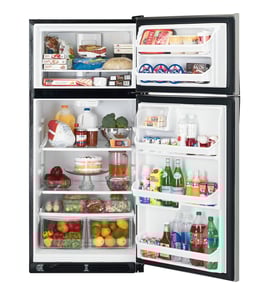


Is a top mount or bottom mount fridge better?
A top-mount refrigerator like the Frigidaire FFHT1814LW4 is usually better if you use the freezer often and want the lowest purchase and repair cost; a bottom-mount is usually better if you use fresh-food items most and want the refrigerator section at eye level.
Quick comparison (what you will notice day to day)
| Feature | Top-mount (freezer on top) | Bottom-mount (freezer on bottom) |
|---|---|---|
| Most-used section | Freezer is easiest to reach | Fresh food is easiest to reach |
| Bending/reaching | More bending for fridge drawers | More bending for freezer drawer |
| Organization | Simple shelves, easy visibility | Freezer drawers can organize better |
| Typical cost to buy/repair | Usually lower | Often higher |
| Best fit for | Frequent freezer users | Frequent fresh-food users |
How to choose for your household
- Pick top-mount if you open the freezer multiple times a day (frozen meals, ice, bulk items).
- Pick bottom-mount if you cook often and want produce, dairy, and leftovers at comfortable height.
- If you have back or knee pain, prioritize the section you access most; that is the section you want higher.
- If you are tight on space, compare door swing and clearances; your installation guide lists clearance needs for proper airflow.
- If you are budget-focused, top-mount designs typically keep ownership costs down over time.
Why it matters
The “better” layout is the one that matches how you load and access food. The wrong configuration can lead to more bending, more door-open time (temperature swings), and less usable storage for the items you actually buy.
Related setup tip for FFHT1814LW4
Whichever style you choose, good door sealing and leveling protect temperature performance. For FFHT1814LW4, the installation checklist calls out making sure the door seals fully and the cabinet is level and slightly tilted back (about 1/4 inch) so doors close properly.
Last updated: February 2026
What are the disadvantages of a top mount fridge?
Top-mount refrigerators like the Frigidaire FFHT1814LW4 are reliable and space-efficient, but the main disadvantages are convenience and organization: fresh-food items sit lower (more bending), freezer access is at eye level (can feel cramped), and premium features like in-door ice and water are less common.
Common drawbacks you may notice
- More bending for daily use: the refrigerator section is below the freezer, so you reach down more often for produce, drinks, and leftovers.
- Less flexible freezer storage: top freezers often have fewer dividers and bins than bottom-freezer designs.
- Fewer built-in dispenser options: many top-mount models do not include external water or ice dispensing.
- Door-swing clearance needs: you may need extra side clearance so doors open fully for drawers and shelves.
- Door seal sensitivity: if the cabinet is not level, doors can close less consistently, which can lead to temperature swings and frost.
What to do if the layout feels inconvenient
We recommend setting up the FFHT1814LW4 to reduce bending and improve access.
- Keep everyday items at mid-shelf height in the fresh-food section.
- Use the crisper for bulk produce and less-frequent items.
- Store heavier frozen items lower in the freezer to reduce lifting overhead.
- Make sure the refrigerator is level and slightly tilted back so doors self-close smoothly.
- Confirm the door seals fully on all sides after any move or leveling adjustment.
Quick setup checklist (from installation guidance)
| Item to check | What “good” looks like | Why it helps |
|---|---|---|
| Leveling | Level side-to-side; slight tilt back | Helps doors close and seal |
| Clearances | Typical guidance is small side/top clearance and about 1 inch behind | Improves airflow and cooling |
| Door seal | Seal contacts cabinet all around | Prevents warm air leaks and frost |
Why it matters
Most “top-mount complaints” come down to ergonomics and airflow. If the doors do not seal well or the unit is not level, you can also see more frost, moisture, or inconsistent temperatures, which makes the design feel worse than it is.
For model-specific setup and leveling steps, follow the installation guide.
Last updated: February 2026
What is the most common problem with Frigidaire refrigerators?
The most common Frigidaire refrigerator problem is a cooling complaint: the fresh-food section runs warm, temperatures swing, or frost builds up because airflow or heat removal is restricted (often coils, fans, or door sealing). For FFHT1814LW4, start with basic airflow, leveling, and control checks in the installation guide.
Most common issues we see (and what to check first)
- Warm refrigerator, freezer OK: restricted airflow, evaporator fan issue, or frost buildup
- Both sections warm: dirty condenser area, condenser fan problem, or compressor not running properly
- Excessive frost in freezer: door not sealing, door left ajar, or defrost system problem
- Noisy operation: fan blade rubbing ice or a failing fan motor
- Water leaks or puddles: defrost drain issues or water line connection leaks (if equipped)
Quick checks for FFHT1814LW4
Use these steps before replacing parts:
- Confirm the refrigerator is level and tilted slightly back (about 1/4 inch) so doors self-close
- Verify door seals contact the cabinet on all sides
- Set temperature controls, then wait 24 hours before making more adjustments
- Make sure the toe grille is installed and vents are not blocked by food packages
- If you have an icemaker, confirm the water supply is connected and not leaking, and the icemaker is ON
Common parts involved (when symptoms match)
| Symptom | Likely area | Example part for this model |
|---|---|---|
| Warm fridge, weak airflow | Evaporator fan system | Refrigerator evaporator fan motor 241854301 or refrigerator evaporator fan blade 5308000010 |
| Frost buildup, poor defrost | Defrost system | Refrigerator defrost heater 242044008 or refrigerator defrost bi-metal thermostat 5303918202 |
| Frost near door, moisture | Door sealing | Refrigerator gasket 242193213 |
Why it matters
Cooling problems usually start small (longer run times, soft ice cream, warm milk) and then turn into food-safety and frost issues. Fixing airflow, leveling, and door sealing early helps the compressor and fans run less and keeps temperatures stable.
Last updated: February 2026
Why is my Frigidaire top mount freezer not freezing?
If your Frigidaire FFHT1814LW4 top-mount freezer is not freezing, the most common causes are incorrect control settings, poor airflow (blocked vents or a failed evaporator fan), or warm air leaking past the door gasket. Set the controls correctly, confirm fans run, and make sure the doors seal tightly.
Quick checks we recommend first
- Confirm the freezer and fresh food controls are set to a normal range; after changing controls, wait 24 hours before adjusting again (this model’s setup guidance calls that out). See the installation guide.
- Make sure the freezer door closes fully and seals to the cabinet on all sides.
- Check for overpacked shelves blocking air vents between the freezer and refrigerator section.
- Listen for the evaporator fan in the freezer; if it is not running, cold air will not circulate.
- Clean dust from the condenser area (dirty coils reduce cooling efficiency).
- Verify the refrigerator is level and slightly tilted back (about 1/4 inch front to back) so doors self-close better.
What the symptoms usually mean
| Symptom | Most likely cause | What to do next |
|---|---|---|
| Freezer warm, fridge also warm | Cooling system not moving heat well | Clean condenser area; check condenser fan operation |
| Freezer warm, fridge still cool-ish | Airflow problem in freezer | Check evaporator fan and frost buildup |
| Frost/ice blanket on freezer back wall | Defrost system issue | Inspect defrost heater and defrost thermostat |
| Ice around door edge, moisture | Door not sealing | Inspect and reshape/replace gasket |
Parts that commonly fix “not freezing” on this model
If your checks point to a failed component, these parts on this model’s parts list are common fixes:
- Refrigerator evaporator fan motor 241854301 (moves cold air through the freezer and into the fresh food section)
- Refrigerator defrost heater 242044008 (melts frost off the evaporator during defrost)
- Refrigerator defrost bi-metal thermostat 5303918202 (helps control defrost heating)
- Refrigerator condenser fan motor 242018301 (cools the condenser and helps the compressor run efficiently)
- Refrigerator gasket 242193213 (helps prevent warm air leaks that stop freezing)
Why it matters
A freezer that cannot reach about 0°F will struggle to keep food safely frozen and can force the compressor to run longer, which increases energy use and can accelerate wear on cooling components.
Last updated: February 2026