Owner’s manual
 Error Codes

How do you put the bottom grill on a GE refrigerator?
On the GE GWE19JGLAFBB bottom-mount refrigerator, the bottom grille (toe grille) typically installs by aligning it with the mounting points along the lower front edge of the cabinet, snapping or sliding it into place, then reinstalling any retaining screws if your version uses them. For the exact attachment points and fastener locations, follow the GWE19JGLAFBB owner's manual.
Steps to reinstall the bottom grille
- Unplug the refrigerator or switch it off at the controls before working near wiring or the condenser fan area.
- Pull the refrigerator slightly forward if needed; avoid rolling over the power cord or water line.
- Align the grille tabs or slots with the openings along the lower front frame.
- Press evenly from one side to the other until the grille seats flush.
- Reinstall any screws (some GE toe grilles use Phillips-head screws at the ends).
- Push the refrigerator straight back into place and re-level if it shifted.
Quick checks if it will not stay on
- Grille not flush: One or more tabs are not fully engaged.
- Gaps at corners: The grille is upside down or shifted left or right.
- Rattling noise: A screw is missing or the grille is not clipped in evenly.
- Hard to align: The refrigerator is not level, or the front leveling legs are too high.
Tools and time
| Task | Typical tools | Typical time |
|---|---|---|
| Reinstall toe grille | Hands, Phillips screwdriver (if screws are used) | 2 to 10 minutes |
| Pull unit forward and re-level | Adjustable wrench | 5 to 15 minutes |
Why it matters
A properly installed bottom grille helps protect components at the base of the refrigerator and supports correct airflow for efficient cooling. If the grille is loose or missing, you can get extra noise, reduced airflow, and easier dust buildup underneath.
Last updated: January 2026
Is GE Cafe considered high end?
Yes. GE Café is GE’s premium line, positioned above standard GE models with upgraded design, finishes, and feature sets. For owners of the GE GWE19JGLAFBB bottom-mount refrigerator, the GWE19JGLAFBB owner’s manual also reflects that GE Café models are grouped with GE Profile as higher-tier offerings.
What “high end” means for GE Café
GE Café is typically considered high end because it focuses on a more premium ownership experience, including:
- More design-forward styling (often with customizable hardware options)
- Feature-rich controls and convenience features (depending on model)
- Higher price positioning than core GE lines
- Premium materials and finishes compared with entry and mid-tier models
- Broader “suite” approach (matching refrigerator, range, dishwasher, etc.)
GE lines at a glance
This is a practical way to think about GE’s lineup when you are comparing appliances:
| GE line | Market position | Typical focus |
|---|---|---|
| GE (standard) | Mainstream | Value, core features |
| GE Profile | Premium | Performance, advanced features |
| GE Café | Premium | Design plus features |
| GE Monogram | Luxury | Built-in, pro-style, highest-end offerings |
Why it matters when you are shopping parts and service
Knowing the product line helps set expectations for features and service coverage. For example, the manual for GE Profile and GE Café models commonly references longer sealed-system coverage (compressor, condenser, evaporator, and connecting tubing) than the basic one-year parts warranty.
Quick tips for owners
- Use your model and serial label to confirm the exact unit before ordering parts.
- Match parts by model number (GWE19JGLAFBB) to avoid fit issues.
- For water and ice performance, replace the filter on schedule; many GE systems call for replacement about every 6 months.
Last updated: January 2026
What is the most common problem with GE Profile refrigerators?
The most common issue we see with GE Profile refrigerators like model GWE19JGLAFBB is a cooling problem: the fresh food section gets warm, the freezer temperature drifts, or temperatures swing. Cooling complaints often trace back to airflow, frost buildup, or a failed sensor or fan; use the GWE19JGLAFBB owner's manual troubleshooting section first.
Most common symptoms customers report
- Refrigerator not cooling or not cold enough
- Freezer cold but refrigerator warm (airflow issue)
- Strange noises (fan noise, rattling, buzzing)
- Ice maker not working or slow ice production
- Water dispenser slow or not dispensing
- Water leaking or puddles under the refrigerator
Quick checks that solve many “not cooling” calls
- Confirm settings: Make sure temperature settings were not bumped.
- Check door sealing and loading: Overpacked shelves can block vents; doors that do not close fully cause warm temps.
- Listen for the evaporator fan: A failed fan can stop cold air from moving into the fresh food section.
- Look for frost buildup: Heavy frost on the back wall of the freezer points to a defrost problem.
- Clean airflow paths: Keep vents clear and allow space around food.
Common causes and the parts that often relate
| Symptom | Likely system | Example part for GWE19JGLAFBB |
|---|---|---|
| Warm refrigerator, freezer OK | Airflow/evaporator fan | Rca refrigerator evaporator fan motor WR60X10185 |
| Temps swing or inaccurate | Temperature sensing | GE profile refrigerator temperature sensor WR55X10025 |
| Frost buildup, warming | Defrost system | Refrigerator defrost bi-metal thermostat WR50X10069 |
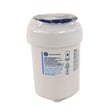
| Slow water, weak ice fill | Water supply/filtration | GE refrigerator water filter MWFP |
Why it matters
A refrigerator that is not cooling correctly can spoil food quickly and can also overwork the compressor. Catching airflow, defrost, or water-supply issues early usually keeps the repair simpler and less expensive.
Helpful DIY guides for GE refrigerators
- GE refrigerator error codes
- How to replace the water filter in a GE refrigerator
- How to fix your evaporator cooling fan
Last updated: January 2026