Installation guide
 Owner’s manual
 Error Codes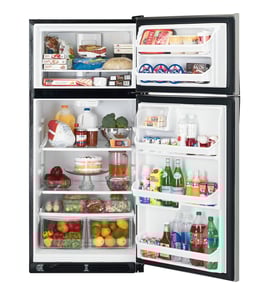

What are the disadvantages of a top mount fridge?
Top-mount refrigerators like the Frigidaire GLRT83TESF are reliable and space-efficient, but the main disadvantages are convenience and features: you bend more to reach fresh food, freezer access is at eye level (which some people dislike), and many models skip premium options like in-door ice and water.
Common disadvantages (what most owners notice)
- Fresh-food section is lower: you reach down more often for everyday items.
- Less “grab-and-go” organization: fewer built-in dividers and specialty drawers than many bottom-freezer designs.
- Fewer dispenser options: many top-mounts do not include an external water or ice dispenser.
- More temperature swing risk: frequent freezer-door openings can affect overall airflow and temperatures.
- Door-swing clearance matters: you need enough room for doors to open fully and for easy counter access.
How this affects day-to-day use
| What you do most | Top-mount impact | Simple workaround |
|---|---|---|
| Grab produce, drinks, leftovers | More bending and crouching | Keep daily items on upper shelves and door bins |
| Use freezer often | Convenient eye-level access | Store most-used items in the door or top basket |
| Need tight installation space | Door swing and airflow clearances still required | Plan clearances before placing the unit |
Installation and space considerations (often overlooked)
Even if the layout works for you, top-mounts still need proper placement for airflow and usability. For GLRT83TESF, our installation guidance calls for typical clearances of 3/8 inch on the sides and top and 1 inch at the back for air circulation and connections. Use the installation guide to confirm placement, leveling, and door-swing needs.
Why it matters
Choosing a top-mount is usually a tradeoff: you often get a simpler design and good capacity for the footprint, but you give up some ergonomic comfort and high-end convenience features. Matching the layout to how your household uses fresh food versus frozen food prevents daily frustration.
Last updated: January 2026
What is the most common problem with a Frigidaire refrigerator?
For the Frigidaire GLRT83TESF top-mount refrigerator, the most common problem we see is cooling performance issues, usually tied to restricted airflow (dirty condenser area, blocked vents, or frost buildup) or a door that is not sealing tightly. These issues show up as warm fresh-food temps, soft ice, or longer run times.
Quick checks that fix many “not cooling” complaints
- Confirm the temperature controls are set correctly and allow 24 hours for temperatures to stabilize after changes.
- Reduce door openings and avoid overcrowding shelves so air can circulate.
- Listen for the evaporator fan; you should hear air moving in the refrigerator section during normal operation.
- Check door closing and gasket contact all the way around the door.
- If the unit seems off, remember it may be in a defrost cycle; wait about 20 minutes and recheck.
What “normal” sounds can tell you
This model can make sounds that are normal but often mistaken for a problem:
| Sound you hear | Common cause | What it means |
|---|---|---|
| Clicking/snapping | Cold control or defrost timer/control | Cycling on and off normally |
| Gurgling/boiling | Refrigerant moving through the evaporator | Normal operation |
| Hissing/sizzling | Water dripping on the defrost heater | Normal during defrost |
| Ice dropping | Ice maker dumping cubes | Normal if equipped |
When it points to a part issue
If temperatures drift warm even after airflow and settings checks, these parts are common suspects:
- Door seal problems (air leaks, condensation, frost near the door); see how to fix a fridge door seal.
- Evaporator fan airflow problems (no fan sound, warm fridge but freezer seems closer to normal); the fan blade can be involved, such as the refrigerator evaporator fan blade 5308000010.
- Defrost system issues (heavy frost on the back freezer panel); a common component is the refrigerator defrost bi-metal thermostat 5303918202.
Why it matters
Cooling problems are often “small causes with big symptoms.” A weak door seal, blocked airflow, or defrost frost buildup can force longer run times and make food storage temperatures harder to maintain (fresh food is typically best kept around the upper 30s °F).
For model-specific operating and safety guidance (including unplugging before cleaning or replacing a light bulb), use the GLRT83TESF owner's manual.
Last updated: January 2026
Are top mount or bottom mount fridges better?
A top-mount refrigerator like the Frigidaire GLRT83TESF is usually the better pick for value and efficiency, while a bottom-mount is usually better for everyday ergonomics. Choose top-mount if you want lower operating cost and simpler design; choose bottom-mount if you want fresh-food access at eye level.
Quick comparison: top mount vs bottom mount
| Feature | Top mount (freezer on top) | Bottom mount (freezer on bottom) |
|---|---|---|
| Fresh-food access | Lower, more bending | Higher, less bending |
| Freezer access | Easy, at chest level | Lower, more bending |
| Energy use (typical) | Often lower | Often slightly higher |
| Repair complexity | Often simpler | Often more complex |
| Price (typical) | Usually lower | Usually higher |
When a top-mount fridge is the better choice
- You want a straightforward, proven layout with fewer “extras” to maintain.
- You prefer a lower purchase price and typically lower energy use.
- You use the freezer often and want it at a more comfortable height.
- You want easier installation planning; the GLRT83TESF installation guide lists common clearance needs (for example, side/top and rear spacing) that apply to many kitchens.
When a bottom-mount fridge is the better choice
- You use fresh food more than frozen food and want shelves at eye level.
- You have back or knee discomfort and want to reduce bending for daily items.
- You like wide refrigerator drawers and easier access to produce and deli items.
Why it matters
The “better” style depends on how you cook and how your kitchen is laid out. If you are in the refrigerator section many times a day, bottom-mount convenience can win. If you want a reliable, efficient design with simpler service needs, top-mount often wins.
Tip for getting the most from a top-mount layout
- Keep everyday items on the middle shelves to reduce bending.
- Use door bins for frequently grabbed condiments and drinks.
- Keep produce organized so airflow is not blocked.
For model-specific features and setup details (including door reversal guidance on many top-mount designs), follow the GLRT83TESF owner’s manual.
Last updated: January 2026