Owner’s manual
 View engine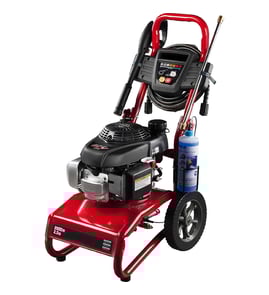

Where to find model number on Craftsman pressure washer?
On your Craftsman pressure washer, the model number is printed on the product identification label; for model 919762000, the manual lists it as MODEL NO. 919.762000. On most units, that label is attached to the frame (commonly on the upper frame or on the back/top of the lower frame). See the 919762000 owner's manual for the exact model identification format.
Look for a sticker or metal tag on the pressure washer frame, not on the spray gun or hose.
- Top of the lower frame (often near the rear)
- Back side of the lower frame rail
- Top or back of the upper frame/handle area
- Near the pump mounting area on the frame (label may face inward)
- Near the engine base plate (label is usually on the frame, not the engine)
The model label usually includes the model number plus performance identifiers (PSI and GPM). For this Craftsman unit, the manual references 6 HP, 2000 PSI, 2 GPM, which helps confirm you are looking at the correct machine.
| Item on label | What it’s used for | Example for this model |
|---|---|---|
| Model number | Matching the correct parts diagrams and lists | 919.762000 (also shown as 919762000) |
| PSI / GPM | Confirming the correct pump and nozzle setup | 2000 PSI / 2 GPM |
| Brand/name | Identifying product family | Craftsman |
A faded label is common on outdoor power equipment.
- Wipe the area with a damp cloth and mild soap; avoid harsh solvents
- Use a flashlight at an angle to make embossed printing easier to see
- Take a close-up photo and zoom in
- Check multiple frame locations; some units have more than one label
Using the exact model number (919762000) keeps you aligned with the correct pressure washer parts list, pump breakdown, and troubleshooting steps, so you do not order the wrong components.
Last updated: February 2026
Are Craftsman gas pressure washers any good?
Yes; Craftsman gas pressure washers like model 919762000 are a solid choice for typical homeowner cleaning because they deliver strong pressure and flow for driveways, siding, and decks. Long-term satisfaction depends on correct operation and maintenance, especially avoiding pump overheating and using the right detergents (see the owner's manual).
A gas pressure washer is “good” when it starts reliably, maintains steady pressure, and runs without leaks or excessive vibration during normal use.
Common signs you are getting good performance:
- Strong, consistent spray without pulsing
- Engine runs smoothly without surging
- No water leaks at hose connections or pump
- Detergent draws correctly when set up for soap
- Unit can run job after job without overheating
Many durability complaints come from a few avoidable operating issues. For the Craftsman 919762000, the manual calls out key practices that protect the pump and engine.
Do these every time:
- Run the washer only with a steady water supply; never run it with the water shut off
- Avoid bypass mode (trigger not engaged) for more than 2 minutes to prevent pump damage
- Use only pressure-washer-safe detergents; never use flammables (gasoline, kerosene) or acids
- Fuel and operate outdoors in a well-ventilated area; never run in garages or enclosed spaces
- Keep children away and maintain firm control of the spray gun because of kickback force
| Feature | Gas pressure washer (like 919762000) | Electric pressure washer |
|---|---|---|
| Cleaning power | Higher for heavy grime | Best for light to medium jobs |
| Portability | No cord; needs fuel | Needs outlet/extension management |
| Maintenance | More (engine + pump care) | Less |
| Noise | Louder | Quieter |
A pressure washer can feel “bad” even when it is mechanically fine if it is run in bypass too long, starved for water, or used with the wrong chemicals. Following the operating limits and detergent guidance keeps pressure consistent and prevents premature pump wear.
Last updated: February 2026
What are common pressure washer problems?
Common problems on the Craftsman 919762000 gas pressure washer include low or fluctuating pressure, chemical not drawing, pump noise or leaks, and an engine that will not start. Most issues trace back to water supply restrictions, a clogged or worn nozzle, air leaks at hose connections, or running the pump too long in bypass; see the owner's manual for model-specific troubleshooting.
- Low pressure or won’t reach rated pressure: restricted water supply, clogged inlet screen, nozzle worn or incorrect
- Fluctuating pressure: air getting into the pump, partially blocked nozzle, inlet strainer clogged
- Pressure drops after normal use: worn seals/packing, dirty inlet or discharge valves, inadequate water supply
- Won’t draw chemical: nozzle not set for chemical draw, chemical screen clogged, injector orifice obstructed
- Pump noisy or leaking: air in the inlet, worn seals, loose fittings, hose damage
- Confirm the garden hose has strong flow and no kinks, leaks, or crushed sections.
- Clean the garden hose inlet strainer and check for debris at the water inlet.
- Inspect the spray tip for blockage; clear it with a nozzle cleaning tool or a thin wire.
- Tighten hose connections and check O-rings to stop air leaks that cause surging.
- If chemical won’t siphon, verify the nozzle is in the correct low-pressure/chemical position and the chemical screen is submerged.
Running the washer without spraying (bypass mode) overheats recirculating water and can damage the pump. We follow the model guidance: do not run more than 2 minutes without pulling the trigger to let cool water flow through the pump.
| Symptom | Most likely cause | What to do |
|---|---|---|
| Low pressure | Restricted supply or clogged strainer | Check hose flow; clean inlet screen |
| Surging | Air leak or partially blocked nozzle | Reseat fittings; clean nozzle |
| No chemical draw | Wrong nozzle position or clogged screen | Set chemical mode; clean screen |
| Engine won’t start | Throttle/primer/pressure buildup | Set throttle to Run; prime; squeeze trigger |
Correcting water flow, nozzle condition, and bypass time prevents pump overheating, seal wear, and unsafe spray behavior (kickback and injection hazards).
Last updated: February 2026
Is it worth repairing a pressure washer?
Yes, it’s worth repairing a pressure washer when the fix is small (clogged nozzle, worn hose, leaking gun) or when the unit is in otherwise good shape. For the Craftsman 919762000, major failures like a damaged pump or engine problems often push costs high enough that replacement makes more sense.
Use this quick guideline to keep the decision practical:
- If the repair estimate is under 50% of the cost of a comparable new pressure washer, repair it.
- If it’s over 50%, replacement is usually the better value.
- If you rely on it for frequent work, include downtime and repeat failures in the decision.
| Issue type | Common examples | Usually worth repairing? |
|---|---|---|
| Quick maintenance | Nozzle cleaning, replacing O-rings, tightening fittings | Yes |
| Wear items | Hose, spray gun, wand/lance, chemical hose | Usually |
| Major mechanical | Pump failure, engine internal damage | Often no |
These are the fixes we see pay off most often because parts and labor stay reasonable:
- Clean or replace a clogged nozzle
- Replace a leaking high-pressure hose
- Fix a leaking spray gun connection (often seals or fittings)
- Replace a damaged wand/lance
- Address minor fuel issues (old gas, dirty carburetor bowl, fouled spark plug)
For gas pressure washers like the Craftsman 919762000, these problems typically drive up cost fast:
- Pump housing cracks or severe internal pump wear
- Engine compression problems or heavy smoking
- Repeated overheating from improper operation
- Multiple leaks across pump, hose, and gun at the same time
A lot of “expensive repairs” start as preventable pump damage. Your manual warns not to run the washer with the water supply shut off, and not to let it sit in bypass mode (trigger not pulled) for more than about 2 minutes because the pump can overheat. Follow the operating and maintenance guidance in the owner's manual to protect the pump and extend service life.
Last updated: February 2026