Owner’s manual
 Error Codes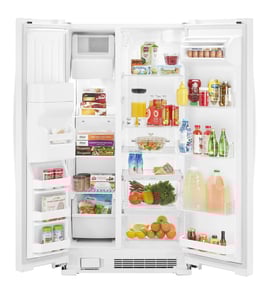

How big is the KSRG25FVMT00?
The KitchenAid KSRG25FVMT00 is a full-size 36-inch-class side-by-side refrigerator. For exact exterior height, width, and depth (including handles, door swing, and required clearances), use the dimension and installation section in the KSRG25FVMT00 owner's manual.
What we can confirm for planning space
When you plan for this model, focus on the measurements that affect fit and usability:
- Cabinet opening width (side-to-side space)
- Overall depth with doors and handles
- Door swing clearance (especially next to a wall)
- Rear clearance for the power cord and water line (if connected)
- Overhead clearance to cabinets or a soffit
Typical size range for 36-inch-class side-by-side refrigerators
These ranges help you estimate space while you verify the exact specs in the manual.
| Measurement | Typical range |
|---|---|
| Width | 35 1/2 to 36 in |
| Height | 65 to 71 in |
| Depth (cabinet only) | 28 to 34 in |
| Depth (with handles) | often 30 to 36+ in |
How to measure your opening correctly
We use this quick method to avoid surprises during delivery and installation:
- Measure width in 3 places (top, middle, bottom) and use the smallest number
- Measure height at the front and at the back (floors can slope)
- Measure depth to the wall, then compare to depth with handles and door swing needs
- Confirm you have a path through doorways and hallways to the kitchen
Why it matters
Correct sizing prevents door-swing problems, makes water line hookup easier for the ice maker and dispenser, and helps ensure drawers and crisper pans can be removed without pulling the refrigerator out.
Last updated: January 2026
What is the average lifespan of a KitchenAid refrigerator?
Most KitchenAid refrigerators last 14 to 17 years on average, and 10 to 20 years is a realistic overall range with normal household use. For your KitchenAid KSRG25FVMT00 side-by-side refrigerator, consistent maintenance and timely part replacement are what most often determine whether you land on the low or high end.
Typical lifespan and what affects it
A refrigerator’s life is usually limited by wear on the sealed system, cooling airflow, and door sealing.
- Maintenance: dirty condenser coils and blocked airflow shorten life
- Door sealing: worn gaskets force longer run times
- Water system upkeep: clogged filters can reduce dispenser and ice maker performance
- Usage habits: frequent door openings and warm food loads increase compressor run time
- Repair timing: fixing small issues early prevents bigger failures
Maintenance checklist to help your KSRG25FVMT00 reach the high end
Use the care and maintenance guidance in the KSRG25FVMT00 owner's manual.
- Clean condenser area regularly (dust and pet hair are common problems)
- Keep vents inside the fresh food and freezer sections clear
- Confirm doors close fully and evenly every time
- Replace the water filter on schedule; use the correct refrigerator water filter EDR3RXD1
- Listen for changes in fan noise (a struggling evaporator fan can reduce cooling)
What the warranty tells you about long-life components
Your manual’s warranty coverage highlights which components are considered major long-term parts.
| Component group | Examples | Why it matters for lifespan |
|---|---|---|
| Sealed refrigeration system | Compressor, evaporator, condenser, dryer, connecting tubing | These parts drive cooling; failures are often the most expensive repairs |
| Door storage components | Door bins and can racks (varies by design) | Breakage is common but usually not a cooling failure |
| Water filtration | Water filter | Regular replacement helps protect water flow and ice maker performance |
Why it matters
A refrigerator that runs longer to maintain temperature uses more energy and puts extra wear on the compressor, evaporator fan motor, and defrost system. Simple upkeep (coils, seals, airflow, filter changes) is the most reliable way to extend service life.
Last updated: January 2026
What is the most common problem with a KitchenAid refrigerator?
The most common issues we see on KitchenAid refrigerators like model KSRG25FVMT00 are ice maker and water dispensing problems, plus cooling complaints caused by airflow or defrost issues. Start with basic checks in the KSRG25FVMT00 owner's manual before replacing parts.
Most common symptoms (and what they usually point to)
- Ice maker not making ice or slow ice production: water supply restriction, clogged filter, or a failing ice maker
- Water dispenser weak or not dispensing: clogged filter, air in the line, or a failing inlet valve
- Fridge warm but freezer cold (or uneven temps): evaporator fan problem or frost buildup from a defrost failure
- Frost buildup on the back wall of the freezer: defrost heater or defrost control issue
- Noisy operation: fan blade interference, worn fan motor, or normal compressor/fan cycling
Quick checks we recommend first
- Confirm the refrigerator is plugged into a grounded 3-prong outlet and has power.
- Make sure temperature controls were not accidentally changed.
- Check for blocked vents (overpacked shelves can restrict airflow).
- Inspect for frost buildup in the freezer (a clue of a defrost problem).
- If water or ice is affected, replace the water filter and purge the dispenser.
Parts that commonly solve these problems on KSRG25FVMT00
| Symptom | Common part to check | What it does |
|---|---|---|
| Weak water flow, bad taste/odor, slow ice | Refrigerator water filter EDR3RXD1 | Filters incoming water to the dispenser and ice maker |
| No water to ice maker/dispenser | Refrigerator inlet valve W10408179 | Opens to let household water into the refrigerator |
| Warm temps, poor airflow, noise | Refrigerator evaporator fan motor WP2315549 | Circulates cold air through freezer and fresh food sections |
| Heavy frost, warm fridge | Refrigerator defrost heater WP2323198 | Melts frost off the evaporator during defrost |
Why it matters
Ice, water, and cooling symptoms often share the same root causes (restricted water flow, poor airflow, or frost buildup). Catching the early signs helps prevent food spoilage, leaks, and compressor overwork.
Last updated: January 2026