 Owner’s manual
 Error Codes



What is the bottom part of a refrigerator called?
On Kenmore refrigerator model 59672912200, the “bottom part” is most often called the machine compartment (or base area); it typically houses the compressor, condenser components, and the toe grille at the very front. Exact naming varies by section and what you mean by “bottom.”
- Toe grille: the front kick plate at floor level that snaps on and off for access.
- Machine compartment: the lower rear area where the sealed system and airflow parts live.
- Compressor area: the section containing the compressor and start components.
- Bottom hinge area: the lower door hinge and door stop location.
- Freezer drawer area: on bottom-mount units, the lower compartment is the freezer.
| If you mean... | Most common name | What you’ll see there |
|---|---|---|
| Front panel at the floor | Toe grille | Snap-in grille, sometimes a bracket cover |
| Lower back where it hums | Machine compartment / compressor area | Compressor, condenser, wiring |
| Bottom door pivot point | Bottom hinge | Hinge bracket, screws, door stop |
| Lower compartment you open | Freezer section | Drawer, rails, baskets |
Our 59672912200 owner’s manual references the toe grille and leveling steps (front slightly higher than the back), which are part of the lower base area you access during setup and service.
Using the right term helps you order the correct Kenmore refrigerator parts and troubleshoot faster. For example, a rattle at the toe grille is a different fix than a clicking noise near the compressor.
Last updated: January 2026
Are bottom mount fridges better?
Bottom-mount refrigerators are better for many households because the fresh-food section sits at eye and waist level, so you reach everyday items (milk, produce, leftovers) more easily. With Kenmore model 59672912200, the freezer stays in a lower drawer, which many people find more ergonomic.
A bottom-mount design tends to work best when you use the refrigerator section more often than the freezer.
- Easier access to fresh-food shelves without bending
- Freezer drawer keeps frozen items grouped, but you may need to dig for smaller items
- Often feels more organized for meal prep and frequent cooking
- Can reduce door-open time because common items are easier to grab
- Door sealing and leveling still matter for performance (any style can struggle if doors do not close well)
| Feature | Bottom-mount refrigerator | Top-freezer refrigerator |
|---|---|---|
| Most-used items | Easier to reach | More bending for fridge items |
| Freezer access | Drawer at bottom | Door at top |
| Organization | Great for fresh food | Great for frozen food access |
| Best fit for | Frequent cooking, fresh foods | Budget-focused, freezer-heavy use |
These habits help any bottom-mount unit cool efficiently and feel “better” day to day.
- Keep frequently used items on the middle shelves
- Avoid overpacking the freezer drawer; leave room for airflow
- Make sure doors close securely; leveling helps doors seal properly
- Clean condenser coils about every 3 months to support cooling and efficiency
- If you notice unusual sounds, many are normal as fans and the compressor cycle
Most households open the refrigerator section far more than the freezer. A bottom-mount layout reduces bending and speeds up access to everyday food, which can improve convenience and help maintain stable temperatures.
For model-specific use and care details, follow the 59672912200 owner's manual.
Last updated: January 2026
What are the common problems with Kenmore Elite refrigerators?
Common Kenmore Elite refrigerator problems usually come down to cooling failures (sealed system or compressor issues), ice maker problems, or an electronic control problem. On Kenmore model 59672912200, start with basic checks like door sealing, condenser coil cleanliness, and control settings in the 59672912200 owner's manual.
- Not cooling or warm temperatures: dirty condenser coils, blocked airflow, or a sealed system/compressor issue
- Ice maker not making ice: ice maker assembly problem, water supply issue, or freezer temperature too warm
- Water droplets or sweating: high humidity, frequent door openings, or a door not sealing
- Odors: spills, old food, or a dirty compartment
- Door not closing properly: gasket not sealing, unit not level, or internal obstruction
- Confirm temperatures: refrigerator about 37°F, freezer about 0°F.
- Inspect door sealing: look for gaps, torn gasket areas, or food packages blocking closure.
- Clean condenser coils: dirty coils commonly cause warm temps.
- Check airflow: do not block the rear air grille or vents with food.
- Reset after a power event: unplug for 5 minutes, then restore power and allow 24 hours to stabilize.
| Symptom | Common part area | Example part for 59672912200 |
|---|---|---|
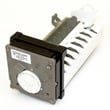
| No ice | Ice maker assembly | Refrigerator ice maker D7824706Q |
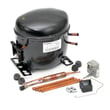
| Warm temps, compressor won’t start | Compressor/start components | Refrigerator compressor W10160407 |
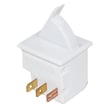
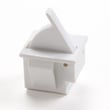
| Lights or door sensing issues | Door switch | Refrigerator switch W11396033 |
Catching airflow, coil, and door-seal problems early helps prevent long run times, temperature swings, and ice maker complaints. The troubleshooting table in the manual also ties symptoms like warm food, odors, and condensation to specific causes and fixes.
Last updated: January 2026





