Owner’s manual
 Error Codes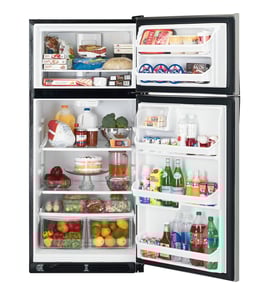


What size is a Kenmore freezer by model number 79573264303?
The Kenmore 79573264303 is a top-mount (top freezer) refrigerator, so the freezer is the upper compartment rather than a separate upright freezer. For this style, total refrigerator capacity is typically about 18 to 22 cubic feet; the freezer portion is commonly about 4 to 6 cubic feet. For the exact capacity and dimensions for your unit, use the 79573264303 owner's manual.
When customers ask for freezer size, it usually means one of these:
- Freezer capacity (cubic feet): how much food it holds
- Overall refrigerator capacity (cubic feet): fridge plus freezer combined
- Physical dimensions (inches): width, height, depth for fit in a space
- Shelf or bin dimensions: for replacing a shelf, drawer, or door bin
These are common ranges for Kenmore top-mount refrigerators like model 79573264303.
| Measurement type | Typical range | What it helps with |
|---|---|---|
| Total capacity | 18 to 22 cu. ft. | Comparing models, storage planning |
| Freezer capacity (top compartment) | 4 to 6 cu. ft. | Freezer storage planning |
| Width | 29 to 33 in. | Cabinet opening fit |
| Height | 65 to 69 in. | Overhead clearance |
We recommend measuring the opening and the refrigerator itself, then allowing clearance for airflow and door swing.
- Measure width, height, and depth of the cabinet opening
- Allow extra space behind for air circulation and connections
- Confirm the door can open fully without hitting a wall or cabinet
- If you have a water/ice setup, plan room for the water line routing
- Leveling matters; an unlevel cabinet can affect door closing and sealing
Getting the correct “size” prevents installation surprises and helps avoid cooling issues caused by restricted airflow. It also helps you choose correctly sized replacement items such as a shelf or gasket if you are repairing your Kenmore 79573264303.
Last updated: February 2026
What is the upper part of a fridge called?
On a Kenmore 79573264303 top-mount refrigerator, the upper compartment is the freezer compartment. It is the section designed to keep foods frozen and it also supplies cold air that helps cool the fresh food (refrigerator) section.
In this style of refrigerator, cold air is produced in the freezer area and then circulates to both compartments through internal vents.
- Keeps food at freezing temperatures for long-term storage
- Feeds cold air to the refrigerator section through vents
- Helps stabilize overall temperatures when doors stay closed
- Often houses the ice maker or ice tray area (if equipped)
- Works with the temperature controls to regulate cooling
| Compartment | Typical purpose | Typical target temperature |
|---|---|---|
| Freezer (upper) | Frozen food storage, ice production | 0°F (-18°C) |
| Refrigerator (lower) | Fresh food storage | 37°F (3°C) |
Knowing the correct name helps when you are reading temperature-control instructions, troubleshooting airflow issues, or ordering parts such as a door gasket, thermistor, or ice maker components for your Kenmore 79573264303.
If temperatures seem off, we follow the same approach recommended in the owner's manual: set the refrigerator control around 37°F and the freezer around 0°F, then wait 24 hours before making another adjustment.
Last updated: February 2026
What model Kenmore fridge do I have?
Your Kenmore refrigerator’s model number is printed on the appliance ID label; once you find it, you can match it to the exact parts list and manual for your refrigerator. For this parts page, the model is Kenmore 79573264303; confirm your label shows 79573264303 to be sure you are ordering the right parts.
We typically see the model and serial label in one of these spots on a Kenmore top-mount refrigerator:
- Inside the fresh food (refrigerator) compartment on a side wall
- On the door frame (around the gasket area)
- Near the ceiling of the fresh food compartment
- Behind the base grille or kick plate area
Record these details exactly as shown on the label:
- Model number (example for this page: 79573264303)
- Serial number
- Date of purchase (often needed for warranty paperwork)
Kenmore model numbers can look similar, but parts like a door gasket, thermistor, or drain tube can vary by model revision. Using the exact model number helps us match the correct diagrams, troubleshooting info, and replacement parts.
Use this simple comparison before ordering:
| Item to compare | What it should look like | What it’s used for |
|---|---|---|
| Model number | 79573264303 | Matching parts and diagrams |
| Serial number | Letters and numbers | Identifying production run |
| Brand | Kenmore | Confirming product family |
- If your label shows 79573264303, use the 79573264303 owner's manual for feature locations and operating details.
- If the model number is different by even one digit, use that exact number to locate the correct parts list before buying items such as the refrigerator freezer door gasket ADX52752649 or refrigerator thermistor 6500JB2002T.
Last updated: February 2026
What are the common problems with Kenmore Elite refrigerators?
Common Kenmore Elite refrigerator problems include warm temperatures (fresh food or freezer), water leaks or puddles, ice maker troubles, unusual fan noise, and doors that do not seal well. On Kenmore model 79573264303, many of these symptoms trace back to airflow, temperature control settings, or drain and gasket issues; our 79573264303 owner's manual covers safe handling and basic temperature adjustment guidance.
- Not cooling or too warm: blocked air vents, frequent door openings, overloaded compartments, dirty condenser coils, or a failing evaporator fan
- Freezer warm or slow ice production: heavy ice use, blocked vents, door left ajar, or temperature controls set too warm
- Water under the refrigerator: clogged or iced defrost drain, drain tube issues, or a loose water line connection
- Frost buildup or moisture: door not sealing, torn gasket, or door alignment problems
- Noisy operation: evaporator fan blade hitting ice, fan motor wear, or items vibrating against the cabinet
- Confirm settings and wait a full day: after any control change, allow 24 hours for temperatures to stabilize.
- Clear airflow paths: keep packages from blocking vents in both compartments.
- Reduce door openings: frequent openings and warm room conditions can make sections run warm.
- Look for leak clues: water near the front often points to a drain issue; water near the back can point to a supply line or valve.
- Listen for fan noise: a ticking or scraping sound from the freezer area often indicates fan interference from ice.
| Symptom | Common part area | Example part for this model |
|---|---|---|
| Water puddles, leaking | Defrost drain path | Refrigerator drain 5251JA3003D |
| Frost, warm temps, moisture | Door sealing | Refrigerator freezer door gasket ADX52752649 |
| Temps swing, inconsistent cooling | Temperature sensing | Refrigerator thermistor 6500JB2002T |
| Fan noise, weak airflow | Evaporator fan | Refrigerator evaporator fan blade 5901JJ1003A |
Most “big” refrigerator complaints (warm temps, leaks, ice maker problems) start as small airflow, sealing, or drain issues. Fixing those early helps protect food, reduces frost buildup, and prevents recurring puddles.
Last updated: February 2026
How do you fix a refrigerator that is not cooling on top?
If your Kenmore 79573264303 is cold in the freezer but warm in the top (refrigerator section), the most common fix is restoring airflow. We check for blocked vents, correct temperature conditions, and a working evaporator fan so cold air can move from the freezer up into the fresh-food compartment (through the top vent). See the owner's manual for the airflow path and vent locations.
- Make sure packages are not blocking the freezer vents or the refrigerator top vent (cold air enters the refrigerator through the top vent).
- Set controls to normal mid-range settings; wait 24 hours after changes.
- Confirm the room temperature is within 55°F to 110°F; extreme ambient temperatures reduce cooling performance.
- Verify the refrigerator is level (front slightly higher than rear) so doors close fully and airflow stays consistent.
- Check door gaskets for gaps, rips, or areas not sealing.
The freezer makes the cold air; the refrigerator section depends on that air being pushed and routed correctly. Use this table to narrow it down:
| What you notice | Most likely cause | What we do next |
|---|---|---|
| Freezer cold, fridge warm | Blocked vents or restricted circulation | Clear vents; avoid overpacking; allow space around vents |
| Weak airflow into fridge top vent | Evaporator fan issue or ice buildup | Listen for fan; inspect for frost; defrost if needed |
| Temps fluctuate, moisture on shelves | Door not sealing or unit not level | Level cabinet; inspect/clean gasket sealing surfaces |
If airflow is clear and the problem persists, these parts are often involved:
- Evaporator fan area: a damaged fan blade can reduce airflow; consider the refrigerator evaporator fan blade 5901JJ1003A.
- Temperature sensing: a faulty sensor can misread temps; check the refrigerator thermistor 6500JB2002T.
- Door sealing: warm air leaks can overwhelm cooling; inspect the refrigerator freezer door gasket ADX52752649 if the freezer door is not sealing well.
On this top-mount design, proper air circulation is the difference between a cold freezer and a properly cooled refrigerator section. When vents are blocked, doors do not seal, or the evaporator fan cannot move air, the top compartment warms up even though the freezer still feels cold.
Last updated: February 2026