Owner’s manual
 Error Codes



What is the average life expectancy of a GE refrigerator?
Most GE refrigerators, including the GE GFE26GSHGSS bottom-mount refrigerator, last 10 to 15 years with normal household use. Regular maintenance (cleaning condenser coils, keeping door seals tight, and changing the water filter on time) is what most often determines whether you land closer to 10 years or closer to 15.
What affects refrigerator lifespan the most
- Condenser coil cleanliness: Dust buildup makes the compressor run hotter and longer.
- Door gasket condition: Air leaks cause longer run times and frost issues.
- Stable temperatures: Frequent warm-ups from heavy door opening shorten component life.
- Water system upkeep: A clogged filter can reduce flow and strain the dispenser/ice maker.
- Airflow around the cabinet: Poor ventilation increases heat load.
Maintenance checklist we recommend
Use the GFE26GSHGSS owner's manual for model-specific care intervals and locations.
- Vacuum or brush condenser coils periodically
- Keep doors level so they self-close and seal evenly
- Set temps to typical targets: 37°F fresh food, 0°F freezer
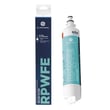
- Replace the water filter on schedule (this model uses GE refrigerator water filter RPWFE)
- Clean spills quickly to prevent odors and blocked air vents
Common “end-of-life” symptoms vs. fixable issues
| Symptom | Often fixable? | Common next step |
|---|---|---|
| Warm fridge but freezer OK | Yes | Check airflow, evaporator fan, frost buildup |
| Both sections warm | Sometimes | Clean coils; check compressor start components |
| Ice maker stops but cooling is fine | Yes | Check water supply, filter, ice maker |
| Loud clicking, won’t start cooling | Sometimes | Test start relay/capacitor; service if needed |
Why it matters
A refrigerator that runs longer than it should uses more electricity and puts extra wear on high-cost components like the compressor and control boards. Simple upkeep helps your GE GFE26GSHGSS reach its full expected service life.
Last updated: February 2026
What does a GE model number tell me?
A GE model number (like GFE26GSHGSS) identifies the appliance family and key configuration details so we can match the correct parts, manuals, and service information. For your GE bottom-mount refrigerator, the model number is the fastest way to confirm fit before ordering items like a water filter or temperature sensor.
What you can learn from a GE model number
GE model numbers are a “code” that typically points to core product attributes. Exact meanings vary by product line, but the model number commonly helps indicate:
- Appliance type and platform (refrigerator vs. range vs. washer)
- Series or feature package (for example, dispenser and ice system variations)
- Size or capacity family (often reflected in the number group)
- Finish or color code (often reflected in the ending letters)
- Engineering revisions that affect part compatibility
For model-specific identifiers and diagrams, use the GFE26GSHGSS owner's manual.
Model number vs. serial number (quick comparison)
The model number tells us what the unit is; the serial number helps narrow down when it was built.
| Identifier | What it’s used for | Why you need it |
|---|---|---|
| Model number | Identifies the exact product design and configuration | Ensures parts fit your GE GFE26GSHGSS refrigerator |
| Serial number | Identifies a specific unit and production details | Helps confirm manufacturing date and some revision breaks |
Where to find the model number on a refrigerator
On most GE bottom-mount and French door refrigerators, you’ll typically find the model/serial tag:
- Inside the fresh food compartment on a side wall
- Near the top interior ceiling area
- On or near the door frame when the door is open
- Occasionally behind a crisper drawer front edge
Why it matters when ordering parts
Small design differences can change which parts fit, even within the same GE family. Using the full model number helps us match the right replacement, such as:
- GE refrigerator water filter RPWFE for water and ice filtration
- Refrigerator temperature sensor WR55X10025 for temperature feedback to the control system
- Ice maker and dispenser components that vary by configuration
Last updated: February 2026
What is the most common problem with a GE refrigerator?
The most common GE refrigerator problem is a cooling complaint (warm fresh food section, warm freezer, or temperature swings). On the GE GFE26GSHGSS, the usual causes are airflow restrictions, dirty condenser coils, or a failing evaporator fan that cannot move cold air through the compartments; see the troubleshooting steps in the GFE26GSHGSS owner's manual.
Quick checks we recommend first
- Confirm the temperature settings are at normal targets (about 37°F fresh food and 0°F freezer).
- Make sure air vents are not blocked by food packages (especially at the back wall).
- Clean dust from the condenser coil area and verify the condenser fan is running.
- Listen for the evaporator fan; a loud, intermittent, or silent fan often points to a fan issue.
- Check door gaskets for gaps and confirm doors fully close.
- If you have a dispenser, replace the water filter on schedule to prevent flow issues.
Common symptoms and the most likely causes
| Symptom | Most likely cause | What to do next |
|---|---|---|
| Fresh food warm, freezer OK | Airflow blocked or evaporator fan weak | Clear vents; inspect/diagnose the fan |
| Both sections warm | Dirty condenser coil, sealed system, or control issue | Clean coils; check fans; consider service |
| Temps swing up and down | Sensor or control reacting incorrectly | Check for error codes; test sensors |
| Ice maker slow or no ice | Water supply, filter restriction, inlet valve | Verify supply; replace filter; test valve |
Parts that commonly relate to cooling and temperature complaints
If basic checks do not fix the issue, these model-matched parts are often involved in GE cooling problems:
- Refrigerator evaporator fan motor and blade WR60X10352 (moves cold air through the refrigerator)
- Refrigerator temperature sensor WR55X10025 (reports temperature to the control)
- Refrigerator main board assembly WR55X46805 (manages compressor, fans, and defrost)
- Refrigerator defrost bi-metal thermostat WR50X10108 (helps protect and control defrost heating)
Why it matters
Cooling problems can look minor at first, but warm temperatures can lead to food spoilage and can also make the compressor run longer than normal. Fixing airflow and coil cleanliness early often prevents bigger repairs.
Last updated: February 2026