Error Codes


Are bottom mount fridges better?
Bottom-mount refrigerators like the GE CFE28TP4MIW2 are better for many kitchens because the fresh-food section sits at eye and waist level, so you reach everyday items (milk, produce, leftovers) more comfortably; the freezer stays in a lower pull-out drawer for bulk storage.
When a bottom-mount refrigerator is the better choice
- You use the refrigerator section more than the freezer (most households do).
- You want less bending for fresh-food access (better day-to-day ergonomics).
- You like wide shelves and door bins for beverages and meal prep.
- You prefer a pull-out freezer drawer for organizing frozen foods.
- You want a layout that works well for frequent cooking and fresh ingredients.
When it might not be “better” for your home
Bottom-mount is not automatically the best fit if your freezer is the most-used compartment or if you prefer freezer shelves at chest height.
- Heavy freezer items can be awkward to lift from a low drawer.
- Some people prefer the visibility of a top-freezer layout.
- If you access ice constantly, dispenser and ice maker performance and maintenance matter more than layout.
Quick comparison: bottom-mount vs top-freezer
| Feature | Bottom-mount | Top-freezer |
|---|---|---|
| Fresh-food access | Best (most-used items higher) | Good, but lower shelves require more bending |
| Freezer access | Lower drawer, good organization | Upper shelves, easier lifting |
| Typical use case | Fresh-food heavy households | Freezer heavy households |
Why it matters
The “better” refrigerator is the one that matches how you cook and shop. If your GE CFE28TP4MIW2 is not meeting expectations (temps, ice, water), layout is rarely the root cause; performance issues are usually tied to airflow, sensors, or filtration.
Parts that commonly affect performance (not layout)
- A drifting temperature reading can point to a sensor issue such as the refrigerator temperature sensor WR55X10025.
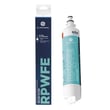
- Slow water flow or bad taste often improves after replacing the GE refrigerator water filter RPWFE.
- No ice or intermittent ice can involve the ice maker assembly such as the ice maker WR30X28731.
For model-specific troubleshooting steps, we use our GE DIY guides like GE refrigerator error codes.
Last updated: February 2026
How to remove bottom grille on GE refrigerator?
On the GE CFE28TP4MIW2 bottom-mount refrigerator, the bottom grille (base grille or toe grille) typically comes off by releasing its retaining clips or removing a few screws, then pulling the grille straight out and down. This gives you access for cleaning and basic service checks.
Steps to remove the bottom grille
- Unplug the refrigerator or switch off power at the breaker if you will be working near wiring.
- Look along the top edge and corners of the grille for screws; remove them with a Phillips screwdriver if present.
- If there are no screws, grip the grille at both ends and pull straight outward to release the clips.
- Tilt the grille slightly and lift it away from the cabinet.
- Set the grille aside and keep any screws together for reinstallation.
Reinstalling the grille
- Line up the grille tabs and clip points with the openings in the cabinet.
- Press evenly along the grille until it snaps fully into place.
- Reinstall any screws you removed and tighten them snug (do not overtighten).
What to check while the grille is off
| What you see | What it usually means | What to do next |
|---|---|---|
| Dust and pet hair on coils | Reduced airflow and efficiency | Vacuum coils and the grille vents |
| Water or dampness | Possible defrost drain or dispenser leak | Inspect for a slow drip and dry the area |
| Rattling grille or loose fit | Clips or mounting points not seated | Re-seat the grille and confirm it is fully clipped in |
Why it matters
A properly installed bottom grille helps protect components and keeps airflow moving across the condenser area. Keeping that area clean helps your GE refrigerator cool more consistently and can reduce run time.
For related GE refrigerator access and door-area service steps, we recommend how to remove a GE french door refrigerator flipper mullion.
Last updated: February 2026
What is the most common problem with GE profile refrigerators?
The most common problems we see on GE Profile refrigerators like model CFE28TP4MIW2 are ice maker issues and temperature control problems (warm fridge, warm freezer, or fluctuating temps). These often trace back to water filtration or ice components, a failed temperature sensor, or an electronic control problem.
Most common symptoms customers report
- Ice maker not making ice or making small/hollow cubes
- Slow ice production or dispenser not dispensing
- Fresh food section too warm while freezer seems OK
- Freezer too warm or temperature swings
- Intermittent cooling, especially after a power outage
What to check first (fast triage)
- Confirm temperatures: set refrigerator to about 37°F and freezer to about 0°F; allow 24 hours to stabilize.
- Check the water filter and flow: a restricted filter can reduce water flow to the ice maker and dispenser.
- Look for airflow problems: blocked vents, overpacked shelves, or frost buildup can cause uneven cooling.
- Check for error codes: GE models often provide diagnostic codes that point to sensors, fans, or control issues.
Common causes and related parts for CFE28TP4MIW2
| Problem area | What typically fails | Example part on this model page |
|---|---|---|
| Ice production | Ice maker assembly, fill issues | Ice maker WR30X28731 |
| Water flow | Clogged filter, air in line | GE refrigerator water filter RPWFE |
| Temperature sensing | Thermistor out of range | Refrigerator temperature sensor WR55X10025 |
| Electronics | Main control board glitches | Main board asm reflashed WR55X46805 |
Why it matters
Ice maker and cooling complaints are usually connected: if water flow is restricted, ice suffers; if airflow or temperature sensing is off, both ice production and food temperatures can drift. Catching the root cause early helps prevent food spoilage and reduces strain on the compressor.
Helpful DIY guides
- Use GE refrigerator error codes to narrow the failure to a sensor, fan, or control issue.
- If the door alarm is part of the complaint, follow how to reset the door alarm on a GE refrigerator.
- For ice and water performance, follow how to replace the water filter in a GE refrigerator.
Last updated: February 2026