Installation guide
 Owner’s manual
 Error Codes




Is Frigidaire Gallery high end?
Frigidaire Gallery is not a true luxury, high-end line; it is a premium mid-range tier that typically adds upgraded finishes, more convenience features, and a more modern look than Frigidaire’s basic models. For your Frigidaire FRS26R4CQ3, the best “high-end” results still come from correct setup and maintenance in the FRS26R4CQ3 owner's manual.
How Frigidaire Gallery compares
Frigidaire’s lineup is usually grouped by feature level and styling. Gallery generally sits above entry-level Frigidaire models, but below luxury brands and pro-style lines.
- More feature-rich than basic models (storage options, controls, dispenser features)
- More design-focused finishes (varies by model and year)
- Better fit-and-finish than entry-level, but not luxury-grade components
- Strong value when you want upgrades without premium-brand pricing
| Tier (typical) | What you usually get | Who it fits |
|---|---|---|
| Entry-level | Core cooling, fewer options | Budget-first shoppers |
| Gallery (premium mid-range) | More features and styling | Best value for most kitchens |
| Pro-style or luxury | Heavier-duty build, premium design | High-end budgets and priorities |
What “high end” means for day-to-day use
Even on premium models, performance depends heavily on installation, leveling, and airflow.
- Level the refrigerator so doors seal and close correctly (a slight tilt back helps)
- Keep the condenser area clean so the compressor does not run excessively
- Avoid frequent, long door openings that warm the compartments
- Use the correct temperature settings and allow about 24 hours for changes to stabilize
Why it matters
“High end” is often about features and finish, but food preservation comes from basics done right: tight door seals, stable temperatures, and clean heat-exchange surfaces. Those fundamentals help any Frigidaire side-by-side run efficiently and keep temperatures consistent.
Last updated: January 2026
How to reset a Frigidaire refrigerator?
For the Frigidaire FRS26R4CQ3 side-by-side refrigerator, the most reliable “reset” is a power reset: unplug the refrigerator (or switch off the breaker) for about 5 minutes, then restore power. This clears many control glitches after a power interruption or minor cooling issue.
Recommended reset methods (in order)
- Power reset (best overall): Unplug the cord, wait 5 minutes, then plug back in.
- Breaker reset: Turn the refrigerator circuit breaker OFF for 5 minutes, then ON.
- Dispenser shutoff reset (water only): If the dispenser stops after long use, release the paddle to reset the built-in 3-minute shutoff.
- Ice maker restart: Lift the wire signal arm to OFF, then lower it back to ON after power is restored.
For model-specific operating details and safety notes (like avoiding extension cords), follow the FRS26R4CQ3 owner's manual.
What to do right after the reset
- Confirm the outlet has power and the plug is fully seated.
- Set temperatures back to normal if they were changed.
- Allow time for temperatures to stabilize (cooling recovery can take several hours).
- If you recently connected water or changed plumbing, flush the dispenser for a few minutes to clear air.
Common situations and what “reset” helps
| Symptom | Reset that helps most | What to check next |
|---|---|---|
| Control acting glitchy after outage | Power reset | Temperature settings, door closure |
| Water dispenser stops mid-fill | Dispenser shutoff reset | Water pressure, filter condition |
| Ice maker not making ice | Power reset + ice maker restart | Wire arm position, water supply |
Why it matters
A power reset safely clears temporary electronic or control-state issues without changing parts. If the refrigerator is running constantly or temperatures will not stabilize, focus next on airflow, door sealing, and basic maintenance steps in the manual.
Last updated: January 2026
What is the most common problem with a Frigidaire refrigerator?
For the Frigidaire FRS26R4CQ3 side-by-side refrigerator, the most common problems are cooling complaints (refrigerator or freezer too warm, or running too long) and ice maker or water dispenser issues. In many cases, the fix is basic: correct temperature settings, reduce door openings, and clean the condenser as outlined in the FRS26R4CQ3 owner's manual.
Most common symptoms and what usually causes them
Cooling and ice maker problems often trace back to airflow, door sealing, or water supply.
- Refrigerator runs too much/too long: doors opened frequently, door slightly open, dirty condenser, or worn/dirty door gasket
- Refrigerator or freezer too warm: warm air entering from frequent openings, door not sealing, dirty condenser
- Ice maker not making ice: wire shutoff arm in OFF position, household water valve closed, freezer not cold enough, clogged water filter
- Moisture between doors or on cabinet: humid conditions or door slightly open
- Unfamiliar noises: evaporator fan airflow, defrost heater sizzling, refrigerant gurgling (often normal)
Quick checks we recommend first (fastest wins)
These steps solve a large share of “not cold enough” and “ice maker not working” calls.
- Make sure both doors fully close and nothing inside is blocking them
- Verify temperature controls are set correctly; allow 24 hours after changes for temperatures to stabilize
- Clean the condenser coils (a dirty condenser can cause long run times and warm temps)
- If ice production is low, confirm the house water valve is open and the freezer is cold enough
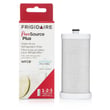
- Replace a clogged water filter such as the Frigidaire puresource plus refrigerator water filter WFCB if water flow is restricted
Cooling vs. ice maker problems: how to tell which you have
| What you notice | Most likely category | What to check first |
|---|---|---|
| Freezer and fresh food both warm | Cooling/airflow | Door sealing, condenser cleanliness, control settings |
| Freezer cold but no ice | Ice maker/water supply | Shutoff arm position, water valve open, filter restriction |
| Runs constantly, temps “almost” right | Efficiency/heat removal | Dirty condenser, door gasket leaks |
Why it matters
A refrigerator that runs too long or can’t hold temperature often has a heat removal or air leak issue (dirty condenser, door not sealing). Fixing those basics protects food, improves ice production, and reduces energy use.
For model-specific operating details and troubleshooting tables, follow the guidance in the FRS26R4CQ3 owner's manual.
Last updated: January 2026
What does CF mean on a Frigidaire refrigerator?
On the Frigidaire FRS26R4CQ3, a CF code typically points to a communication failure between the main control board and the user interface (display/control panel). The most common causes are a loose or damaged wire connection, or a failing control board.
What to do first (safe, quick checks)
- Unplug the refrigerator for 5 minutes, then plug it back in to reset the controls.
- Confirm the refrigerator is plugged into a dedicated 115V outlet (avoid extension cords and adapters).
- Check for a pinched harness or loose connector at the control area if accessible.
- If the code returns quickly after reset, plan on a wiring inspection and control diagnosis.
- If cooling is affected, move food to a safe location while troubleshooting.
For model-specific control locations and access steps, follow the FRS26R4CQ3 owner's manual.
What CF usually means (and what it does not)
CF is generally an electronics communication issue, not a sealed system problem by itself.
| Symptom you see | Most likely direction | What to check next |
|---|---|---|
| CF appears but cooling seems normal | Intermittent connection | Harness plugs, corrosion, loose connectors |
| CF appears and temps drift warm | Control not responding correctly | Main control board, user interface, power supply stability |
| CF comes back immediately after reset | Hard failure | Wiring continuity, board replacement diagnosis |
Parts that are commonly involved
We see these areas involved most often with CF-type issues:
- Main control board connections (harness seating and pin fit)
- User interface/display connections
- Door hinge area wiring (flexing can damage wires over time)
- Power supply issues (outlet, loose plug, voltage drop)
Why it matters
A communication fault can prevent the refrigerator from regulating temperatures correctly. Addressing CF early helps protect food storage temperatures and reduces the chance of secondary issues like poor ice production.
If you are also seeing performance symptoms (warm freezer, no ice, dispenser issues), use the Frigidaire refrigerator error codes reference to narrow the next checks.
Last updated: January 2026