Owner’s manual
 Error Codes


Where to find model number on Kenmore side by side refrigerator?
On Kenmore side-by-side refrigerator model 10641569801, the model and serial number information is printed on a rating label (model/serial tag) inside the fresh food (refrigerator) compartment; open the refrigerator door and look along the interior walls near the front opening.
Most common places to check
Look for a paper or foil label with MODEL and SERIAL printed on it. On side-by-side units like 10641569801, it is typically in one of these spots:
- Inside the fresh food compartment on the left wall near the top
- Inside the fresh food compartment on the right wall near the top
- Along the side wall near the crisper drawers
- On the ceiling of the fresh food compartment near the light
- Behind the base grille area (less common, but worth a quick check)
How to find it fast (step-by-step)
- Open the fresh food door fully.
- Use a flashlight and scan the interior side walls near the front edge.
- Check around the crisper area if you do not see it up high.
- Write down the full model number and serial number exactly as shown.
- Use the model number to match parts and diagrams in the owner's manual.
What the label looks like
| What you will see | Why it matters |
|---|---|
| Model number (example: 10641569801) | Ensures the part fits your exact refrigerator |
| Serial number | Helps identify production details for correct revisions |
| Electrical ratings | Useful when troubleshooting power or control issues |
Why it matters
Kenmore 106 model refrigerators often have multiple versions that look similar. Using the exact model number from the rating label helps us match the correct parts (like a refrigerator light switch W11384469 or ice maker W11700559) and avoid returns due to fit differences.
Last updated: February 2026
What are the most common problems with Kenmore refrigerators?
The most common problems we see on Kenmore refrigerators like model 10641569801 are cooling issues, ice maker and water dispenser troubles, leaks, frost buildup, and unusual noises. Many of these start with airflow restrictions, door seal gaps, or a defrost system problem; the owner's manual covers quick checks.
Most common symptoms and what usually causes them
- Not cooling or weak cooling: dirty condenser coils, blocked vents, evaporator fan issue, or a temperature control problem
- Freezer cold but fresh food warm: restricted airflow, iced-over evaporator, or evaporator fan not moving air
- Ice maker not making ice: water supply issue, frozen fill tube, or failed ice maker module
- Water leaking: clogged defrost drain, loose water line, or door left ajar causing excess condensation
- Excess frost: door not sealing, frequent door openings, or a defrost failure
- Noisy operation: normal compressor/fan cycling sounds, or a fan blade rubbing ice
Quick checks we recommend first (fast, no parts)
- Confirm the refrigerator control is on and set appropriately; then recheck temps in 24 hours (the manual notes that “coldest” does not cool faster).
- Allow 24 hours after installation for full cooling.
- Make sure doors fully close and nothing blocks interior air vents.
- Reduce frequent door openings; humidity drives moisture and frost.
- Listen for fan noise changes; a sudden stop can point to an airflow problem.
Common parts involved (when a repair is needed)
| Problem area | What it affects | Example part for this model |
|---|---|---|
| Defrost system | Frost buildup, warm fridge section | Refrigerator heater WP2323198 |
| Air circulation | Warm temps, uneven cooling | Refrigerator evaporator fan blade WP2169142 |
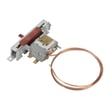
| Temperature regulation | Temps too warm or too cold | Refrigerator temperature control WP2315562 |
| Ice production | No ice or intermittent ice | Ice maker W11700559 |
Why it matters
Cooling, frost, and leak symptoms often cascade: restricted airflow can cause longer run times, moisture buildup, and icing. Catching the root cause early helps protect food temperatures and reduces strain on the compressor.
Last updated: February 2026
What are the main 5 parts of a refrigerator?
The five main parts that make a refrigerator cool are the compressor, condenser coil, evaporator coil, metering device (capillary tube/expansion device), and a temperature control (thermostat/control). On Kenmore model 10641569801, these work together to move heat out of the cabinet and keep food at safe temperatures; see the owner's manual for control and feature details.
The “cooling system” 5-part breakdown
- Compressor: pumps refrigerant through the sealed system and creates the pressure difference that makes cooling possible.
- Condenser coil: releases heat to the room as refrigerant condenses from a hot gas to a warm liquid.
- Metering device (capillary tube/expansion device): drops pressure so refrigerant can boil at a low temperature.
- Evaporator coil: absorbs heat inside the freezer/refrigerator as refrigerant evaporates.
- Temperature control (thermostat/control): senses temperature and cycles cooling to maintain the set point.
Common “major parts” customers also mean (not part of the 5)
Many people use “main parts” to mean the most noticeable service items. On a side-by-side like 10641569801, these are often:
- Evaporator fan (moves cold air through the compartments)
- Defrost system (heater, thermostat, control)
- Door gaskets (keep warm air out)
- Ice maker and dispenser components
Examples of model-matched parts on this page
| Function | Example part name | Part ID |
|---|---|---|
| Temperature control | Refrigerator temperature control | Refrigerator temperature control WP2315562 |
| Defrost heat | Refrigerator heater | Refrigerator heater WP2323198 |
| Defrost sensing | Refrigerator bi-metal thermostat | Refrigerator bi-metal thermostat WPW10225581 |
| Ice production | Ice maker | Ice maker W11700559 |
Why it matters
Knowing which “main part” you mean helps troubleshooting. For example, warm fridge and freezer points toward the sealed system (compressor, coils, metering device), while frost buildup points toward the defrost heater, bi-metal thermostat, or defrost control.
Last updated: February 2026