Owner’s manual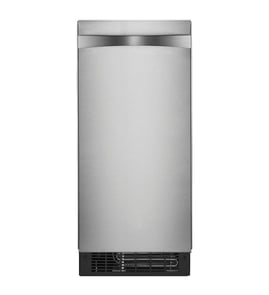


Can I replace my own ice maker?
Yes, you can replace the ice maker in your Kenmore freestanding ice maker model 10689483997 if you are comfortable with basic hand tools and safe electrical practices. We recommend following the step-by-step procedure in the 10689483997 owner's manual so wiring, water connections, and leveling are handled correctly.
Before you start (safety and prep)
- Unplug the ice maker (do not rely on the control being off).
- Shut off the water supply to the unit.
- Empty the ice bin and dry up any standing water.
- Protect the floor; a shallow pan and towels help with drips.
- Take a quick photo of wire connectors and tube routing before disconnecting anything.
Basic replacement overview
Most freestanding ice makers follow the same general process:
- Remove the ice bin and any interior covers.
- Disconnect the ice maker wiring harness (release locking tabs carefully).
- Disconnect the water feed tube and/or distributor tube.
- Remove mounting screws, lift the assembly off its brackets, and transfer any reusable brackets.
- Install the replacement assembly, reconnect wiring and water lines, then restore power and water.
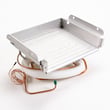
If your issue is poor ice production or leaking rather than a dead ice maker, a targeted part replacement is often faster than replacing the whole assembly. For example, a cracked fill line can be addressed with the water tube W10823511, and water flow problems can point to the valve W10801996.
What to check after installation
- Confirm the unit is level; poor leveling can cause thin ice or harvest issues.
- Check all water connections for leaks during the first few fill cycles.
- Listen for the condenser fan; airflow problems can reduce ice output.
- Run a cleaning cycle if the unit has been sitting; scale buildup can affect performance.
| Symptom after replacement | Most common cause | What we recommend |
|---|---|---|
| No water fill | Water supply off, kinked line, inlet valve issue | Verify shutoff valve is open; inspect line; test/replace inlet valve |
| Leaks inside cabinet | Loose tube connection, cracked tube | Reseat tube; replace damaged tube |
| Slow ice production | Dirty condenser, poor airflow, warm room | Clean condenser area; ensure ventilation clearance |
Why it matters
Replacing the correct component prevents repeat leaks, electrical damage, and low ice output. Using the manual steps for model 10689483997 also helps you avoid breaking harness tabs and misrouting the water tube.
Last updated: January 2026
Is it worth replacing the ice maker on a refrigerator?
Yes, it’s usually worth replacing a refrigerator ice maker when the refrigerator is otherwise in good shape and the fix is limited to common service parts (valve, thermostat, water tube). For Kenmore ice systems like model 10689483997, checking the basics in the 10689483997 owner’s manual helps you avoid replacing more than you need.
Quick decision checklist
- Replace the ice maker or ice system parts if the refrigerator cools normally and only ice production is failing.
- Replace individual parts first when symptoms point to a single failure (no fill, small cubes, leaking, slow harvest).
- Consider replacing the refrigerator if it has sealed-system cooling problems (warm temps, constant running) plus ice issues.
- Replace the refrigerator if repair cost approaches about half the price of a comparable new unit.
- Keep the refrigerator and add a standalone unit if you need high ice output and reliability.
Common “replace the part, not the whole ice maker” fixes
Many ice complaints are caused by water supply or control parts, not the entire ice maker assembly.
| Symptom | Most likely area to check | Example part for this system |
|---|---|---|
| No water entering ice maker | Water inlet valve, supply line, shutoff | Valve W10801996 |
| Leaking or misdirected fill water | Fill tube or distributor tube | Water tube W10823511 |
| Ice production stops or cycles oddly | Bin thermostat or sensing issue | Ice maker bin thermostat WPW10503764 |
Why it matters
Replacing the whole ice maker can cost more than necessary if the real issue is a restricted fill tube, a weak inlet valve, or a failed thermostat. Targeting the correct part typically restores ice production faster and reduces repeat problems.
What we recommend before you decide
- Confirm the freezer temperature is consistently cold enough for ice production.
- Verify household water supply is on and pressure is adequate.
- Inspect for kinks, freezing, or mineral buildup in the fill path.
- Use the diagnostic and operating steps in the 10689483997 owner’s manual to match symptoms to the right component.
Last updated: January 2026
How do I reset the icemaker on a Kenmore refrigerator?
For Kenmore model 10689483997 (a freestanding ice maker), the most reliable “reset” is a power reset: turn the unit off, disconnect power for a few minutes, then restore power and let it restart its harvest cycle. For model-specific control locations and timing, use the 10689483997 owner's manual.
Quick reset steps (power reset)
- Turn the ice maker OFF using the power switch or control (if equipped).
- Unplug the unit or switch OFF the circuit breaker.
- Wait 5 minutes to fully clear the control.
- Restore power and turn the unit ON.
- Allow 15 to 30 minutes for the first cycle to begin (longer if the unit is warm).
If it still will not restart
These checks solve most “won’t make ice after reset” complaints.
- Confirm the water supply valve is fully open and the supply line is not kinked.
- Check for a frozen, pinched, or leaking fill line; a damaged fill line often points to the water tube W10823511.
- Make sure the room temperature and airflow around the condenser area are adequate.
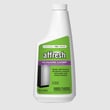
- Clean the unit if scale buildup is suspected; use a cleaner made for freestanding ice makers such as freestanding ice maker cleaner W11179302.
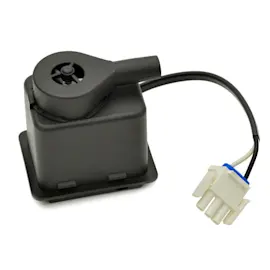
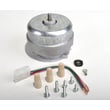
- If the unit runs but does not cool well, inspect the condenser fan operation; a failed fan motor can be the condenser motor W10822259.
What “reset” actually does (and why it matters)
A reset clears a stuck control state and forces the ice maker to reinitialize its sensors and cycle timing. If the underlying issue is water flow, mineral scale, or poor condenser cooling, the unit may appear “reset” but still will not produce ice.
Reset vs. fix: quick guide
| Symptom after reset | Most likely area to check | Common next step |
|---|---|---|
| No water entering | Water supply, inlet path | Verify supply; inspect fill tube |
| Water enters, no ice | Cooling/airflow, condenser | Clean condenser area; verify fan |
| Small or hollow cubes | Water restriction or scale | Clean system; check for kinks |
| Leaks during fill | Fill tube or connections | Inspect/replace fill tube |
Last updated: January 2026
Why is my free standing ice maker not making ice?
If your Kenmore freestanding ice maker model 10689483997 runs but won’t make ice, the most common causes are no water getting to the reservoir, poor water distribution over the evaporator plate, or a cooling/airflow problem. Use the 10689483997 owner's manual to confirm the correct start-up and water supply checks.
Quick checks (fastest fixes first)
- Confirm the unit is powered on and the ice bin is seated correctly.
- Make sure the water supply valve is fully open and the supply line is not kinked.
- Verify the reservoir is filling; if it is empty, the issue is usually water supply or the inlet valve.
- Look for a frozen, pinched, or leaking fill line; inspect the water tube W10823511.
- Check that the condenser area is not clogged with dust and that airflow is not blocked.
What the symptoms usually mean
| What you see | What it points to | What to do next |
|---|---|---|
| Reservoir empty | Water supply issue or inlet valve not opening | Check shutoff valve, line kinks, then test/replace valve W10801996 |
| Reservoir full but evaporator plate stays dry | Water not circulating or not distributing | Inspect water path and distributor; check dispenser W10863947 for blockage |
| Unit runs, warm cabinet, little or no ice | Cooling/airflow problem | Clean condenser area; if fan not running, suspect condenser motor W10822259 |
Why it matters
An ice maker can “run” (lights on, pump noise, fan noise) but still make no ice if water never reaches the evaporator plate or if the condenser cannot reject heat. Fixing water flow and airflow early helps prevent long run times and poor ice production.
When a part is commonly needed
- Water inlet valve: If water supply is good but the reservoir never fills, valve W10801996 is a common failure point.
- Water tube or distributor: If you see leaks, weak flow, or uneven water over the plate, check water tube W10823511 and dispenser W10863947.
- Condenser fan motor: If the condenser fan is not spinning or is noisy, condenser motor W10822259 can restore proper cooling.
Last updated: January 2026