Installation guide
 Owner’s manual
 Error Codes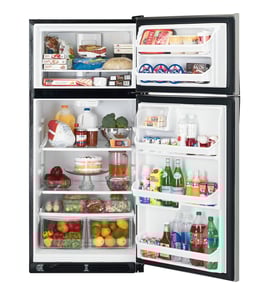



What are the disadvantages of a top mount fridge?
Top-mount refrigerators like the Kenmore 2536880201D put the freezer at eye level and the fresh-food section below; the main disadvantages are more bending to reach everyday items, fewer convenience features on many models, and less flexible organization compared with some bottom-freezer designs. For model-specific setup limits (clearances, room temperature range), use the owner's manual.
Common disadvantages (what most owners notice)
- More bending for fresh food: the refrigerator compartment sits lower, so you reach down more often.
- Less “grab-and-go” convenience: many top-mount designs do not include external water or ice dispensing.
- Organization can feel tighter: door bins and crisper layouts are often simpler than premium layouts.
- Freezer access can dominate: frequently used freezer items are easy to reach, but fresh-food items are not.
- Door swing and placement constraints: you may need extra side clearance if the hinge side is near a wall.
Setup and environment limits that can feel like “disadvantages”
Even a great top-mount can perform poorly if the install conditions are off. For this Kenmore model, the guidance includes:
- Install on a level, solid floor.
- Avoid direct sunlight and nearby heat sources.
- Do not block the toe grille; airflow matters.
- Avoid locations below 55°F (13°C) or above 110°F (43°C); performance can suffer.
Quick reference: top-mount vs bottom-freezer
| Feature | Top-mount refrigerator | Bottom-freezer refrigerator |
|---|---|---|
| Fresh-food access | Lower, more bending | Higher, easier access |
| Freezer access | Higher, easier access | Lower, more bending |
| Typical features | Often simpler | Often more feature-rich |
| Footprint | Often compact | Varies widely |
Why it matters
If you use fresh foods daily, the lower refrigerator section can be the biggest day-to-day annoyance. If you use frozen foods more often, a top-mount layout can actually feel more convenient.
Last updated: February 2026
What is the top part of a fridge called?
On a Kenmore 2536880201D top-mount refrigerator, the top section is the freezer compartment. It’s the insulated area designed to keep food frozen, and it also houses key cooling airflow components that help the fresh food section stay cold.
What you’ll typically find in the top (freezer) section
- Freezer shelves or bins for frozen food storage
- An evaporator area behind an interior panel (where cold is produced)
- Air vents that send cold air down to the refrigerator compartment
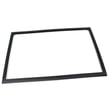
- A freezer door gasket that seals the door to prevent warm air leaks
- A freezer door handle and hinges for opening and alignment
Freezer vs. refrigerator compartment (quick comparison)
| Section | Common name | Main job | Typical temperature |
|---|---|---|---|
| Top section | Freezer compartment | Freezes and stores frozen foods | 0°F |
| Bottom section | Fresh food (refrigerator) compartment | Keeps foods chilled (not frozen) | 37°F to 40°F |
Why the name matters when ordering parts
Parts lists and diagrams for model 2536880201D usually separate items by freezer door, freezer liner, or fresh food section. Using the correct section name helps you match the right part the first time.
If you’re troubleshooting frost buildup, warm temperatures, or poor airflow, freezer-related parts are often involved, such as the defrost system or evaporator fan components.
Helpful model-specific references
- For door removal, handle reversal, leveling, and installation clearances, use the installation guide.
- For compartment features (like crispers and storage) and operating tips, use the owner's manual.
Last updated: February 2026
What water filter fits my Kenmore fridge?
For Kenmore model 2536880201D, the correct water filter is the one that matches your refrigerator’s filter housing and the part number printed on your current filter (or listed for your exact model in the documentation). Use the 2536880201D owner's manual to confirm the filter style and replacement steps.
How to identify the right filter (fast)
- Check the model tag inside the fresh food compartment: 2536880201D
- Remove the current filter and read the printed part number on the label
- Confirm the filter location (inside the refrigerator, in the grille, or inline on the water line)
- Match the shape and end connections (twist-in, push-in, or inline fittings)
- If your unit uses an inline filter, verify your water line setup and shutoff valve access
If your refrigerator uses an inline water filter
Some installations use an inline filter on the water supply line rather than a cartridge inside the cabinet. Your installation requirements call for a cold water line with 30 to 100 psi and recommend copper tubing (plastic tubing is more likely to leak). For water line and filter placement details, use the installation guide.
Quick inline setup checklist
- Confirm water pressure is within 30 to 100 psi
- Use 1/4-inch OD copper tubing where possible
- Use a standard shut-off valve (avoid self-piercing valves)
- Flush the supply line until water runs clear before final connection
Common outcomes and what they mean
| What you find | What it usually means | What to do next |
|---|---|---|
| Filter has a clear printed number | You already have the exact match | Replace using the same number |
| No filter inside the fridge | You may have an inline filter or no filtration | Check the water line and installation guide |
| Filter won’t seat or leaks | Wrong style or damaged seals/housing | Recheck style, inspect housing, reinstall carefully |
Why it matters
Using the correct filter keeps water flow steady for the dispenser and ice maker, helps reduce taste and odor issues, and prevents leaks caused by mismatched seals or connections.
Last updated: February 2026
Will a 33 fridge fit in a 33 opening?
A “33-inch” refrigerator usually will not fit well in a true 33-inch-wide opening because you still need clearance for airflow, leveling, and door swing. For Kenmore model 2536880201D, plan for extra space beyond the cabinet width and follow the clearance guidance in the owner's manual.
Minimum clearance to plan for
Most installations need more than the advertised width so the refrigerator can breathe and the doors can open without rubbing.
- Leave about 3/8 inch clearance at the sides and top for installation and air circulation.
- Leave about 1 inch clearance at the back for airflow and connections.
- If the hinge side is against a wall, allow additional space so the door can open wider.
- Make sure the unit can be leveled (front-to-back slope helps doors close and seal).
- Confirm the opening is square; tight cabinets often vary by 1/8 inch or more.
Quick fit check (what to measure)
Use this checklist before you buy or move a refrigerator into place:
- Opening width at front and back (cabinet faces are not always parallel)
- Opening height (including trim or a cabinet lip)
- Depth to the wall plus space for cords and the water line (if used)
- Door swing clearance (handles and hinges can add width)
- Pathway clearance (doorways, turns, and flooring transitions)
Typical “33-inch opening” outcomes
| Opening width | What usually happens | Recommendation |
|---|---|---|
| 33" exactly | Extremely tight; poor airflow risk; doors may rub | Avoid unless the fridge is clearly under 33" and clearance is still met |
| 33 3/8" to 33 1/2" | Often workable for many 33" models | Verify actual cabinet width and hinge-side clearance |
| 34" or more | Comfortable install | Best for ventilation and service access |
Why it matters
Proper clearance helps your Kenmore refrigerator cool efficiently, prevents overheating, and reduces door-seal problems. The manual also notes that leveling the cabinet helps doors close and seal correctly, which protects food temperatures and reduces frost issues.
Last updated: February 2026
What size is a Kenmore 2536880201D refrigerator?
The size (width, height, and depth) for your Kenmore 2536880201D is the set of published dimensions in the owner's manual. For installation planning, use those specs and also allow the required airflow clearances from the installation guide.
What “size” usually means (and what to record)
When we talk about refrigerator size, we mean exterior dimensions plus the space needed to install and open the doors.
- Width: cabinet at the widest point (not just the doors)
- Height: floor to the top of the cabinet or hinge cover
- Depth: back of cabinet to the front of the doors (measure handles separately)
- Door swing space: room for doors to open without hitting walls or cabinets
- Pathway fit: narrowest doorway and any tight turns for moving it in
Model-specific installation clearances for 2536880201D
The installation instructions for this Kenmore top-mount platform specify these minimum clearances for air circulation:
| Location | Minimum clearance |
|---|---|
| Sides and top | 3/8 inch |
| Rear | 1 inch |
Quick measuring checklist
Measure with the refrigerator in its normal position and doors closed.
- Measure twice and write down inches to the nearest 1/8
- Note whether you are measuring with handles or without handles
- If you are placing it in a cutout, confirm the floor is level and solid
Why it matters
Using the published dimensions and required clearances prevents poor cooling, rubbing doors, and an installation that will not slide fully into place.
Last updated: February 2026