Installation guide
 Owner’s manual
 Error Codes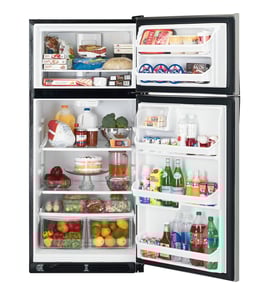


How to tell cubic feet of Kenmore refrigerator by model number?
For Kenmore refrigerator model 25378892010, the most reliable way to get cubic feet is to look up the capacity in the 25378892010 owner's manual. If you need a quick estimate, you can calculate interior volume from measurements, but the model number itself usually does not directly state cubic feet.
- Check the specifications section in the 25378892010 owner's manual.
- Look for a rating/spec label inside the fresh food compartment (often on a side wall or near the crisper area); it may list capacity.
- Search the model’s published specs using the full model number (25378892010), not a partial.
- Estimate capacity by measuring the interior (helpful if labels are missing).
- Empty the refrigerator enough to measure the usable interior.
- Measure width x depth x height (in inches) of the fresh food section and freezer section.
- Convert each section to cubic feet:
- Cubic feet = (W x D x H) / 1728
- Add the two section totals.
| Measurement unit | Convert to cubic feet |
|---|---|
| Cubic inches | Divide by 1728 |
| Cubic feet | No conversion needed |
Kenmore model numbers (including 253-series units) are best for identifying the correct parts, features, and documentation. Capacity can vary within a series, so using the manual/spec listing is the accurate method.
Capacity is interior volume; installation clearances are about airflow and fit. For this model, the installation guide covers placement basics like allowing space for ventilation and avoiding extreme room temperatures.
Last updated: January 2026
What is the upper part of a fridge called?
On the Kenmore 25378892010 top-mount refrigerator, the upper section is the freezer compartment. It’s the coldest area of the appliance, designed to keep foods frozen, support proper cold-air circulation, and (on some setups) supply ice through an automatic ice maker.
Common components and features in the top freezer include:
- Freezer shelves and door bins for frozen food storage
- Cold-air vents that help circulate air through the refrigerator section
- Defrost system components (heater, thermostat, and controls) that prevent heavy frost buildup
- Optional automatic ice maker parts (if equipped)
- The freezer door gasket that seals in cold air
For model-specific layout and storage guidance, use the 25378892010 owner's manual.
| Area | Primary purpose | Typical temperature target |
|---|---|---|
| Freezer compartment (upper) | Long-term frozen storage, ice production | 0°F |
| Fresh food compartment (lower) | Short-term refrigerated storage | 37°F |
Knowing the correct name helps when you’re troubleshooting symptoms (like frost buildup or warm temperatures) and when you’re ordering parts. For example, a poor seal at the freezer door can let warm air in and create frost, which can reduce cooling performance.
If you’re asking because the top section is not cooling well, these checks usually help first:
- Make sure packages are not blocking freezer vents; airflow matters
- Avoid overloading the freezer with warm food at one time
- Confirm the doors close tightly and the refrigerator is level
- Listen for normal defrost-cycle sounds (hissing/sizzling, popping) described in the manual
- If you suspect a worn seal, inspect the door gasket for gaps or tears
If you’re replacing a seal, match the color and fit to your door; one option used on this model is the refrigerator gasket 242193213.
Last updated: January 2026
Is there a way to reset a Kenmore Elite refrigerator?
Yes. For the Kenmore 25378892010 top-mount refrigerator, the most reliable “reset” is a hard power reset: unplug the refrigerator (or switch off the breaker) for about 5 to 10 minutes, then restore power and allow the controls to reboot and cooling to restart.
- Unplug the refrigerator or turn the circuit breaker off.
- Wait 5 to 10 minutes (this clears the control’s temporary state).
- Restore power.
- Set the temperature controls back to your normal settings.
- Give the refrigerator time to stabilize (cooling changes are not instant).
For model-specific control and operating details, use the 25378892010 owner’s manual.
A reset helps most when the issue is a temporary control glitch. If cooling, door sealing, or airflow is the real problem, the symptoms usually return.
- Make sure the toe grille is not blocked (air circulation matters for proper operation).
- Confirm the cabinet is level and the doors close freely.
- Check that the doors align and seal evenly.
- Verify the room temperature is in a normal operating range (many refrigerators perform best around 70°F to 80°F).
- If the unit was moved, re-level it before judging cooling performance.
| Situation | What a reset can do | What usually fixes it |
|---|---|---|
| Control panel acting odd | Reboots electronics | Power reset, then verify settings |
| Not cooling well | Rarely fixes root cause | Airflow, door seal, defrost system checks |
| Door not closing | Does not help | Leveling and door alignment |
Resetting is a safe first step because it restores normal control operation without replacing parts. If the refrigerator is not level or airflow is restricted, the compressor and fans can run longer and temperatures can drift even after a reset.
If you suspect a door seal problem, our how to fix a fridge door seal guide pairs well with checking the door gasket condition.
Last updated: January 2026