 Owner’s manual
 Error Codes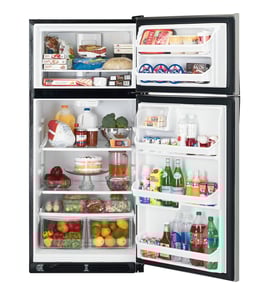


How much top clearance does a fridge need?
Most refrigerators, including the Kenmore 79578032210 top-mount style, need about 1 inch of open space above the cabinet (not above the hinge) so heat can vent properly and the compressor does not run excessively. For the exact installation clearances for your unit, use the 79578032210 owner's manual.
Recommended clearances (typical)
Use these spacing targets unless your manual specifies something different:
- Top: about 1 inch above the refrigerator case
- Sides: 1/8 inch to 1 inch per side (more space helps airflow and door swing)
- Back: 1 to 2 inches for ventilation and water line clearance (if equipped)
- Front: enough room for full door opening and drawer removal
Quick clearance guide
| Location | Typical minimum | Why it matters |
|---|---|---|
| Top | 1 in. | Lets warm air escape; improves cooling efficiency |
| Sides | 1/8 to 1 in. each | Prevents cabinet rubbing; improves airflow |
| Back | 1 to 2 in. | Protects coils/lines; reduces overheating |
Why clearance matters for cooling and energy use
Refrigerators reject heat through the condenser area. When the top or back is too tight, heat builds up, which can cause longer run times, warmer temperatures, and higher energy use.
Tips before you slide the refrigerator into place
- Confirm the cabinet opening is square and the floor is level.
- Clean dust from the condenser area before final placement.
- Avoid pinching the power cord or any water line behind the unit.
- Recheck door swing clearance so bins and shelves do not hit nearby walls.
Last updated: February 2026
What is the top part of a fridge called?
On a Kenmore top-mount refrigerator like model 79578032210, the top compartment is called the freezer. It’s the section designed to keep food at freezing temperatures and, on many models, it also supports ice-making (with an ice maker or ice tray).
What the freezer does (and what’s usually inside)
The freezer is built to maintain temperatures at or below 0°F for safe long-term storage.
Common freezer-related features include:
- Freezer shelves or bins for organizing frozen foods
- An evaporator area that produces cold air
- An evaporator fan that circulates cold air through the freezer and into the fresh-food section
- A defrost system (heater, thermostat/sensor, and control) that prevents heavy frost buildup
- Optional ice maker components (if your unit is equipped)
Quick terminology guide
Here are the most common names you’ll see in the refrigerator literature:
| What people call it | Common name in manuals/parts lists | Where it is |
|---|---|---|
| Top part of the fridge | Freezer compartment | Top (top-mount design) |
| Bottom part of the fridge | Fresh food compartment (refrigerator section) | Bottom |
| “Fridge” (whole appliance) | Refrigerator | Entire unit |
Why it matters
Using the right term helps you find the correct instructions and parts faster, especially when you’re troubleshooting cooling issues, frost buildup, or ice maker problems. For model-specific diagrams and compartment names, check the owner's manual.
Last updated: February 2026
What water filter fits my Kenmore fridge?
For Kenmore model 79578032210, the correct water filter depends on the filter style used in your exact configuration (cartridge in the fresh food section, or an inline filter on the water line). We match the right filter by confirming your model number and the filter part number printed on the old filter or listed in the owner's manual.
How to identify the right filter for 79578032210
Use these quick checks before ordering:
- Look for the old filter’s part number printed on the cartridge or cap.
- Check the filter location: inside the refrigerator compartment, in the base grille, or inline behind the unit.
- Confirm the model tag inside the refrigerator reads 79578032210 (character-for-character).
- Note your symptoms: slow water flow and hollow ice cubes often point to a restricted filter.
- If you do not see a cartridge, your refrigerator may use an inline filter on the supply line.
What to do if you do not have the old filter
If the old filter is missing or the label is unreadable, use this approach:
- Find the filter housing location and any numbers on the housing or cap.
- Use the filter replacement section in the owner's manual to confirm the filter type and reset steps.
- If your unit uses an inline filter, match by the inline filter’s printed part number and tubing size.
Common Kenmore filter number formats (what you might see)
These are common Kenmore filter identifiers customers recognize; we use them as cross-reference clues, not as a guarantee of fit.
| What you see | What it usually means | What to do next |
|---|---|---|
| 9081, 9083, 9690, 9990 | Kenmore retail filter numbers | Match to the exact filter part number for 79578032210 |
| LT-series style numbers | Often used on LG-built Kenmore units | Match to the cartridge label or manual listing |
Why it matters
Using the wrong water filter can cause leaks, poor water flow, bad taste, or an ice maker that stops filling. The correct filter keeps water pressure stable and protects the water valve and ice maker.
For step-by-step help with filter styles and replacement tips, use how to replace the water filter in a Kenmore refrigerator.
Last updated: February 2026
How to tell how old a Kenmore refrigerator is by serial number?
To estimate the age of your Kenmore refrigerator model 79578032210, use the serial number on the rating label: the first characters typically encode the manufacturing date (month and year), and the remaining digits identify the production sequence. We use that date code to determine how old the unit is.
Where to find the serial number
Check the model and serial tag (rating label). Common locations on top-mount refrigerators include:
- Inside the fresh food compartment on a side wall
- On the ceiling of the refrigerator compartment
- Behind the crisper drawers
- On the cabinet frame near the door opening
- Occasionally on the back exterior panel
For label location and how it is formatted on your unit, check the owner's manual.
How to read the serial number date code
Kenmore refrigerators are built by different manufacturers, so the serial number format is not universal. The most reliable approach is:
- Write down the full serial number exactly as shown
- Note any prefix letters at the beginning
- Look for a month code (often a letter) and a year code (often a letter or number)
- Compare the pattern to the serial number chart in your documentation
Quick guide to what the characters usually mean
| Serial number section | What it usually indicates | What you do with it |
|---|---|---|
| First 1 to 2 letters/numbers | Date code (month/year) | Convert to a build month and year |
| Middle digits | Plant/line info | Not needed for age |
| Last digits | Sequence number | Not needed for age |
If you need a practical age estimate
Once you decode the build month and year, the refrigerator’s age is simply the time from that build date to today. For example, a unit built in March 2016 is about 10 years old as of February 2026.
Why it matters
Knowing the build date helps you choose compatible refrigerator parts (like a door switch, shelf, or control board), plan maintenance, and decide whether a cooling or ice maker issue is worth repairing.
Last updated: February 2026
What are the most common problems with Kenmore refrigerators?
The most common issues we see on Kenmore refrigerators like model 79578032210 are cooling problems, water leaks, ice maker troubles, frost buildup, unusual noises, and door sealing or control issues. Many of these start with airflow restrictions, dirty condenser coils, or a failing fan, sensor, or control.
Most common symptoms and what usually causes them
- Not cooling or warm fridge/freezer: dirty condenser coils, failed condenser fan motor, evaporator fan issues, or a control/sensor problem
- Freezer cold but fridge warm: air damper not opening, blocked vents, frost restricting airflow
- Water leaking or puddles: clogged defrost drain, cracked water line, or ice maker fill issues
- Ice maker not making ice: water supply problem, frozen fill tube, ice maker failure
- Noisy operation: fan blade hitting ice, worn fan motor, loose mounting hardware
- Door not closing or warm spots: misalignment, worn hinge/bushing, or gasket not sealing
Quick checks we recommend first (before replacing parts)
- Set temps to typical targets: 37°F fresh food, 0°F freezer.
- Make sure vents are not blocked by food packages.
- Clean condenser coils and confirm the condenser fan runs when the compressor is running.
- Listen for the evaporator fan in the freezer; a stalled fan often means poor cooling.
- Check door closure with the “paper test” (paper should drag when pulled).
Parts that commonly solve these problems on 79578032210
If troubleshooting points to a failed component, these model-matched parts are commonly involved:
| Symptom | Common suspect part | Example model-matched part |
|---|---|---|
| Warm temps, poor airflow | Condenser fan motor | Refrigerator condenser fan motor EAU61644105 |
| Door light issues, fan stops when door shuts | Door switch | Lg refrigerator door switch 6600JB1010A |
| Frost or airflow restriction noises | Fan blade interference or damage | Refrigerator evaporator fan blade 5901JJ1003A |
| Erratic temps | Sensor/harness issue | Refrigerator harness assembly 6500JB2001B |
| Dead display or odd behavior | Main control problem | Refrigerator electronic control board EBR74799502 |
Why it matters
Cooling and ice maker complaints often trace back to airflow and heat removal. Keeping coils clean and fixing fan, damper, or sensor problems early helps prevent food spoilage and reduces compressor strain.
Helpful model-specific guidance
Use the owner's manual for your exact control settings, airflow locations, and any diagnostic indicators specific to Kenmore model 79578032210.
Last updated: February 2026





