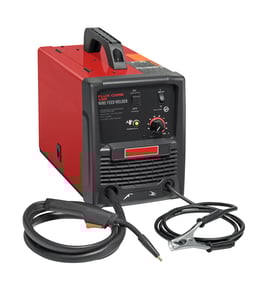

Can Lincoln welders be repaired?
Yes. Lincoln welders, including the Lincoln SP135T, can typically be repaired by troubleshooting common electrical and feed issues first, then replacing failed components (such as switches, fuses, cables, or wire-feed parts) when needed. For complex internal faults, professional service is the safest path.
- Verify the outlet and input power are correct and stable.
- Inspect the power cord, plug, and ground clamp for heat damage or looseness.
- Check for a blown fuse or tripped breaker (especially after a short or overload).
- Look for loose, burned, or broken wires at terminals and connectors.
- Confirm the wire spool turns freely and the drive rolls are feeding smoothly.
- Make sure the gun consumables (tip/nozzle/liner) are not clogged or worn.
| Symptom | Likely cause | Typical fix |
|---|---|---|
| No power | Blown fuse, bad switch, damaged cord | Test power path; replace failed component |
| Wire will not feed | Worn drive parts, bad trigger circuit, liner blockage | Clean/replace feed parts; repair wiring |
| Arc is weak or unstable | Poor ground, bad connections, incorrect settings | Clean/tighten connections; reset parameters |
| Trips breaker | Shorted cable, internal short, overload | Inspect cables; test circuits before reuse |
A welder combines high current and heat; a small wiring fault or poor connection can cause erratic welds, nuisance breaker trips, or component damage. Systematic checks help you fix the real cause instead of replacing parts at random.
We list replacement parts by model when available. If you do not see the exact Lincoln SP135T part you need, search by the full model number on Sears PartsDirect to find compatible components and diagrams.
For electrical diagnosis, these DIY resources help you test safely and accurately:
- How to tell if a fuse is blown
- How to use a multimeter to test electrical parts video
- How to repair broken or damaged wires video
Last updated: February 2026
How much is a Lincoln SP135T?
Pricing for the Lincoln SP135T welder varies widely by condition and what is included (gun, regulator, cart, consumables). For a used SP135T, most listings land in the low hundreds of dollars; for a new-in-box unit, pricing is typically higher when available. For current availability and pricing, search by model on Sears PartsDirect.
- Condition: new, refurbished, lightly used, or “for parts”
- Included accessories: MIG gun, ground clamp, gas regulator/flowmeter, spool gun capability, cart
- Input power setup: 120V plug condition, cord integrity, and whether it trips breakers
- Consumables and extras: wire spools, contact tips, nozzles, drive rolls
- Local market: pickup-only deals often price lower than shipped units
| SP135T situation | What you’re usually paying for | Typical price range (USD) |
|---|---|---|
| For parts / not welding | Transformer, board, or feed issues | $50 to $200 |
| Used and working | Basic welder only | $200 to $450 |
| Used with accessories | Welder plus regulator, cart, consumables | $350 to $650 |
| New old stock (if found) | Unused, complete package | $600+ |
- Confirm the data plate shows SP135T (not a similar Lincoln model).
- Ask if it feeds wire smoothly at multiple settings (no surging).
- Check the drive system: tension arm, drive roll wear, and liner condition.
- Inspect cables and clamps for heat damage or stiff/brittle insulation.
- If possible, do a short test weld on clean steel and listen for steady arc.
A “cheap” welder with wire-feed problems or damaged leads can quickly cost more after repairs and consumables. Paying a bit more for a smooth-feeding SP135T with intact wiring usually saves time and frustration.
Last updated: February 2026
How to tell the year of Lincoln Welder by serial number?
For a Lincoln SP135T welder, the serial number is primarily an identifier; the most reliable way to determine the build year is to use the complete model number plus the full serial (and any “code” number on the data plate) when looking up the unit’s production information and correct parts.
On SP135T units, the information you need is typically on the rating or data plate on the welder cabinet.
- Check the exterior side or rear panel of the welder case
- Look near the wire spool compartment area (inside the door on some units)
- Write down the full serial number exactly as printed
- If a separate “code” number is listed, record it too
- Take a clear photo of the entire data plate for reference
Instead of assuming the year is “encoded” in the serial, use the serial as a lookup key along with the model.
- Search using the exact model number SP135T plus the full serial number
- Include the code number if present; it often distinguishes production revisions
- Compare your welder’s features (controls, drive assembly style, gun connection) to the parts diagrams you find
| Data plate item | Example format | Why it matters |
|---|---|---|
| Model number | SP135T | Identifies the product family and parts system |
| Serial number | Letters and numbers | Uniquely identifies your specific unit |
| Code number (if shown) | Numeric | Helps match the correct revision and parts fit |
Welders can have running changes during production. Using the model, serial, and any code number together helps us match the correct wiring, switches, drive components, and other replacement parts for your exact SP135T.
Start with the parts list for your model, then use Sears PartsDirect to search by SP135T and narrow results using the serial and any code number from the data plate.
Helpful identification reference:
Last updated: February 2026
How thick of steel can a 200 amp MIG welder weld?
A true 200-amp MIG welder commonly welds mild steel up to about 1/4 inch in a single pass; thicker sections (5/16 to 3/8 inch) are typically done with beveling and multi-pass technique. Your Lincoln SP135T is a smaller-output MIG, so expect best results on thinner steel and use joint prep for thicker work.
- Single-pass, short-circuit MIG: up to about 1/4 inch (6 mm) on a true 200A machine
- Multi-pass with bevel: 5/16 inch (8 mm) is common; 3/8 inch (9.5 mm) is achievable with excellent prep and heat control
- Flux-cored wire (FCAW-S): often increases penetration versus solid wire on the same machine
- Preheat (when appropriate) helps on thicker plate by reducing heat sink
- Joint prep: bevel (V-groove), root gap, and tight fit-up matter more than the number on the dial
- Transfer mode: short-circuit vs spray (spray requires the right machine, wire, and gas)
- Wire type and size: solid wire vs flux-cored; larger wire generally carries more current
- Shielding gas: CO2-rich mixes run hotter than argon-rich mixes (penetration changes)
- Duty cycle: thicker steel needs longer arc time; pauses can be required to prevent overheating
| Steel thickness | 200A MIG typical approach | Notes |
|---|---|---|
| 1/8 in (3 mm) | Single pass | Easy range |
| 3/16 in (5 mm) | Single pass | Watch travel speed |
| 1/4 in (6 mm) | Single pass (best case) | Common single-pass max |
| 5/16 in (8 mm) | Multi-pass + bevel | Prep is key |
| 3/8 in (9.5 mm) | Multi-pass + bevel, sometimes preheat | Advanced setup |
Thickness ratings are really about penetration and fusion, not bead appearance. On thicker steel, beveling and multi-pass welding prevent lack of fusion and weak joints.
For replacement parts and diagrams for your Lincoln SP135T welder, search by model number on Sears PartsDirect.
Last updated: February 2026