Owner’s manual
 Error Codes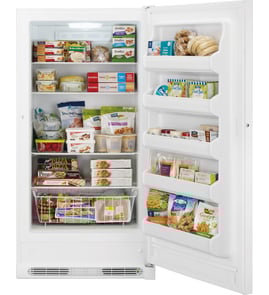



How do I find the cubic feet of my Kenmore freezer?
To find the cubic feet of your Kenmore Pro freezer model 25344833600, we measure the usable interior space (height × width × depth in inches) and divide by 1,728. For model-specific cabinet layout and interior features that affect usable space, use the 25344833600 owner’s manual.
Steps to calculate cubic feet
- Empty enough space to measure: Remove bulky bins or shelves if they block your tape measure.
- Measure the interior opening in inches:
- Height (top interior to bottom interior)
- Width (left interior wall to right interior wall)
- Depth (back interior wall to inside front edge)
- Multiply:
height × width × depth = cubic inches - Convert to cubic feet:
cubic inches ÷ 1,728 = cubic feet
Quick checklist for accurate measurements
- Measure inside the cabinet, not the outside case.
- Measure to the nearest 1/8 inch for best accuracy.
- If shelves or an air diffuser reduce usable space, measure the largest open rectangle you can.
- Keep the door open briefly so warm air does not build up.
- If your freezer has a door temperature gauge, ignore it for capacity; it is for temperature, not volume.
Example calculation
| Measurement | Example (inches) |
|---|---|
| Height | 60 |
| Width | 24 |
| Depth | 20 |
| Cubic inches | 28,800 |
| Cubic feet (÷ 1,728) | 16.7 |
Why it matters
Cubic feet helps you compare freezer capacity, plan food storage, and confirm you are buying correctly sized accessories (like baskets and organizers) for your Kenmore Pro upright freezer.
Last updated: January 2026
Is there a reset button on a Kenmore upright freezer?
Kenmore upright freezers such as model 25344833600 typically do not have a dedicated “reset” button. The most reliable reset is a power reset (unplugging briefly, then restoring power) and then re-setting the electronic temperature controls inside the cabinet per the 25344833600 owner's manual.
How to reset it safely (recommended)
- Unplug the freezer (or switch the breaker off).
- Wait 5 minutes to let the control board fully power down.
- Restore power.
- Set the temperature using the UP button for warmer and DOWN button for colder.
- Allow several hours for temperatures to stabilize after any adjustment.
What to check if it still will not “reset”
If the control panel is unresponsive or temperatures do not stabilize, focus on the most common causes first.
- Confirm the outlet has power (try a lamp or small appliance).
- Make sure the door is closing and sealing; a torn gasket can cause temperature issues.
- Listen for the evaporator fan; no airflow can mimic a control problem.
- Check for heavy frost buildup that can indicate a defrost system issue.
- If the freezer has an ice maker, remember no ice is produced during the first 24 hours after initial startup.
Quick reference: “reset” options
| Situation | What we recommend | What to expect |
|---|---|---|
| Controls acting glitchy | Power reset (5 minutes unplugged) | Controls reboot and resume normal operation |
| Temperature not changing quickly | Adjust UP/DOWN, then wait | Several hours to stabilize |
| Poor sealing or warm spots | Inspect/replace gasket | More consistent temps and less run time |
Why it matters
A power reset clears minor electronic glitches, but temperature performance depends on airflow, door sealing, and defrost operation. Resetting without fixing an underlying issue can lead to thawing, frost buildup, or long run times.
Last updated: January 2026
Which upright freezers are garage ready?
An upright freezer is “garage ready” only when the manufacturer states it is approved to run in an unheated space across a specified ambient temperature range. For Kenmore Pro model 25344833600, use the ambient temperature and location requirements in the 25344833600 owner's manual to decide if your garage conditions fit.
How to identify a garage-ready upright freezer
We recommend using the product specifications and the use and care information, not the label alone.
Look for:
- A stated “garage ready” or “garage installation” approval
- A published ambient operating temperature range (minimum and maximum room temperature)
- Guidance for unheated spaces (winter operation, hot-weather operation)
- Electrical requirements (dedicated, grounded outlet; no extension cord)
- Clearance and airflow requirements around the cabinet
What to check for your Kenmore Pro 25344833600
The manual for this model includes operating and setup guidance you can match to your garage environment.
Verify these items:
- Allowed ambient temperature range for operation
- Required clearances for ventilation
- Temperature control adjustment guidance and stabilization time
- Door sealing and leveling guidance (helps prevent warm air leaks)
Quick comparison table (what “garage ready” should include)
| Spec or statement | What you want to see | Why it matters |
|---|---|---|
| Ambient temperature range | A clearly stated min and max | Confirms it can run in hot and cold garages |
| Location approval | “Garage/unconditioned space” allowed | Prevents performance issues in extreme temps |
| Ventilation clearance | Specific side/back/top clearances | Protects compressor cooling and efficiency |
| Power guidance | Grounded outlet, no extension cord | Reduces nuisance trips and voltage drop |
Why it matters
Garages can swing from very cold to very hot. If the freezer is not designed for those conditions, it can run inefficiently, struggle to hold temperature, or cycle incorrectly. A manufacturer-rated garage-ready model is engineered to handle those swings.
Last updated: January 2026