
How to repair a drill press spindle?
On the Craftsman drill press model 11324591, spindle repair is a quill-and-spindle service: remove the chuck, drop the quill/spindle assembly, replace rough or loose bearings, then reassemble and verify smooth rotation and low runout. The key is using the correct retention points for this head design.
Safety and prep
- Unplug the drill press before servicing.
- Remove the bit and chuck; lower the table for clearance.
- Wear eye protection; springs and clips can release suddenly.
- Mark belt position and pulley alignment before disassembly.
- Support the quill so it cannot drop when released.
Spindle and quill service steps (model-appropriate approach)
- Remove the chuck using the correct taper release method for your chuck (Jacobs taper typically releases with wedges/drift).
- Open the head and relieve belt tension so the spindle pulley can turn freely during checks.
- Locate the quill retention and stops used on this Craftsman head. On this series, retention and adjustments are commonly handled with set screws, stop hardware, and the quill return spring housing rather than a generic “retaining ring.”
- Remove the quill/spindle assembly while supporting its weight.
- Press the spindle out of the quill with proper support blocks; do not hammer directly on the spindle threads or taper.
- Replace spindle bearings if they feel gritty, have side play, or show heat discoloration; press bearings on and off by the correct race.
- Reassemble and test: verify the quill feeds smoothly, returns fully, and the spindle turns without noise.
What to check (quick diagnosis)
| Symptom | Most common cause | Fix |
|---|---|---|
| Wobble/runout at chuck | Damaged taper, bent spindle, bad bearings | Inspect taper, replace bearings or spindle |
| Growling or rumble | Bearing wear | Replace bearings |
| Quill sticks | Dirt, burrs, dry quill bore | Clean, deburr, light lubrication |
| Spindle does not return | Return spring/stop misadjusted | Reset spring tension, adjust stop |
Why it matters
A worn spindle bearing or damaged taper causes runout, chatter, oversized holes, and faster chuck wear. Correct spindle service restores drilling accuracy and reduces vibration.
Helpful DIY reference
If you need to confirm switch or motor power after reassembly, use how to use a multimeter to test electrical parts video for safe, step-by-step testing.
Last updated: February 2026
How to take chuck off Craftsman drill?
On the Craftsman drill press model 11324591, the chuck typically comes off by loosening the chuck jaws fully, removing the internal retaining screw (if present), then using a sharp downward tap to release the chuck from its taper or unthread it from the spindle, depending on the design.
Before you start (safety and setup)
- Unplug the drill press; do not rely on the switch alone.
- Lower the table or remove the workpiece so you have clear access.
- Open the chuck jaws all the way.
- Wear eye protection; a chuck can drop suddenly when it releases.
- Support the chuck with one hand while you loosen or release it.
Identify which chuck mount you have
Most drill presses use one of these chuck connections:
| Chuck type | How it’s held on | How it comes off | Common clue |
|---|---|---|---|
| Taper-mounted (Jacobs taper) | Press-fit taper | Knock it off with a wedge or a firm tap | No visible screw inside chuck |
| Threaded | Threads on spindle/arbor | Unthread it (usually counterclockwise) | Threads visible when chuck is off |
| Retained with screw | Screw plus threads | Remove screw first, then unthread | Screw head inside chuck (often left-hand thread) |
Steps to remove the chuck (most common methods)
1) Check for a retaining screw
- Open the jaws fully.
- Look up inside the chuck for a screw.
- If you see one, remove it first.
- Many chucks use a left-hand thread retaining screw, so it loosens by turning clockwise.
2) If it’s taper-mounted
- Insert a chuck removal wedge (or the correct drift) at the arbor slot if your spindle/arbor has one.
- Tap the wedge evenly until the chuck pops free.
- If there is no slot, lower the quill and use a controlled downward tap on the chuck body while supporting it.
3) If it’s threaded
- Lock the spindle (if your drill press has a lock) or hold the pulley to prevent rotation.
- Use an Allen wrench in the chuck (tighten jaws onto it) and strike the wrench to break it loose, then unthread.
Why it matters
Using the correct removal method prevents damage to the spindle/arbor taper, reduces chuck runout (wobble), and helps the new chuck seat straight for accurate drilling.
For tool and electrical troubleshooting basics that often come up during drill press repairs, we recommend how to use a multimeter to test electrical parts video.
Last updated: February 2026
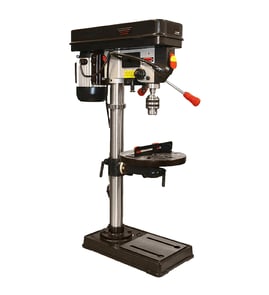
What are the parts of a drill press?
A Craftsman drill press like model 11324591 is built around a few core assemblies: a heavy base and column for support, a head with the motor and pulleys for power, and a quill and spindle that move the chuck straight down for accurate drilling.
Main drill press parts (what they do)
- Base: Stabilizes the drill press and provides mounting holes for bolting it down.
- Column: Vertical post that supports the head and guides the table support.
- Head: Houses the motor and drive system (often belts and pulleys) and supports the quill.
- Table and table clamp: Supports the workpiece; tilts and raises/lowers for positioning.
- Quill and spindle: The quill moves up/down; the spindle rotates and drives the chuck.
- Chuck: Grips the drill bit or accessory.
- Feed handles: Let you lower and raise the quill smoothly.
- Depth stop: Limits how deep the bit can drill for repeatable holes.
- On/off switch: Controls power to the motor.
Quick “where to look” guide
| If you’re dealing with… | Check these parts first | Common symptom |
|---|---|---|
| Wobble or runout | Chuck, spindle, quill | Hole is oversized or bit “walks” |
| Slipping or low power | Belt, pulleys, motor | Bit stalls, squealing sound |
| Table won’t hold position | Table clamp, support lock | Table drifts or rotates |
| Inconsistent hole depth | Depth stop, feed mechanism | Depth changes between holes |
Why it matters
Knowing the names of the assemblies helps you match the right replacement parts and troubleshoot faster, especially when you are diagnosing issues like vibration, belt slip, or a table that will not stay square.
Helpful DIY reference
- Use how to find your appliance model number (and what it means for parts) to confirm you are shopping parts for 11324591 and not a similar Craftsman model.
Last updated: February 2026
What is a good horsepower for a drill press?
For the Craftsman drill press model 11324591, a 1/2 HP motor is the correct target because this drill press is designed to perform its best work with a 1/2 HP, 1725 RPM motor. For other drill presses, 1/2 HP to 3/4 HP covers most home-shop drilling.
Horsepower recommendations (by typical use)
- 1/3 HP: light-duty drilling, small bits, softwood, occasional use
- 1/2 HP: best all-around for most benchtop and light floor drill presses (wood plus light metal)
- 3/4 HP: frequent use with larger bits, tougher hardwoods, more demanding metal work
- 1 HP and up: heavy-duty drilling, large hole saws, production-style use
| Task | Good HP range | Notes |
|---|---|---|
| Woodworking with twist bits and Forstner bits | 1/2 to 3/4 HP | More HP helps resist stalling in larger diameters |
| Light metal drilling (smaller twist bits) | 1/2 to 3/4 HP | Torque at low speed matters most |
| Large hole saws, step bits, frequent heavy cuts | 3/4 to 1+ HP | Also requires rigid table and proper speed selection |
Specs that matter as much as horsepower
Horsepower helps, but drill press performance is often limited by setup and mechanics.
- Speed range: slower speeds are essential for metal and large-diameter bits
- Pulley and belt condition: slipping belts mimic “low horsepower”
- Quill travel: more travel improves capacity on thicker stock
- Chuck quality and capacity: reduces bit slip and improves accuracy
- Table rigidity and clamping: prevents the workpiece from grabbing and spinning
Why it matters
Matching motor horsepower to what the drill press is designed for (and to your bit size and material) prevents stalling, overheating, belt slip, and rough holes, especially when drilling at low RPM where torque demand is highest.
For electrical testing basics when diagnosing power, switch, or motor issues, use how to use a multimeter to test electrical parts video.
Last updated: February 2026
Where is the model number on a Craftsman drill press?
On the Craftsman drill press model 11324591, the model number is typically on the identification plate (data tag) on the base, close to the column. We use that number to match the correct diagrams and replacement parts for your exact drill press.
Common places to check
Look for a metal plate or printed label in these spots:
- On the base casting, near where the column bolts on
- On the rear of the base (facing away from the operator)
- On the side of the column near the base
- Under the belt cover area (less common)
- On the motor nameplate (this is motor info, not always the drill press model)
How to confirm you found the right number
The correct model number is usually a short numeric string like 11324591. Use this quick check:
| What you found | What it usually means | Use it for parts? |
|---|---|---|
| 11324591 | Drill press model number | Yes |
| Motor HP/amps/volts | Motor rating label | No |
| Serial number | Production identifier | Sometimes helpful, not required |
Why it matters
Craftsman drill presses can look similar across multiple model families. Using the exact model number helps us match the correct parts list and avoid ordering the wrong items (especially for belts, pulleys, switches, and quill components).
Helpful next step
If the tag is worn or painted over, gently clean it and take a clear photo. If you still cannot read it, use our guide: how to find your appliance model number (and what it means for parts).
Last updated: February 2026
Who made Craftsman drill presses?
Many Craftsman drill presses were made for Craftsman by outside manufacturers, and the maker can vary by era and by the specific model. For the Craftsman drill press model 11324591, the 113 prefix is commonly associated with tools produced for Sears by Emerson Electric (often through its Emerson Tool Co. division).
How to identify the manufacturer for model 11324591
Use these quick checks to confirm what you have before ordering parts or comparing specs:
- Verify the full model number on the nameplate: 11324591 (not just “113”).
- Look for a separate data tag that lists a manufacturer name, city, or an “MFG No.”
- Check whether the drill press is a bench model or floor model; the base and column style can help match diagrams.
- Compare your machine to parts diagrams by assembly (head, quill, table, base) to ensure the right revision.
- If your tag includes a date code, use it to narrow the production era.
What the model prefix usually means
On many older Craftsman tools, the first three digits of the model number indicate the source manufacturer that built the tool for Sears.
| What you see on the tag | What it typically indicates | Why it helps |
|---|---|---|
| 113.xxxxx | Emerson-built (for Sears/Craftsman) | Points you toward Emerson-style parts layouts and common wear items |
| Different 3-digit prefix | Different supplier | Explains why parts and castings may not match “113” machines |
Why it matters when you are buying parts
Knowing the likely manufacturer helps you match the correct parts breakdown and avoid ordering the wrong quill parts, belts, pulleys, or switches. It also helps when you are comparing chuck tapers, spindle bearings, and table lift hardware across similar-looking drill presses.
Helpful next step
If you are unsure you are reading the tag correctly, use our guide: how to find your appliance model number (and what it means for parts).
Last updated: February 2026