Owner’s manual
 Error Codes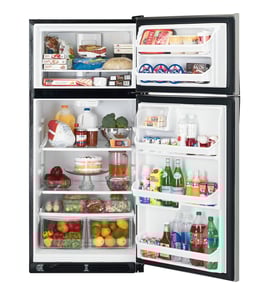


What is the upper part of a fridge called?
On the Kenmore 79579433212 top-mount refrigerator, the upper section is the freezer compartment. It’s the insulated space designed to keep foods frozen, and it also helps drive airflow that circulates cold air between the freezer and fresh food sections (refrigerator compartment). See the 79579433212 owner's manual for your exact compartment layout and controls.
What the top section does (and why it matters)
The freezer is more than storage for frozen food; it’s a key part of how the refrigerator cools properly.
- Keeps food at freezing temperatures for long-term storage
- Supplies cold air that circulates to the refrigerator compartment
- Works with the temperature controls to balance freezer and fresh food temps
- Can include an ice maker (if equipped) and related water components
- Needs clear vents for proper airflow
Freezer vs. refrigerator compartment: quick comparison
| Section | Common name | Primary purpose | Typical issue when airflow is blocked |
|---|---|---|---|
| Upper section | Freezer compartment | Freezes food and supports cooling airflow | Fresh food section warms up, uneven temps |
| Lower section | Refrigerator compartment (fresh food) | Keeps food cold (not frozen) | Items near vents may freeze or temps fluctuate |
Tips to avoid temperature problems
Airflow between compartments is critical on this style of Kenmore refrigerator.
- Don’t block air vents with boxes, bags, or tall items
- Keep high-water-content foods (like produce) away from the cold air discharge vent
- Make temperature changes one step at a time, then wait 24 hours before adjusting again
- If the door feels hard to open right after closing, wait about a minute for pressure to equalize
- If you see moisture or warm spots, check that doors close fully and seals are clean
Why it matters
When the freezer section can’t circulate air correctly, the refrigerator compartment often runs too warm, while items near vents can freeze. Keeping vents clear and using the correct control settings helps prevent food spoilage and temperature swings.
Last updated: January 2026
What does DH mean on Kenmore Elite refrigerator?
On Kenmore refrigerators like model 79579433212, dH/DH typically points to a defrost heating problem (the unit is not warming the evaporator enough during the defrost cycle), which can lead to frost buildup and warm temperatures in the fresh food section.
What you’ll notice when DH is showing
- Frost or ice buildup on the back wall inside the freezer
- Refrigerator section warming up even though the freezer seems cold
- Fan noise changing as airflow gets blocked by frost
- Water leaking or puddling during/after a defrost attempt
Quick checks we recommend first
- Power reset: Unplug the refrigerator for 5 minutes, then plug it back in.
- Check door closure: Make sure both doors close fully and seals are making contact.
- Look for heavy frost: If the freezer back panel is packed with frost, the defrost system needs attention.
- Confirm control settings: Verify temperature settings in the 79579433212 use and care guide.
Most common causes (and what they affect)
| Likely issue | What it does | Common symptom |
|---|---|---|
| Defrost heater circuit problem | Heater does not melt frost | Solid frost sheet on evaporator cover |
| Defrost sensor/thermistor issue | Control does not “see” correct temp | DH returns after reset |
| Main control board issue | Does not send power to heater | Intermittent or repeated DH |
Parts that are often involved
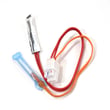
We match parts by symptom and diagnosis. If you’re also seeing door-related symptoms (lights not reacting, fan behavior changing when the door opens), this part is commonly checked:
Why it matters
A defrost heating problem reduces airflow across the evaporator coil. That forces longer run times, causes temperature swings, and can eventually lead to food spoilage if the refrigerator section can’t stay cold.
Last updated: January 2026
How to tell cubic feet of Kenmore refrigerator by model number?
For Kenmore model 79579433212, the model number alone usually does not state the exact cubic-foot capacity. The most reliable way is to look up the published specifications in the 79579433212 use & care guide; if you need a quick estimate, calculate interior volume from measurements.
Best ways to find cubic feet (most accurate first)
- Check the specifications section in the 79579433212 use & care guide.
- Look for the model/serial label inside the fresh food compartment (commonly on the interior liner). Record the full model number and any suffixes.
- Measure the usable interior space and calculate an estimate (helpful if bins or shelves have been changed).
- Compare to similar Kenmore 795 top-mount units if you only need a rough size range.
How to estimate cubic feet by measuring
- Empty the compartment enough to measure.
- Measure the interior width, depth, and height in inches.
- Multiply:
W × D × Hto get cubic inches. - Divide by 1728 to convert to cubic feet.
Quick conversion table
| What you have | What to do | Result |
|---|---|---|
| Interior dimensions in inches | Multiply W × D × H | Cubic inches |
| Cubic inches | Divide by 1728 | Cubic feet (approx.) |
What the model number can and cannot tell you
Kenmore model numbers help identify the series and manufacturer platform (for example, many 795 models are LG-built), but they are not a dependable “capacity code.” Two models with similar digits can still have different insulation thickness, liner shapes, or freezer layouts that change usable volume.
Why it matters
Cubic feet affects how you shop for replacement shelves and bins, plan food storage, and compare energy use across refrigerators. Getting the published spec from the manual keeps you from overestimating usable space.
Last updated: January 2026