Owner’s manual
 Error Codes



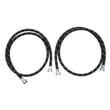
What is the average lifespan of a Kenmore washer?
A Kenmore washer typically lasts 10 to 15 years. For Kenmore model 11031312020, lifespan depends most on installation, load habits, and routine care; following the maintenance steps in the 11031312020 installation & care manual helps you reach the higher end of that range.
Most washers fall into these real-world averages:
| Washer type | Typical lifespan | Notes |
|---|---|---|
| Top-load (belt/impeller or agitator) | 12 to 15 years | Often simpler mechanically; wear items are common fixes |
| Front-load | 10 to 12 years | More seals and bearings; maintenance is critical |
These are the most common lifespan killers we see across Kenmore washers:
- Overloading (stresses the drive system, basket, and suspension)
- Chronic unbalanced loads (extra wear on basket support and bearings)
- Poor water supply maintenance (sediment and restricted flow)
- Skipping routine cleaning (detergent residue, odors, and performance issues)
- Ignoring small leaks (corrosion and electrical damage over time)
The manual calls out several care items that directly protect long-term reliability:
- Replace inlet hoses every 5 years and inspect them periodically for bulges, kinks, cuts, wear, or leaks
- Keep the washer on a level floor to reduce vibration and component stress
- Use HE detergent and avoid overdosing to reduce residue buildup
- After installation or service, run a test cycle and check for leaks at the faucets and inlet connections
- Confirm hot and cold faucets are fully open
- Check inlet hose connections for seepage
- Verify the washer is level and stable on the floor
- Clean the dispenser area regularly (if equipped)
A washer can run for years while slowly wearing out key systems. Simple preventive steps (especially hose replacement and keeping loads balanced) reduce strain on expensive components like the motor, belt, and tub support, which helps avoid early breakdowns.
Last updated: January 2026
How to hard reset kenmore washer?
For Kenmore washer model 11031312020, a hard reset is simple: unplug the washer (or switch off the breaker) for 1 to 2 minutes, then restore power and try a normal cycle. This clears many temporary control glitches and stuck cycle states.
- Press Power/Cancel to stop the cycle (if the console responds).
- Unplug the washer for 1 to 2 minutes (or turn the breaker off).
- Plug back in (or turn breaker on).
- Select a Rinse and Spin or Drain and Spin cycle and press Start.
- If the washer was moved or stored, confirm hoses and power are reconnected correctly per the 11031312020 owner's manual.
These checks often solve the same symptoms people call a “reset” issue.
- Confirm the outlet is a grounded 3-prong outlet (no extension cord or adapter).
- Make sure both water faucets are fully open.
- Verify the drain hose is secured and not shoved too far down the standpipe.
- Check that the washer is level; an unlevel washer can stop or act erratically.
- If the lid will not lock, inspect the lid strike and lid lock.
| Symptom | What to check | Likely area |
|---|---|---|
| Won’t lock, won’t run | Lid closes but won’t “click” locked | Lid lock/strike |
| Fills slowly or not at all | Water supply is on but flow is weak | Inlet valve/screens |
| Hums but won’t agitate/spin | Motor runs but basket does not move | Belt/pulley/actuator |
If you suspect a lid-lock problem, the model uses a lid lock assembly such as the lid lock-sol W11700916.
A hard reset restores the control to a known state after a power glitch, but it will not fix a mechanical failure (like a worn belt, a failing actuator, or a lid lock that cannot engage). Resetting first helps you avoid replacing parts unnecessarily.
Last updated: January 2026
Is Kenmore Elite high end?
Yes. Kenmore Elite is Kenmore’s higher-end line, typically offering upgraded design, larger capacity options, and more advanced wash features than standard Kenmore models. For your Kenmore washer model 11031312020, the exact feature set is listed in the 11031312020 washer installation & care manual.
Kenmore Elite models are positioned above standard Kenmore washers because they commonly include:
- Higher spin speeds for better water extraction
- More cycle and temperature options (including specialty cycles)
- Improved vibration control and quieter operation
- Better efficiency (water and energy use) compared with older traditional designs
- More robust controls and convenience features (cycle status, delay start, etc.)
The most reliable way is to confirm the branding and model identification on the unit and in the documentation.
- Check the control panel for “Elite” branding
- Verify the full model number on the model tag (often under the lid or on the cabinet)
- Match the model number to the documentation and parts list
- Compare your cycle names and options to what the manual describes
| What to check | Where you’ll see it | What it tells you |
|---|---|---|
| “Elite” label | Console/control panel | Product line branding |
| Model number 11031312020 | Model tag | Exact unit identification |
| Cycle list and options | Manual and console | Feature level and capability |
Knowing whether your washer is Kenmore Elite helps us guide you to the right troubleshooting steps and the right replacement parts (for example, a lid lock, actuator, or drive belt can vary by design and series).
If you are diagnosing performance issues (noise, slipping, not spinning, lid not locking), these model-specific parts are often involved:
- Drive belt W11239857 (spin and agitation drive)
- Washer actuator W10913953 (shifts between agitation and spin functions)
- Lid lock-sol W11700916 (enables safe spinning and cycle operation)
Last updated: January 2026
How to unclog drain hose on Kenmore washer?
To unclog the drain hose on your Kenmore washer model 11031312020, unplug the washer, drain any standing water, then remove and flush the drain hose to clear lint, coins, or small socks. Reinstall it correctly so only 4.5 in. (114 mm) sits in the standpipe (see the 11031312020 owner's manual).
- Unplug the washer.
- Turn off both water faucets.
- Keep towels and a shallow pan or bucket ready.
- Pull the washer forward to access the rear drain connection.
- Expect water to spill when the hose is lowered or removed.
- Disconnect the drain hose from the standpipe or laundry tub and lower it into a bucket to empty the tub.
- Check the home drain (standpipe or tub drain) for blockage; a clogged house drain mimics a washer clog.
- At the back of the washer, remove the clamp and pull the hose off the drain port.
- Flush the hose with running water; push a flexible brush or small drain snake through to remove debris.
- Reinstall the hose and clamp securely; route the hose with a smooth curve (no kinks).
| Item | Correct setup for this design |
|---|---|
| Standpipe insertion | Max 4.5 in. (114 mm) of hose inside |
| Standpipe height | 39 to 96 in. above floor |
| Goal | Prevent siphoning and slow draining |
- A kinked hose behind the washer can restrict flow.
- A partially blocked hose elbow can re-clog quickly.
- A weak or jammed drain pump can cause humming with little or no draining.
If the hose is split, soft, or will not flush clean, replace it with the correct part, the hose asm - d W11244231.
A restricted drain hose leaves water in the tub, reduces spin performance, and can trigger drain-related problems. Correct hose depth and standpipe height also prevent siphoning that causes fill and drain issues.
Last updated: January 2026