Owner’s manual
 Error Codes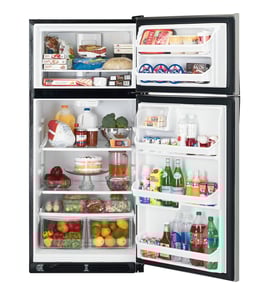



What is meant by top mount refrigerator?
A top-mount refrigerator means the freezer compartment is on top and the fresh-food (refrigerator) compartment is below. Your Kenmore 10671184100 uses this classic layout to keep frozen foods at eye level and everyday refrigerated items in the lower section.
In a top-mount design, cold air is produced in the freezer and then shared with the refrigerator section through internal vents. For proper cooling, we recommend keeping airflow paths clear.
- Freezer is the upper compartment; refrigerator is the lower compartment
- Cool air circulates between sections through vents
- Blocking vents with food packages can cause temperature and moisture problems
- Odors can transfer between compartments because air circulates between both sections
- Door alignment and leveling affect how well doors seal and how efficiently the unit runs
| Feature | Top-mount refrigerator | Bottom-mount refrigerator |
|---|---|---|
| Freezer position | Top | Bottom |
| Most-used section height | Refrigerator is lower | Refrigerator is higher |
| Typical cost/complexity | Often simpler | Often more complex |
| Common benefit | Easy freezer access | Easier fresh-food access |
Top-mount refrigerators like the Kenmore 10671184100 depend on good airflow and good door sealing. If temperatures are uneven, frost builds up, or food spoils early, the first checks are usually vent blockage, door seal condition, and proper leveling.
- Keep packages away from freezer and refrigerator vents
- Wrap foods tightly to reduce odor transfer and drying
- Make sure doors close fully and sit evenly
- Leave ventilation space around the cabinet during installation
For model-specific operating details and airflow guidance, use the 10671184100 owner's manual.
Last updated: January 2026
What is the average lifespan of a Kenmore Elite refrigerator?
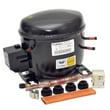
A Kenmore Elite refrigerator typically lasts 10 to 15 years. For a Kenmore top-mount refrigerator like model 10671184100, lifespan depends most on sealed-system health (compressor and refrigerant tubing), airflow, and door sealing; routine maintenance helps you reach the upper end of that range.
Most refrigerators are replaced because a major cooling component fails or repair costs outweigh the value.
- Compressor or sealed-system issues (cooling loss, loud running, hard starting)
- Airflow problems (dirty condenser area, failed fan motor, blocked vents)
- Defrost system failures (ice buildup on the evaporator, warm fridge section)
- Door gasket leaks (moisture, frost, temperature swings)
- Ice maker or water system leaks (if equipped)
Your owner’s manual includes warranty coverage that reflects the components designed for long service:
| Coverage area | What it generally includes | Time period (from purchase date) |
|---|---|---|
| Full refrigerator warranty | Defects in materials or workmanship | 1 year |
| Sealed refrigeration system warranty | Refrigeration system components including compressor and connecting tubing | 5 years |
These steps reduce strain on the compressor and help temperatures stay stable.
- Keep condenser airflow clear (don’t block the rear or toe-kick area)
- Set proper temps: 0°F freezer, 37°F to 40°F fresh food
- Make sure doors close fully; correct sagging or misalignment
- Clean and condition gaskets; replace if torn or warped
- Fix water leaks quickly to prevent corrosion and ice buildup
A refrigerator that runs hotter than normal or runs constantly wears the compressor faster. Simple airflow and door-seal maintenance often prevents the “runs all the time” condition that shortens appliance life.
Last updated: January 2026
What size is a Kenmore refrigerator model 10671184100?
Kenmore top-mount refrigerator model 10671184100 is a full-size top-freezer refrigerator. For the exact exterior dimensions and the installation clearances that affect fit (hinges, handles, and door swing), use the specifications and installation section in the 10671184100 owner's manual.
Use a tape measure and compare it to the manufacturer specs so you account for the real installed footprint.
- Measure width at the widest point (often the hinge side)
- Measure height from the floor to the top of the cabinet (include hinge cover if it sits higher)
- Measure depth two ways: cabinet only and to the front of the handle
- Check door swing clearance so bins and drawers open fully
- Leave space for the power cord and, if equipped, the ice maker water line
Clearances are just as important as the cabinet dimensions because they protect airflow and allow the doors to open.
- Leave ventilation space on the sides and top as specified in the 10671184100 owner's manual
- If the refrigerator sits next to a fixed wall, follow the manual’s hinge-side clearance so the door can swing open
- If you have an ice maker, allow extra space at the back for the water line connection
| What you are planning for | What to measure | Why it matters |
|---|---|---|
| Cabinet opening fit | Width, height, depth (cabinet only) | Prevents binding against cabinets |
| Real installed footprint | Depth to handle, hinge-side width | Prevents door and handle interference |
| Service and hookups | Space behind unit | Prevents pinched cord or water line |
A refrigerator can match the opening but still fit poorly if the hinge side is tight, the handle depth is ignored, or airflow clearance is restricted. Measuring and matching the manual specs prevents installation problems.
Last updated: January 2026