
Why does my gas trimmer keep turning off?
Your Craftsman 636795456 37.7-cc gas brushwacker usually turns off because it is losing fuel delivery or ignition under load. The most common causes are stale fuel, a restricted fuel filter or fuel line, a dirty carburetor, or a failing spark plug.
Quick checks that fix most shut-off problems
- Drain old fuel and refill with fresh, properly mixed fuel (if your unit is 2-cycle) and a clean fuel can.
- Loosen the fuel cap after it stalls; if it restarts, the tank vent in the cap is restricted.
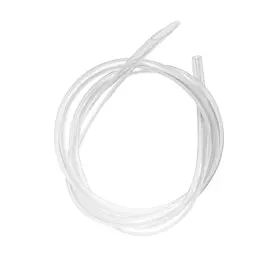
- Inspect the fuel lines for cracks, soft spots, or loose connections (air leaks can starve the carburetor).
- Replace or clean the fuel filter in the tank if flow looks weak.
- Remove the spark plug; if it is black and sooty, clean or replace it and set the gap to the plug spec.
- Check the air filter; a clogged filter can make the engine run rich and stall.
Carburetor and adjustment symptoms
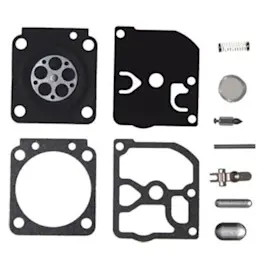
A carburetor that is gummed up or out of adjustment can run for a minute or two, then die as demand increases.
| What you notice | Most likely cause | What we do next |
|---|---|---|
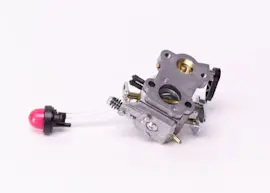
| Runs on choke, dies on run | Lean fuel delivery (clogged carb or air leak) | Clean carb, inspect fuel lines, check primer bulb |
| Idles, dies when you throttle | Restricted fuel filter or carb jets | Replace filter, clean carb passages |
| Dies after warming up | Ignition coil or plug breaking down | Replace plug first, then test/replace coil |
Why it matters
Repeated stalling is more than an annoyance; running lean (not enough fuel) can overheat the engine and accelerate wear on the piston and cylinder. Fixing fuel flow and ignition issues early helps the trimmer start easier and hold steady power.
Finding the right replacement parts
Use the model number 636795456 to match the correct carburetor, fuel lines, primer bulb, air filter, and spark plug. Our fastest way to search is through Sears PartsDirect.
Last updated: February 2026
What is the lifespan of a line trimmer?
A gas line trimmer like the Craftsman 636795456 typically lasts 8 to 12 years for most homeowners with routine maintenance; in heavy commercial use, many pros plan around 900 to 1,200 run-hours before major wear shows up.
What affects lifespan the most
- Fuel quality and storage: fresh, properly mixed fuel (and draining or stabilizing for storage) prevents carburetor and fuel-line issues.
- Air filtration: a clean air filter reduces cylinder and piston wear.
- Cutting load: thick brush, woody weeds, and constant full-throttle cutting shortens engine life.
- Cooling and cleanliness: debris packed around the engine and muffler raises operating temps.
- Vibration and fasteners: loose hardware accelerates wear on the drive system and handles.
Typical lifespan ranges (what to expect)
| Usage pattern | Typical lifespan | What usually fails first |
|---|---|---|
| Light homeowner (seasonal trimming) | 8 to 12 years | Fuel system, starter rope, clutch |
| Heavy homeowner (weekly, long sessions) | 5 to 8 years | Carburetor, ignition parts, drive components |
| Commercial or daily use | 900 to 1,200 hours | Engine compression, clutch/drive, bearings |
Maintenance that extends service life
- Replace or clean the air filter regularly.
- Keep the spark plug in good condition and correctly gapped.
- Inspect the fuel lines and primer bulb for cracking or leaks.
- Keep the cutting head and guard clean; remove wrapped grass.
- Check and tighten fasteners; inspect the drive shaft area for abnormal noise.
Why it matters
Knowing the expected lifespan helps you decide whether to tune up the fuel system, replace wear items (like the trimmer head or spark plug), or plan for a replacement when run-hours and performance drop.
For help confirming you have the correct model before ordering maintenance items, use how to find your appliance model number (and what it means for parts).
Last updated: February 2026
How to replace a line trimmer head?
To replace the trimmer head on your Craftsman 636795456 37.7-cc gas brushwacker, you typically lock the shaft, unthread the old head (often reverse-threaded), then thread the new head on and tighten it securely before reloading line and test-running the unit.
Before you start (safety and prep)
- Shut the engine off and let it cool completely.
- Disconnect the spark plug wire so the trimmer cannot start accidentally.
- Wear gloves; the cutting attachment area can be sharp and dirty.
- Clean grass and debris from the gearhead area so threads seat correctly.
- Confirm you are replacing the correct style head (bump-feed, fixed-line, or blade adapter).
Steps to replace the trimmer head (common method)
- Lock the shaft/gearhead: Most trimmers have a small locking hole in the gearhead. Insert a screwdriver, Allen key, or locking pin to keep the shaft from turning.
- Remove the old head: Turn the head to unthread it. Many Craftsman heads use left-hand (reverse) threads, so loosening can be clockwise instead of counterclockwise.
- Inspect the threads: If you see damaged threads, heavy rust, or melted plastic, correct that before installing the new head.
- Install the new head: Thread it on by hand first to avoid cross-threading, then snug it firmly while the shaft is still locked.
- Reload line and test: Load the correct diameter line for your head, reconnect the spark plug wire, then run briefly at low throttle to confirm it spins true.
Quick direction check (most common)
| What you are doing | If the head is reverse-threaded (common) | If the head is standard-threaded |
|---|---|---|
| Loosening/removing | Turn clockwise | Turn counterclockwise |
| Tightening/installing | Turn counterclockwise | Turn clockwise |
Why it matters
A trimmer head that is cross-threaded or installed in the wrong direction can loosen during use, damage the drive shaft threads, and cause excessive vibration. Locking the shaft and starting threads by hand prevents most installation problems.
If you get stuck
- If the head will not budge, re-seat the locking pin fully and try again with steady pressure.
- If the head spins but the shaft does not lock, the locking hole may not be aligned; rotate the head slightly and reinsert the pin.
- If you are unsure which replacement head fits, use the model number to look up the correct cutting head and hardware on Sears PartsDirect.
Last updated: February 2026
How to replace line on Craftsman gas trimmer?
To replace trimmer line on your Craftsman 636795456 (37.7-cc gas brushwacker), reload the bump-feed head by winding new line in the marked direction, keeping the two lines in separate channels, and routing the ends through the eyelets so the head feeds smoothly when bumped.
Before you start
- Shut the engine off and let it cool.
- Disconnect the spark plug wire to prevent accidental starting.
- Wear gloves and eye protection.
- Use the correct line diameter for your head (most gas trimmers use 0.080 in to 0.095 in).
- Cut clean, square line ends to help threading through the eyelets.
How we replace the line (typical bump-feed head)
- Open the head: Press the side tabs or remove the bump knob (varies by head style) and lift off the cover.
- Remove old line: Pull out remaining line; clean debris from the spool and housing.
- Cut new line: Cut two equal lengths (a common starting point is 10 to 15 ft each, depending on spool capacity).
- Wind the line:
- Follow the arrow on the spool for wind direction.
- Wind each line into its own channel to prevent overlap and tangles.
- Feed the ends: Push each line end through the eyelets.
- Reassemble: Seat the spool, reinstall the cover/knob, then pull both ends to remove slack.
Quick checks if it will not feed after reloading
- Line is wound the wrong direction.
- Line is crossed between channels or overlapped on the spool.
- Line ends are too short and retract inside the head.
- Spool spring is missing, stuck, or installed incorrectly.
- Eyelets are worn and grabbing the line.
Line length and performance guide
| What you notice | Most likely cause | What we do |
|---|---|---|
| Line jams immediately | Overfilled spool | Reload with shorter lengths |
| Feeds but breaks often | Line too thin or brittle | Use correct diameter, fresh line |
| Will not advance on bump | Tangled wind or wrong direction | Rewind neatly in the arrow direction |
Why it matters
Correct wind direction and keeping the two lines separated prevents binding inside the head, which is the most common reason a bump-feed trimmer stops advancing line.
If you need help confirming you have the right model for the correct head style and line size, use how to find your appliance model number (and what it means for parts).
Last updated: February 2026